A 27-meter stone sundial, accurate to within two seconds. No lenses, no gears, no electronics — just geometry, shadow, and the ambition of an 18th-century king who refused to accept imprecision. Welcome to Jantar Mantar, Jaipur's mind-bending astronomical observatory and one of India's most quietly astonishing UNESCO World Heritage Sites.
Tucked inside the Pink City's bustling walled quarter, this collection of massive masonry instruments looks like something pulled from a fever dream — enormous curves of ochre and dusty pink stone rising at impossible angles, casting shadows that still tell time with eerie precision nearly 300 years after they were built. Whether you're wired for science, drawn to history, or simply love places that stop you mid-step and make you whisper "wait, what?" — this is your kind of destination.
More Than Stone: The Genius Behind the Name
"Jantar Mantar" comes from the Sanskrit yantra (instrument) and mantra (formula) — essentially, "calculating instrument." Maharaja Sawai Jai Singh II, the same visionary who founded Jaipur in 1727, commissioned this observatory between 1724 and 1735. He wasn't dabbling in astronomy as a royal hobby. He was obsessed with it — frustrated by the clumsy inaccuracies of the metal instruments available in his era.
His solution? Go massive. Forget portable brass gadgets. Build your instruments out of stone and mortar at a scale so grand that measurement errors shrink to almost nothing. Nineteen fixed masonry structures, each engineered for a specific astronomical purpose — tracking stars, predicting eclipses, mapping celestial coordinates, measuring solar time. Together, they form a complete observation system that was cutting-edge in the 1730s and remains functional today.
Walking Through a Surrealist Painting
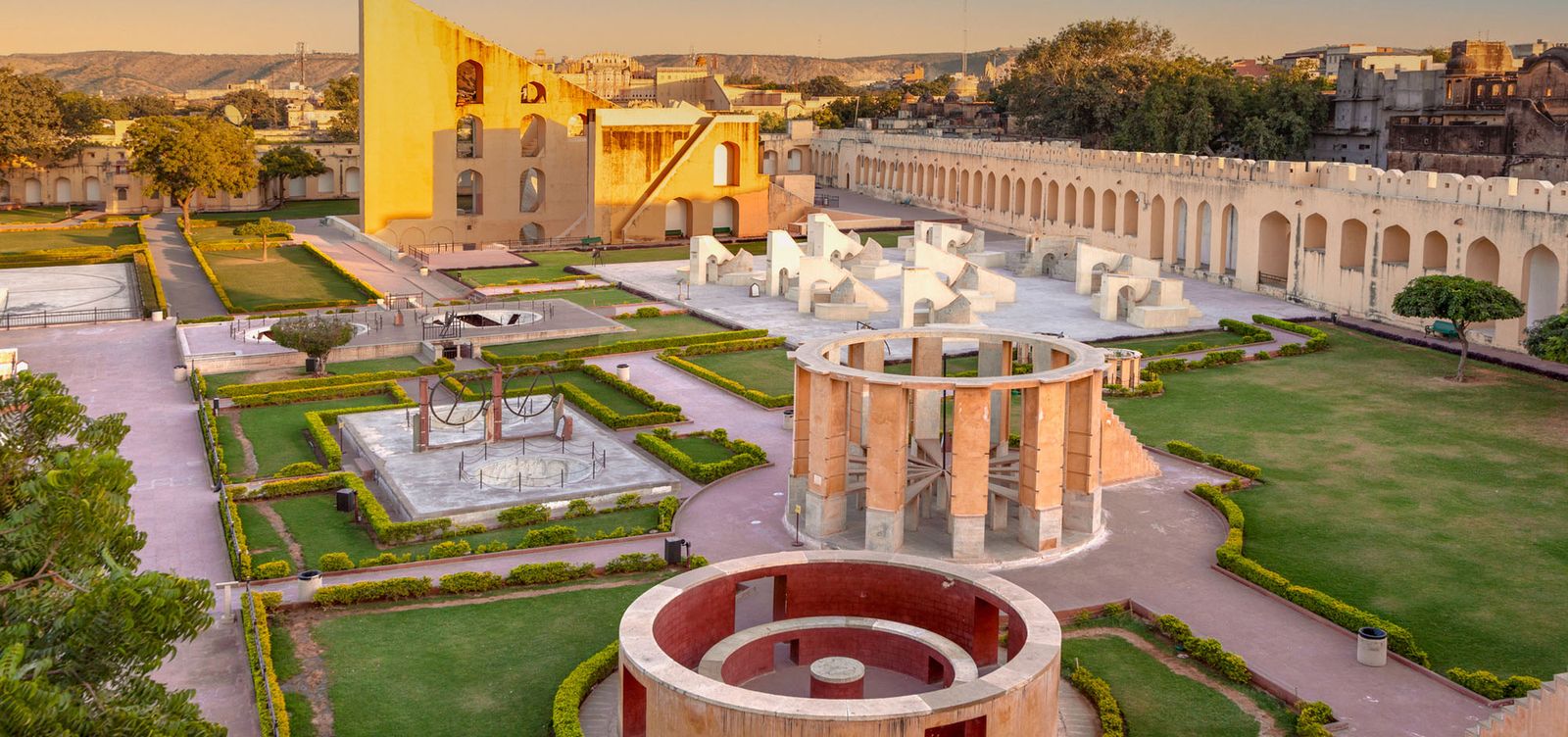
Nothing quite prepares you for the first moment inside the complex. Pale stone ramps sweep skyward at sharp angles. Circular marble bowls sit sunken into the earth like alien artifacts. Curved walls frame slices of blue Rajasthani sky. The heat radiates off the sandstone beneath your feet, and the shadows — those famous, precise shadows — creep across calibrated scales with a slowness you can almost feel in your bones.
The centerpiece is the Samrat Yantra, the "Supreme Instrument." At nearly 27 meters tall, it's the world's largest sundial, and watching its shadow slide across the curved quadrants is hypnotic. It determines local solar time accurate to two seconds — from a structure built before the Industrial Revolution even began.
Then there's the Jai Prakash Yantra, a pair of concave marble hemispheres etched with celestial maps. Sunlight drops into each bowl, and a tiny shadow dot pinpoints the sun's exact position against the sky in real time. It's elegant, intuitive, and strangely moving — like holding a conversation with the cosmos through carved marble.
The cylindrical Ram Yantra, with its open walls and radiating lines, measures the altitude and azimuth of celestial bodies. Every curve, every angled gradient across the complex serves a deliberate scientific purpose. There is zero ornamentation for its own sake. The beauty here is the precision.
The King Who Rewrote the Stars
Sawai Jai Singh II wasn't content to simply rule. He wanted to understand — and to correct. Dissatisfied with the astronomical tables used for religious ceremonies and civil calendars, he embarked on a mission to reform them entirely. He built five observatories across India: in Jaipur, Delhi, Varanasi, Ujjain, and Mathura. The Jaipur installation is the largest and best preserved of all five.
His intellectual reach extended far beyond Rajasthan. He corresponded with European astronomers, studied both Islamic and Hindu astronomical traditions, and dispatched scholars to Portugal and other nations to gather data. The finished observatory represented something rare and powerful — a fusion of ancient Indian knowledge with contemporary global science, bankrolled by royal ambition and genuine curiosity.
Centuries later, that fusion still resonates. Standing among these instruments, you feel the weight of a single question that drove an entire king's legacy: How can we measure the universe more truthfully?
Finding Your Way There
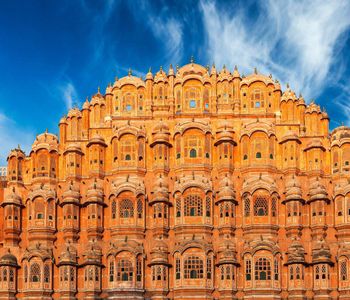
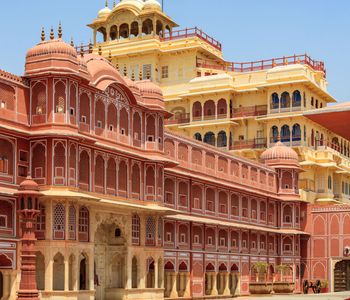
You can't miss Jantar Mantar's location — it sits right next to The City Palace, steps from the iconic honeycomb facade of Hawa Mahal, deep in the beating heart of Jaipur's old walled city. If you're already wandering the Pink City's lanes, you're practically there.
Flying in? Jaipur International Airport is roughly 12 kilometers away, with taxis and ride-shares readily available at reasonable fares. Arriving by train is equally easy — Jaipur Junction connects to Delhi, Mumbai, Agra, and beyond. From the station, a quick auto-rickshaw ride through chaotic, horn-happy traffic delivers you to the old city gates.
Many heritage hotels and guesthouses cluster within walking distance, so if you've based yourself in the historic quarter, just lace up your shoes and follow the sandstone-colored walls.
Tickets, Timing, and the Guide You'll Be Glad You Hired
The observatory opens daily from 9:00 a.m. to 4:30 p.m. Entry fees are modest for Indian citizens and slightly higher for international visitors — still an extraordinary bargain for a UNESCO site of this caliber. Children under 15 generally enter free, though it's worth confirming current rates before you go, as prices see occasional updates.
Here's a tip that will transform your visit: hire a local guide. Without one, you'll admire the shapes but miss the stories. Many instruments look abstract until someone explains exactly how shadows, curves, and angles work together to track a planet or predict an eclipse. A skilled guide turns stone geometry into living science. Audio guides in multiple languages are also available at the entrance if you prefer to explore at your own pace.
When to Go: Chasing the Perfect Light
Jaipur's desert climate means summers are punishing — April through June can push past 45°C, and the idea of standing on sunbaked stone at noon will lose its appeal fast. Monsoon months (July–August) cool things slightly but bring downpours that can interrupt outdoor plans.
The sweet spot? October through March. Crisp mornings, comfortable afternoons, and skies so clear you'll understand exactly why Jai Singh chose this city for his grandest observatory.
Arrive early in the morning, when golden light pours across the pale instruments and the complex is still quiet enough to hear pigeons cooing from the Samrat Yantra's upper ramp. Or come at midday to watch the great sundial's shadow inch across its calibrated arc in real time — a visceral reminder that this 300-year-old structure is still doing its job, still reading the sun, still keeping time.
Beyond the Observatory: A Full Day in the Pink City
Jantar Mantar anchors Jaipur's densest cluster of heritage sites, so build your day around it. Step next door into the City Palace, where royal apartments, gleaming museums, and a sprawling courtyard tell the story of the Kachwaha dynasty's grandeur. A short stroll brings you face-to-face with the Hawa Mahal, its latticed pink sandstone facade filtering light like a coral reef turned to stone — best photographed from the chaotic street below, chai in hand.
When the history settles into a happy haze, lose yourself in Johari Bazaar. The narrow lanes burst with gemstones catching the light in glass cases, bolts of block-printed fabric stacked to the ceiling, and the clink of silver bangles being haggled over in rapid Hindi. The smell of cardamom chai mixes with incense smoke and the distant sizzle of kachoris frying in deep iron pans.
As evening falls, climb to one of the rooftop restaurants that overlook the Pink City's skyline. Order dal baati churma — Rajasthan's signature dish of baked wheat balls dunked in ghee-laced lentils — and let the day unspool. Below you, the city glows amber. Behind you, somewhere in the fading light, Jai Singh's stone instruments are still casting shadows, still measuring the slow turn of the Earth, still answering a question their creator asked three centuries ago.
Jantar Mantar isn't just a monument to visit. It's proof that curiosity, ambition, and a king's stubborn refusal to accept "close enough" can build something that outlasts empires.