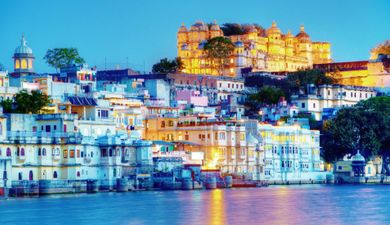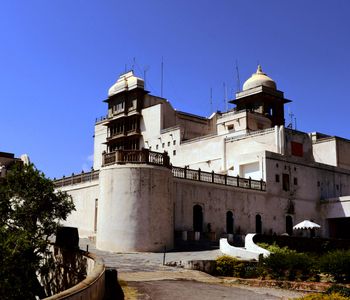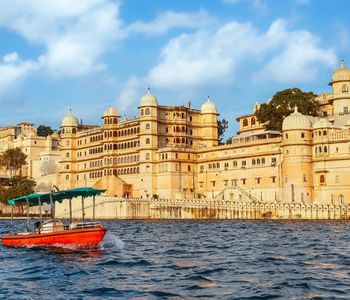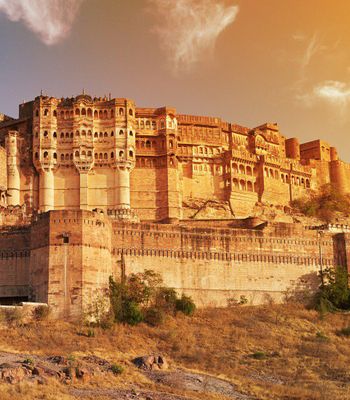
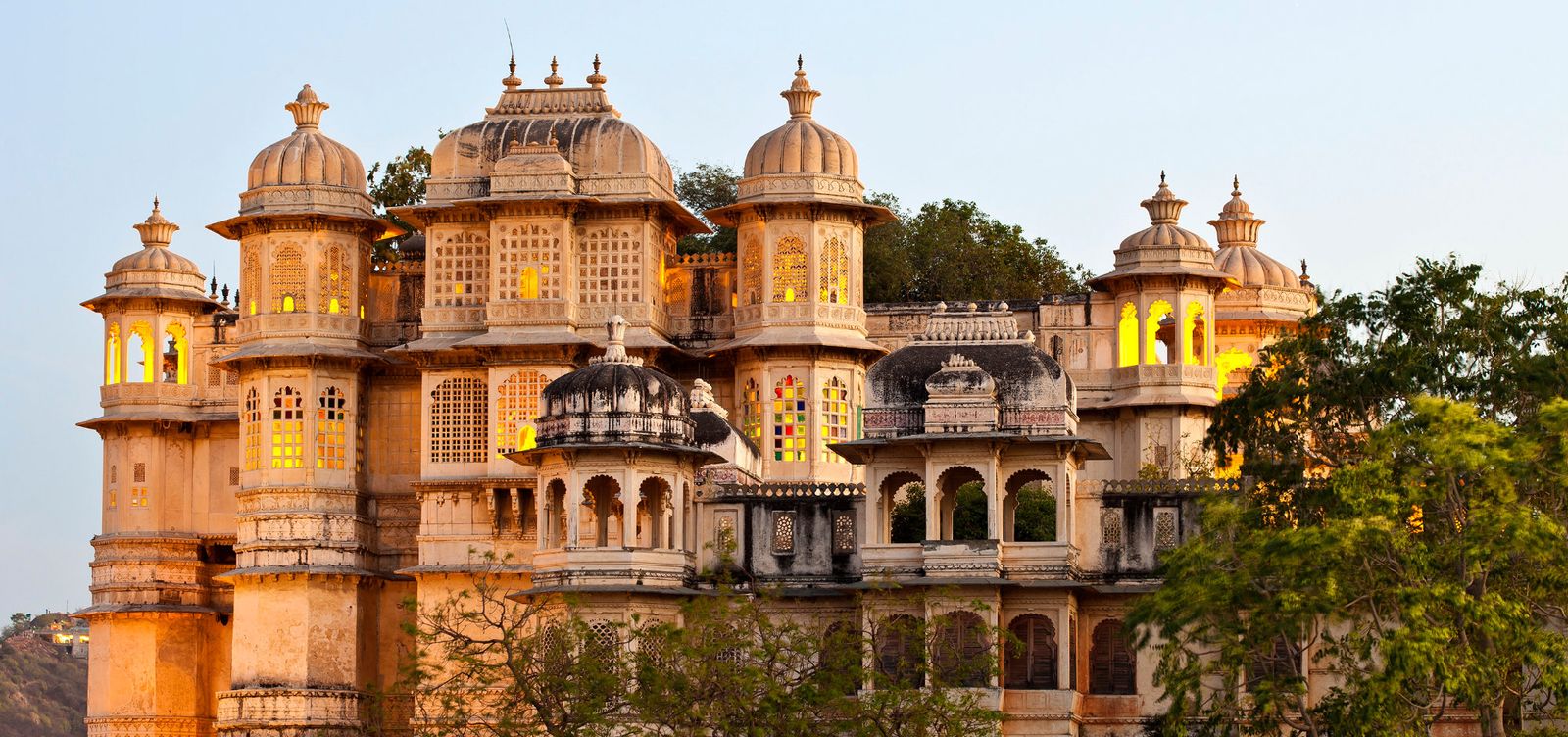
The City Palace of Udaipur rises from the eastern bank of Lake Pichola like a cliff face carved from marble and granite, its unbroken facade stretching nearly 244 metres along the waterfront. It's the largest palace complex in Rajasthan, yet from a boat on the lake at dusk, it reads as a single, impossibly long wall of white — as though the mountain itself decided to put on its best clothes. Construction began in 1559 under Maharana Udai Singh II, who moved the Mewar capital here after Akbar's relentless sieges on Chittorgarh. That decision — a retreat that doubled as a reinvention — produced something no conqueror ever managed to take. The Mewar dynasty never bent to Mughal authority, and this palace is their refusal made permanent in stone.
Where Granite Meets Grandeur
The palace isn't one building. It's a labyrinth of eleven smaller palaces, each commissioned by a different Maharana over four centuries, fused together so seamlessly you lose track of where one era ends and the next begins. The effect is disorienting in the best way — you'll duck through a low Rajput archway and find yourself in a courtyard blazing with Mughal-influenced mirror work, then climb a tight staircase into a room lined with Chinese and Dutch tiles that sailed in on 18th-century trade routes.
What binds it all is the local pale granite and marble, quarried from the Aravalli hills surrounding the city. The stone drinks the heat of the day and releases it slowly after dark, which keeps the palace interiors noticeably cooler than the streets below. In summer, when Udaipur cracks 40 degrees Celsius, this isn't decoration. It's functional engineering wearing beauty's mask.
Rooms That Earn Their Names
The Mor Chowk — Peacock Courtyard — delivers exactly what it promises. Three alcoves display peacocks crafted from coloured glass mosaic, each representing a different season of the Indian calendar. The detail work borders on obsessive: individual feather barbs rendered in blue, green, and gold tessera no larger than a fingernail. Press close and the artistry overwhelms. Step back and the peacocks shimmer as if caught mid-strut, alive in the shifting light.
Above, the Sheesh Mahal — the Palace of Mirrors — takes Belgian glass fragments and arranges them across walls and ceilings so that a single candle, lit at the centre, fractures into what feels like a constellation. It was built for intimate evening gatherings, and even now, under modern lighting, the room won't let you orient yourself. Your own reflection arrives from directions you don't expect.
Then there's the Manak Mahal, the Ruby Palace, where miniature paintings line the walls in the Mewar school style — a tradition distinct from the better-known Mughal miniatures. The colours run flatter, the faces sharper and more angular, the subjects tilting toward court life and Hindu mythology rather than imperial conquest. These aren't tourist reproductions. They're originals, some dating to the 17th century, hanging with the casual confidence of things that have simply always been here. Because they have.
The Lake Rewrites the Light
Plenty of Indian palaces overwhelm with sheer scale or ornamentation. The City Palace does something quieter — it uses water. Lake Pichola isn't a backdrop here; it's a collaborator. The palace was deliberately positioned so its western-facing rooms catch the lake's reflected light each afternoon, flooding interiors with a cool, shifting luminescence that no chandelier could approximate.
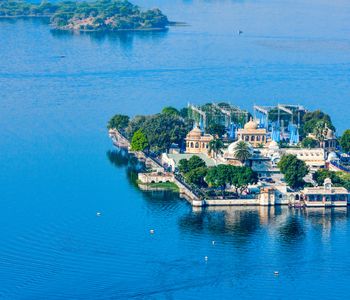
From the upper terraces, you look out across the water to Jag Niwas, the island palace now operating as the Taj Lake Palace hotel, and beyond that to the Aravalli range dissolving into haze. The sight pulls you outward even as the palace draws you inward. That tension — between intimate courtyard and infinite horizon — is the real intelligence of the complex's design. Most people feel it before they can articulate it.
A Dynasty Still in Residence
Here's the detail that separates the City Palace from Rajasthan's many fort-museums: the Mewar royal family still lives in part of the complex. The palace is divided between the museum, managed by the Maharana Mewar Charitable Foundation, and the private Shambhu Niwas Palace, where the 76th custodian of the Mewar dynasty resides. You won't stumble into his living room, but knowing that someone's morning tea is being poured behind one of those carved jharokha windows gives the place a strange vitality. This isn't a relic. It's still breathing.
The museum section spans a significant portion of the complex and holds a formidable collection of weapons, royal palanquins, and silver furniture. A pair of silver elephants standing outside the Durbar Hall weigh roughly 200 kilograms each and were once hoisted aloft in royal processions. They remain polished — not behind glass, not roped off — just standing there, as if waiting for the next occasion.
Getting There and Getting In
The main entrance sits at Badi Pol, a triple-arched gate on the city's eastern side, reachable by auto rickshaw from virtually anywhere in Udaipur for under 100 rupees. If you're staying near Fateh Sagar Lake, the ride takes about fifteen minutes through narrow lanes that test the nerve of every driver involved.
Entry to the museum costs 300 rupees for Indian nationals and 700 rupees for international visitors. An audio guide, available for an additional fee, is genuinely worth it — the palace's layout is confusing enough that without context you'll walk past entire sections without realizing they exist. Photography is permitted in most areas, though a few rooms restrict it with small signs that are easy to miss. The palace opens at 9:30 a.m. and closes at 5:30 p.m. daily.
Arrive before 10 a.m. if you want anything resembling solitude. By noon, tour groups flood the courtyards and the narrow staircases become one-way traffic with zero enforcement. Late afternoon rewards your patience — the light drops lower, the stone turns amber, and the lake below shifts from silver to copper.
A Palace That Accumulates
Udaipur's City Palace doesn't shout. It builds. Room after room, courtyard after courtyard, it makes its case — not for the grandeur of empire, but for the stubbornness of a kingdom that simply refused to vanish. The Mewars didn't command the wealth of the Mughals or the military reach of the British, yet their palace stands, occupied, maintained, still adding pages to its own story. Walk through it slowly. Let the rooms speak in sequence. By the time you reach the upper terraces and the lake opens before you, bronze in the falling light, you'll know what four centuries of persistence look like when they're built into every wall.