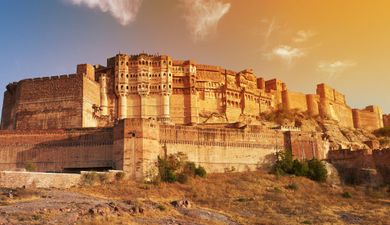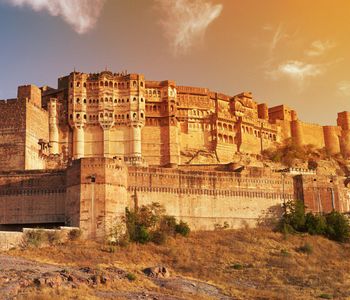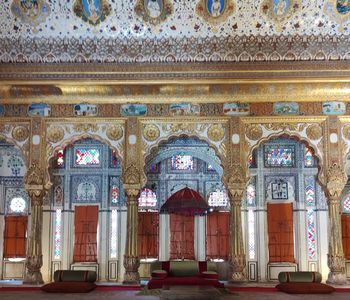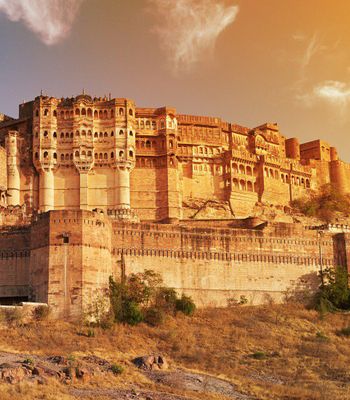
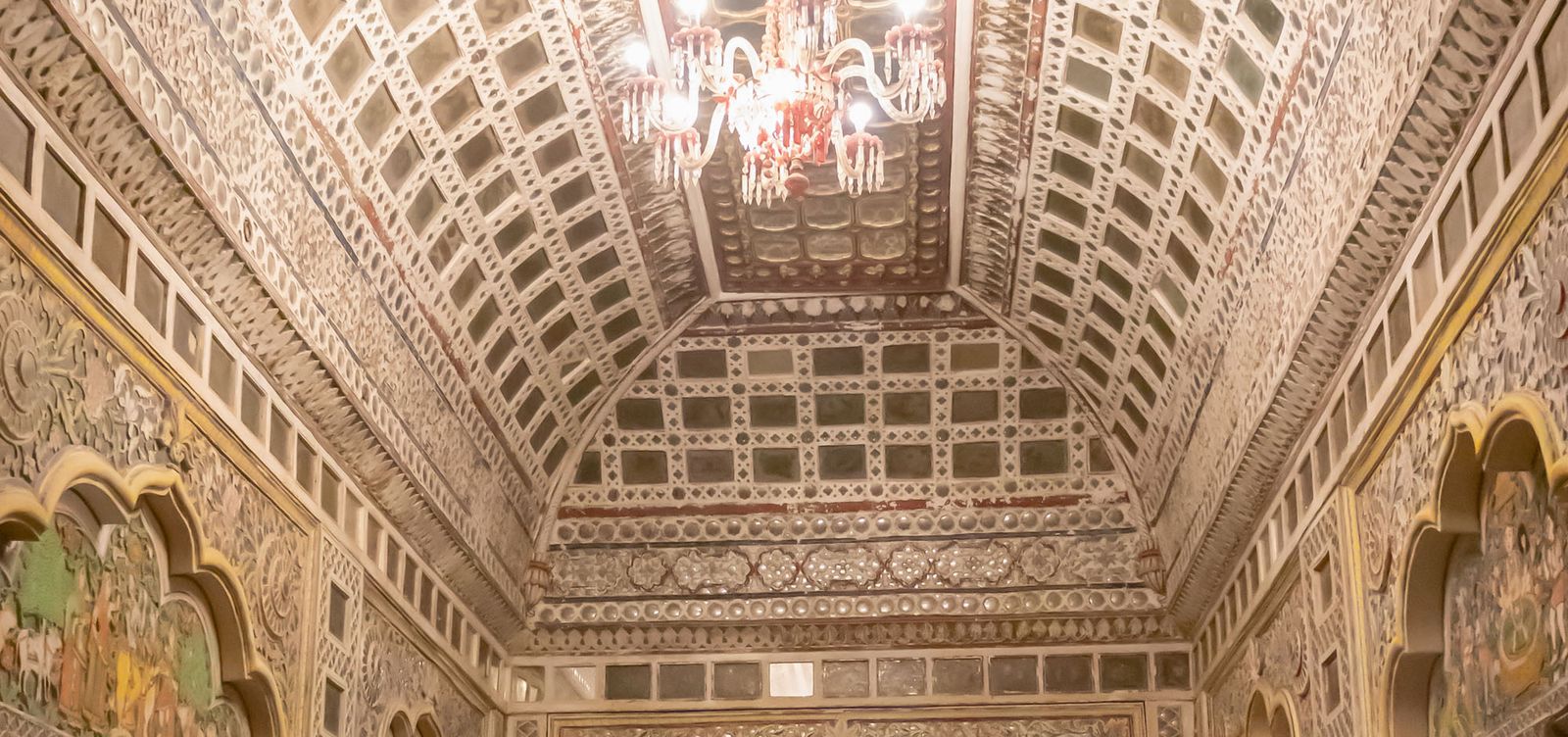
A single candle once lit this room — and it was enough to set the walls on fire with light. Tucked inside the colossal Mehrangarh Fort, perched 400 feet above the blue-washed streets of Jodhpur, the Sheesh Mahal (Palace of Mirrors) is one of those rare places where you stop mid-step and forget to breathe. Thousands of tiny mirrored glass fragments blanket every surface — walls, ceiling, every curve and corner — turning even the faintest glow into a galaxy. Outside, the fort is all brute sandstone and warrior history. In here, it's pure poetry.
A Palace Born from Conflict and Beauty
Mehrangarh Fort has stood watch over Jodhpur since 1459, when Rao Jodha — the ruler who gave the city its name — laid its first stone on a jagged cliff of red sandstone. Over the centuries, successive Marwar rulers kept building, layering palace upon palace, courtyard upon courtyard, until the fortress sprawled across roughly 1,200 acres.
Maharaja Ajit Singh, who ruled from 1679 to 1724, commissioned the Sheesh Mahal during one of the most turbulent chapters in Marwar history. Even while locked in bitter struggles against the Mughal Empire, he poured resources into art and architecture — and here's the fascinating contradiction: the very mirror-work technique that defines this chamber draws heavily from Mughal artistic traditions. The Marwar rulers resisted Mughal political control with one hand and embraced their aesthetic brilliance with the other.
What emerged is something neither purely Mughal nor purely Rajput. It's a dazzling hybrid — distinctly Rajasthani in spirit, yet carrying the fingerprints of a continent-wide artistic revolution sweeping across 17th- and 18th-century India.
When Glass Becomes Starlight: The Architecture Up Close
Step through the doorway and your eyes won't know where to land first. Every inch of wall and ceiling shimmers with hand-cut mirrored glass fragments, each one pressed into lime plaster by artisans who must have had the patience of saints. Geometric patterns spiral outward. Floral medallions bloom beside curving arabesques and paisley motifs. The effect is rhythmic, almost musical — your gaze follows the patterns like a melody.
The Magic of Candlelight Design
Here's what most visitors don't realize: this room was engineered for candlelight, not daylight. The original occupants would have experienced something far more intimate and dramatic than what you see on a sunny afternoon. Each fragment was angled to catch and multiply a flame's flicker, scattering it across the chamber until the walls pulsed with a warm, living shimmer — like sitting inside a jewel box at dusk.
Between the mirrored sections, painted panels tell their own stories. Religious scenes and snapshots of court life glow in pigments made from crushed minerals and plant extracts — colors so resilient they've barely faded over the centuries. Run your eyes across the transition from painted surface to mirror work and you'll notice how seamlessly the artisans wove two entirely different art forms into one breathtaking whole.
Desert Engineering, Hidden in Plain Sight
Don't mistake this for mere decoration. The room is a masterclass in spatial engineering. Thick sandstone walls hold Jodhpur's punishing desert heat at bay, keeping the interior cool even when temperatures outside scorch past 110°F. Carefully positioned windows control exactly how much light enters and from which angle — ensuring the mirrors perform their magic without flooding the intimate space with harsh glare.
Compared to the fort's grand public halls, the Sheesh Mahal feels deliberately small, almost secret. This was a private royal chamber, after all — built for audiences of the privileged few, not the masses.
More Than Mirrors: What This Palace Meant
For Marwar's rulers, this wasn't just a pretty room. Mirrors carried deep symbolic weight in Rajput culture — they represented light, spiritual illumination, divine connection. Holding court in a chamber that seemed to glow from within reinforced the king's association with the celestial. Power and artistry were inseparable here, each amplifying the other.
Today, the Sheesh Mahal stands as one of the finest surviving examples of mirror work anywhere in Rajasthan, alongside celebrated chambers in Jaipur and Udaipur. The Mehrangarh Museum Trust has invested heavily in conservation, and it shows — the delicate glass work and painted surfaces look remarkably crisp. You're not squinting at faded glory here. You're seeing something close to what Maharaja Ajit Singh himself would have seen, which makes the experience feel startlingly intimate across three centuries.
Beyond the Mirrors: Treasures of Mehrangarh Fort
One room won't be enough — the entire fort complex demands your time. Wander into the Phool Mahal (Palace of Flowers), where gold filigree catches the light beneath a lavishly painted ceiling that could hold your attention for half an hour alone. Cross into the Moti Mahal (Pearl Palace), the grand hall where rulers once held public audiences, and feel the shift in scale and energy. Each chamber peels back a different layer of Marwar royal life.
The Mehrangarh Museum, housed within the fort, is one of India's best-curated collections of royal artifacts. Ornate palanquins, battle-worn armor, exquisite miniature paintings, silk textiles so fine they seem to ripple — the galleries reward slow, unhurried browsing. Block out an entire morning or afternoon; you'll need it.
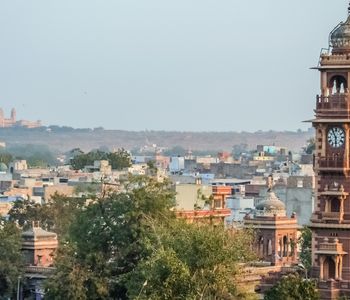
And before you leave, climb the ramparts. Below you, Jodhpur's old city unfolds in every shade of blue imaginable — powder, cobalt, cerulean — stretching toward the pale haze of the Thar Desert. It's one of India's most iconic panoramas, and standing above it all, with the wind pulling at your clothes, you'll understand why photographers keep coming back.
Your Game Plan: Timing, Tickets & Tips
Mehrangarh Fort, including the Sheesh Mahal, opens daily from 9 a.m. to 5 p.m. International visitors pay 600 rupees per person; Indian nationals pay 100 rupees. Audio guides are available for an additional fee and offer detailed commentary on each palace — well worth it if you want the full story behind every room.
Even better? Hire a local guide at the fort entrance. These storytellers know the anecdotes that no placard will tell you — the rivalries, the romances, the secrets embedded in the stonework. They transform a walk through old rooms into a living narrative.
Timing matters enormously. Between May and July, Jodhpur bakes under temperatures regularly exceeding 110°F — brutal for exploring a hilltop fortress. Visit between October and March instead, when the air is dry, warm, and walkable. Arrive right when the gates open at 9 a.m. to beat both the midday heat and the tourist crowds that thicken after 11.
Finding Your Way to the Fort
Jodhpur Airport receives daily flights from Delhi, Mumbai, and Jaipur — a taxi from there to Mehrangarh takes roughly 20 minutes. Jodhpur Junction railway station sits right in the city center, connected by regular train services to major destinations across India.
Auto rickshaws and taxis will get you to the fort easily; every driver in the city knows the way. But if you have the energy, walk up through the old city instead. Narrow lanes thread past spice sellers and chai stalls, the scent of cardamom and turmeric mingling with engine exhaust and incense. Colorful storefronts crowd the path. Voices haggle, music drifts from doorways, motorbikes thread through impossibly tight gaps. And all the while, the massive sandstone walls of Mehrangarh grow larger above the rooftops, pulling you upward like a magnet.
By the time you finally stand inside the Sheesh Mahal — watching light dance across centuries-old glass, tracing hand-painted flowers with your eyes, feeling the cool stone underfoot — you'll carry something with you long after you leave Jodhpur. This is a place where artistry and power fused into something luminous, and three hundred years later, it still hasn't stopped shining.