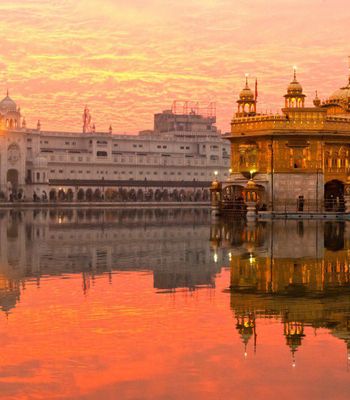
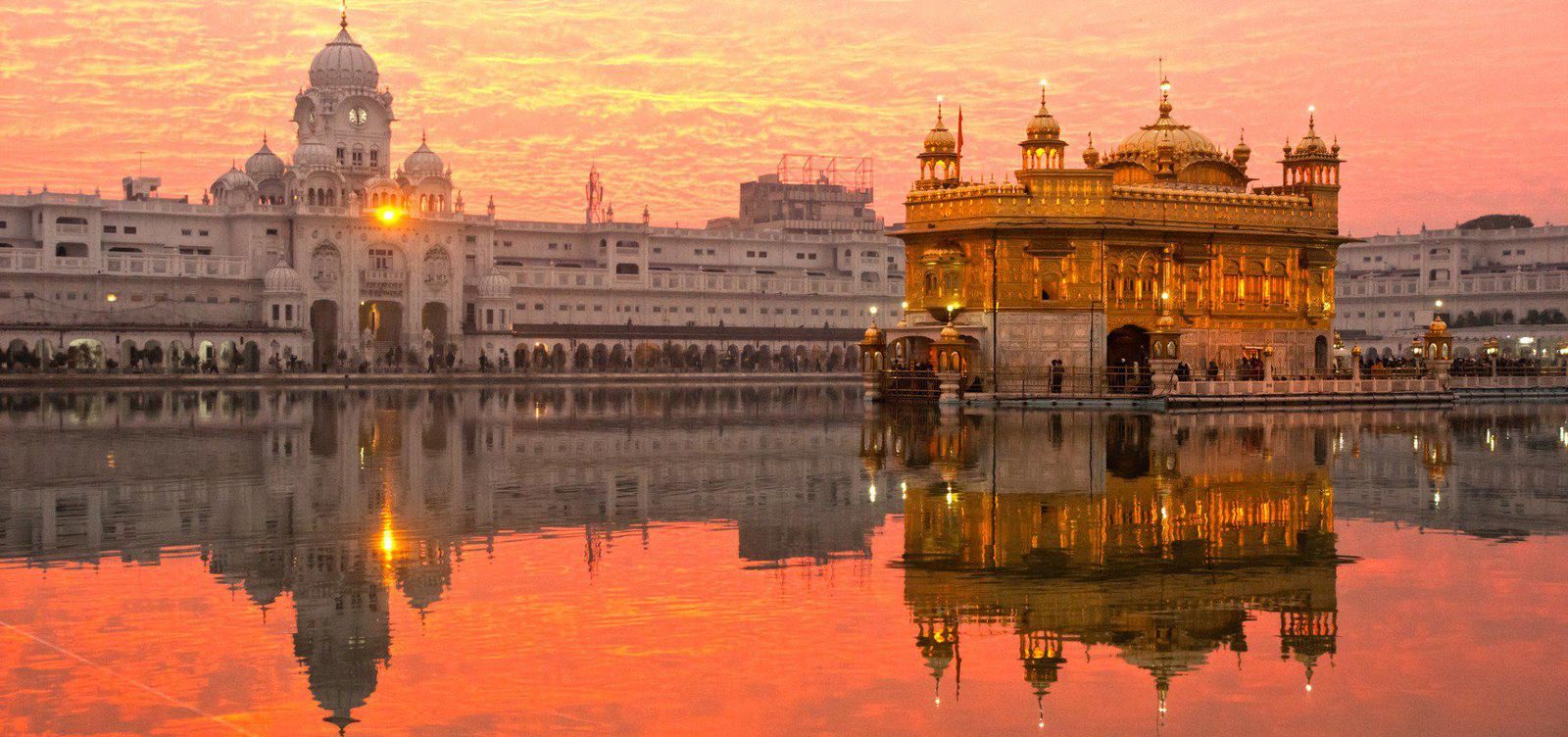
At four in the morning, before the city has shaken off sleep, the marble walkway around the sacred pool is already cool underfoot and crowded with pilgrims. The Golden Temple — Sri Harmandir Sahib, if you want its proper name — sits in the middle of that pool like something dreamed up rather than built. Its upper storeys are sheathed in roughly 750 kilograms of gold leaf, and in the pre-dawn dark they glow as if lit from within. You hear the ragis before you see the shrine itself: live hymns from the Guru Granth Sahib, broadcast across the complex from speakers mounted discreetly on the white marble walls. No photograph prepares you for this. Arrive early. Stay longer than you planned. The temple rewards patience the way few places do.
Gold, Marble, and a Pool That Heals
The central shrine is smaller than you expect. That's part of its power. While most grand religious buildings try to overwhelm you with scale, Harmandir Sahib does the opposite — it sits low, almost modestly, at the end of a narrow causeway called the Guru's Bridge. You queue to cross it. Everyone queues. Prime ministers, farmers, backpackers, grandmothers from Ludhiana carrying their grandchildren on one hip. The line moves slowly and nobody seems to mind.
Around the shrine stretches the Amrit Sarovar, the pool of nectar that gave Amritsar its name. The water is said to have healing properties, and you'll see devotees bathing in it through the steps on all four sides. The temple has four doors — one on each side — a deliberate architectural statement that people of every caste, creed, and direction are welcome to enter.
Built on a Gift from an Emperor
The land itself was granted to the fourth Sikh Guru, Ram Das, by the Mughal Emperor Akbar in the sixteenth century. His successor, Guru Arjan, oversaw the construction of the original temple and placed the first copy of the Adi Granth — the foundational Sikh scripture — inside it in 1604. That scripture, now called the Guru Granth Sahib, still sits in the inner sanctum today, ceremonially carried in each morning from the Akal Takht and returned each night.
The gold came later. Maharaja Ranjit Singh, ruler of the Sikh Empire in the early nineteenth century, commissioned the gilding and marble work that give the temple its modern appearance. The building you see today is essentially his vision — an Indo-Islamic hybrid of Mughal arches, Hindu decorative motifs, and distinctly Sikh spatial logic.
The World's Largest Free Kitchen
Walk east from the main shrine and you'll find the Langar Hall, and this is where the Golden Temple becomes something beyond a monument. The community kitchen here serves free meals to roughly 50,000 people on ordinary days, and over 100,000 on weekends and festivals. Nobody checks your religion. Nobody asks for payment. You sit on the floor in long rows, cross-legged, and volunteers move down the line ladling dal, sabzi, and kheer onto steel plates.
The scale of the operation is genuinely staggering. Vast cauldrons of lentils simmer over open flames. Machines press out thousands of rotis an hour, but so do hundreds of volunteers by hand, because the tradition of seva — selfless service — matters more than efficiency. Spend an hour in the dishwashing area afterward. You'll see bankers and barefoot farmers scrubbing steel plates side by side, and the hierarchy that structures most of Indian life simply dissolves.
The Darker Corner of the Compound
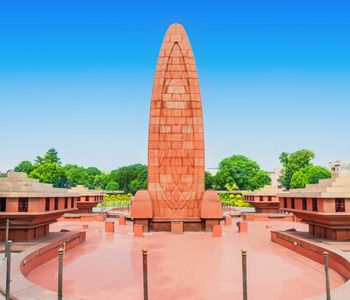
Step out the northern exit and walk five minutes, and you'll reach Jallianwala Bagh — the garden where, in April 1919, British troops under General Dyer opened fire on an unarmed crowd gathered for the Baisakhi festival. Hundreds died. The bullet holes are still preserved in the brick walls, and the well into which people jumped to escape the gunfire is still there, covered now but marked.
Most visitors to the Golden Temple also come here. It takes perhaps thirty minutes to walk through, and it changes the weight of your visit. The two sites share a history, and understanding one deepens the other.
What to Know Before You Go
Covering Your Head, Removing Your Shoes
Before entering the complex, you must cover your head — scarves are available free of charge near the entrance if you didn't bring one — and remove your shoes at the shoe depository, which is also free and staffed entirely by volunteers. You'll walk through a shallow channel of water to rinse your feet before stepping onto the marble.
Timing Your Visit
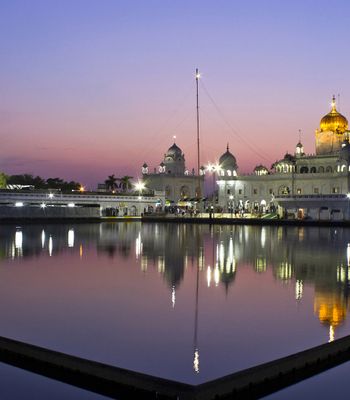
The temple is open 24 hours a day, every day of the year, and this matters more than it sounds. The atmosphere shifts dramatically depending on when you come. Pre-dawn is meditative and cool. Mid-morning brings heavy pilgrim crowds. Evenings glow beautifully as the gold catches the setting sun, and the reflection in the pool is at its most photogenic around 7 p.m. in summer.
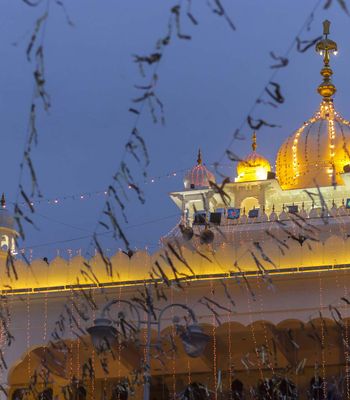
If you can manage it, come at least twice — once at dawn, once after dark. The temple at 3 a.m. under floodlights, with the hymns still flowing and only a handful of devotees circling the pool, is something you won't forget.
Getting There
Amritsar's Sri Guru Ram Dass Jee International Airport handles flights from Delhi, Mumbai, and several international cities. From the airport, the temple is about a 30-minute drive. The railway station is closer — around 15 minutes by auto-rickshaw — and well-connected to Delhi via multiple daily trains, including the Shatabdi Express. Once you're in the old city, the streets narrow quickly and walking is easier than driving. Free pilgrim accommodation is available at the temple's own guesthouses, though rooms fill fast.
Why It Lingers
You leave the Golden Temple differently than you arrived. It's not the gold, impressive as it is. It's not even the architecture. It's the sense that you've just spent a few hours inside a place where the usual rules of Indian public life — the noise, the hierarchy, the hustle — have been quietly suspended. People are calm here. They share food with strangers. They wait their turn. The temple isn't selling you anything, and that alone makes it rare. Come hungry, come curious, and come with time to spare. Amritsar gives you its heart freely.