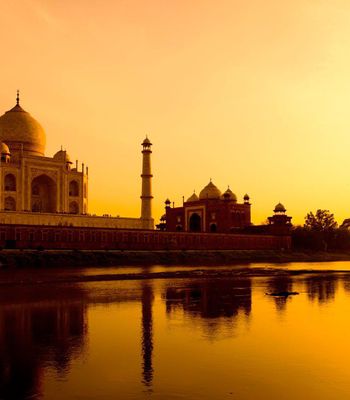
There's a moment, just before sunrise in Agra, when the Taj Mahal looks less like a building and more like something dreamed into existence. The marble hasn't caught the light yet. The Yamuna behind it is still the color of wet slate. Then the sun clears the horizon and the whole thing turns peach, then cream, then that impossible white you've seen in a thousand photographs but never quite believed. Commissioned in 1632 by the Mughal Emperor Shah Jahan to hold the body of his wife Mumtaz Mahal, the monument is a UNESCO World Heritage site that draws millions every year. And yet, standing in front of it, you realize no photograph has ever done it justice. What follows is what you'll want to know before you go.
A Grief That Built an Empire's Masterpiece
Mumtaz Mahal died in 1631 giving birth to her fourteenth child. Shah Jahan, by every account, never recovered. What he built instead was a tomb meant to silence every other tomb ever made. Construction began the next year in Agra, then the pulse of Mughal power, and it would take roughly 22 years and around 20,000 artisans and laborers to finish.
The workforce was astonishing. Persian calligraphers. Stone cutters from Baluchistan. Specialists from Central Asia, Europe, and across India, each summoned for a single craft. By 1653, the main mausoleum and its surrounding complex stood essentially as you see them today. Shah Jahan himself was eventually buried beside his wife in the lower chamber, his cenotaph the only element in the entire complex that breaks the symmetry. A small imperfection, planted in the heart of perfection.
The Marble That Lies to Your Eyes
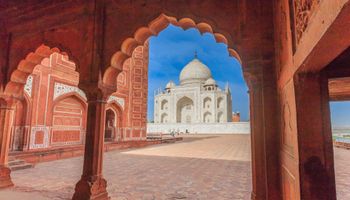
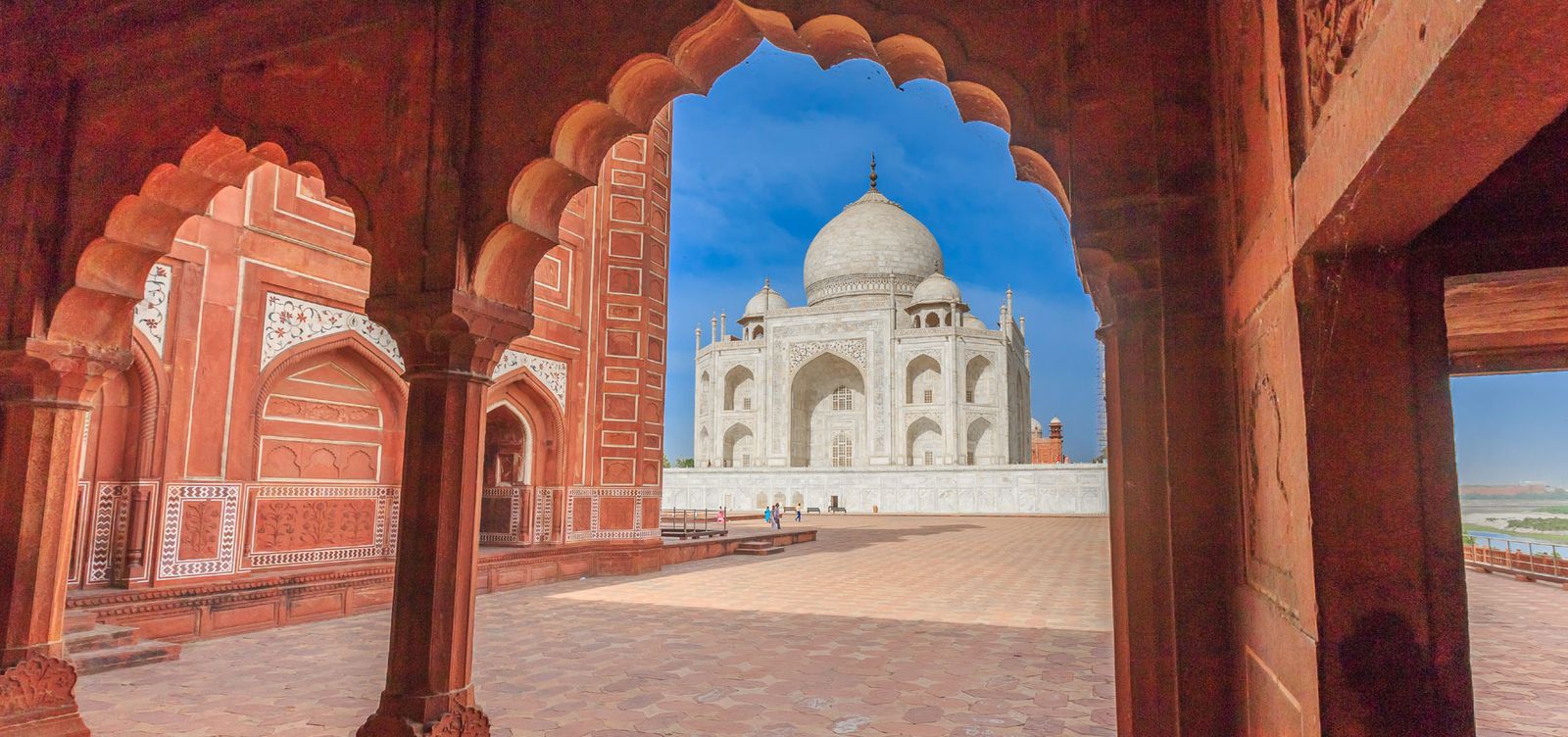
Makrana marble is what gives the Taj its strange, living luminosity. It doesn't just sit there being white. It absorbs whatever the sky is doing and hands it back to you, softened. The central dome rises about 240 feet, ringed by four smaller domes. Four minarets, each roughly 130 feet tall, stand at the corners of the platform and lean almost imperceptibly outward, a deliberate choice so that if they ever fell in an earthquake, they'd fall away from the tomb rather than onto it.
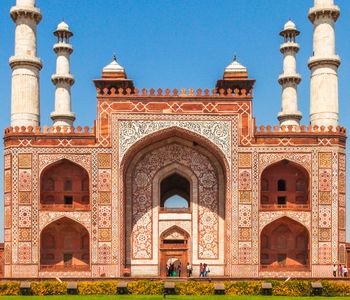
Get closer and the marble begins to confess its secrets. Pietra dura inlay work covers the surfaces: jasper, jade, turquoise, lapis lazuli, embedded into channels carved directly into the stone, arranged into flowers that look painted but aren't. Around the main archways, verses from the Koran run in black calligraphy. The script appears perfectly uniform from where you stand. It isn't. The letters grow larger as they climb, calibrated to the angle of your gaze, so that your eyes never register the distance.
Inside the Chamber
The interior is smaller than you'd expect. An octagonal room. Soft, filtered light. The cenotaphs of Mumtaz Mahal and Shah Jahan sit behind a screen of carved marble so fine it looks more like lace than stone. The actual tombs rest one level below, in a quieter chamber at garden level, closed to the public.
You move through along a set path, and it's over quickly. But up close, the work does something to you. The craftsmanship isn't abstract anymore. It's inches from your face.
Paradise, Divided by Four
The gardens are a charbagh, the classical Mughal quadrant layout, split by raised walkways and water channels that stretch roughly 300 meters from the main gate to the tomb. The design draws directly from Islamic descriptions of paradise. Cypress trees flank the central reflecting pool, and when the water is still, the Taj appears twice, which is why that one composition has become the most photographed frame in travel photography.
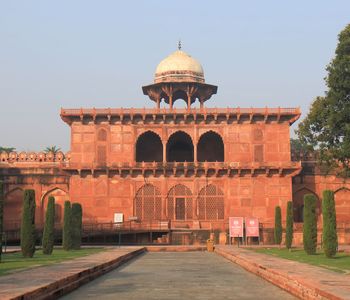
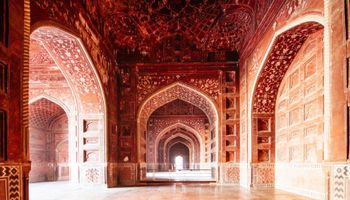
To the east and west sit two red sandstone buildings, nearly identical twins. The western one is a working mosque. The eastern one is called the jawab, meaning "answer," and it exists purely for balance. It can't function as a mosque because it faces the wrong direction. It's there because the Taj demanded its mirror.
Why It Still Matters
UNESCO added the Taj to its World Heritage list in 1983, calling it "the jewel of Muslim art in India." In 2007, a global poll named it one of the New Seven Wonders. Those are the official markers. What they don't capture is the way the monument moves across religious and cultural lines without asking permission, becoming, for most who see it, simply a statement about what love can make a person do.
In Agra itself, the Taj is the economy. Thousands of families live off its orbit. In the lanes behind the monument, artisans still practice pietra dura by hand, cutting the same semi-precious stones into the same floral patterns their ancestors set into Shah Jahan's walls. You can watch them work. It's worth the detour.
Get There Before the Sun Does
The Taj is open six days a week, sunrise to sunset, closed on Fridays for prayers at the mosque. If you do one thing, arrive before the gates open. The early light moves across the marble in a slow, deliberate shift from gold to pale to brilliant white, and watching it happen is the version of the Taj most people never see.
The cool months from October through March are the only sensible time to visit for any length of time. Agra summers routinely push past 110 degrees Fahrenheit, and the heat off the marble platform is its own punishment. Monsoon season, July through September, brings heavy rain and occasional haze, but also dramatic skies that photographers quietly prefer.
What You'll Pay
Entry tiers by nationality. Indian citizens pay roughly 50 rupees. Visitors from SAARC and BIMSTEC countries pay around 540 rupees. Everyone else pays about 1,100 rupees, and that fee includes access to the main mausoleum. Children under 15 enter free regardless of where they're from. Book online through the Archaeological Survey of India's website if you'd rather not stand in the ticket queue, which on busy mornings can be its own minor endurance event.
Getting to Agra
From Delhi, the Gatimaan Express covers the distance in under two hours, which makes a day trip genuinely workable. Driving the Yamuna Expressway takes three to four hours depending on traffic, and traffic in this part of India is never really a known quantity.
Agra's Kheria Airport handles a limited schedule of domestic flights. For anything more ambitious, you'll fly into Delhi's Indira Gandhi International Airport and make your way down. Once in Agra, auto rickshaws, taxis, and ride-sharing apps all work. The last stretch to the monument itself must be done on foot or by electric bus; motorized vehicles are banned near the complex to protect the marble from pollution, which has been slowly yellowing it for decades.
The Taj Mahal has been standing for nearly four centuries, and the thing that surprises you, when you finally see it, is how it refuses to feel familiar. The symmetry of the gardens, the precision of the inlay, the way the dome seems to float rather than rest, none of it flattens into the image you arrived with. You leave understanding, in a way you didn't before, what one man's grief and an empire's best hands were capable of building together.