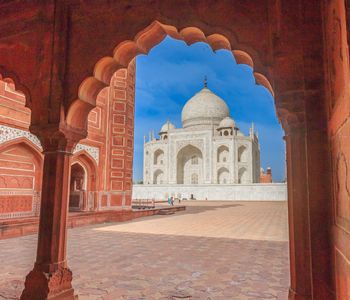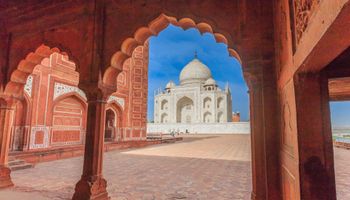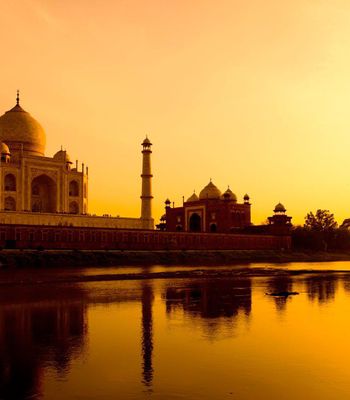
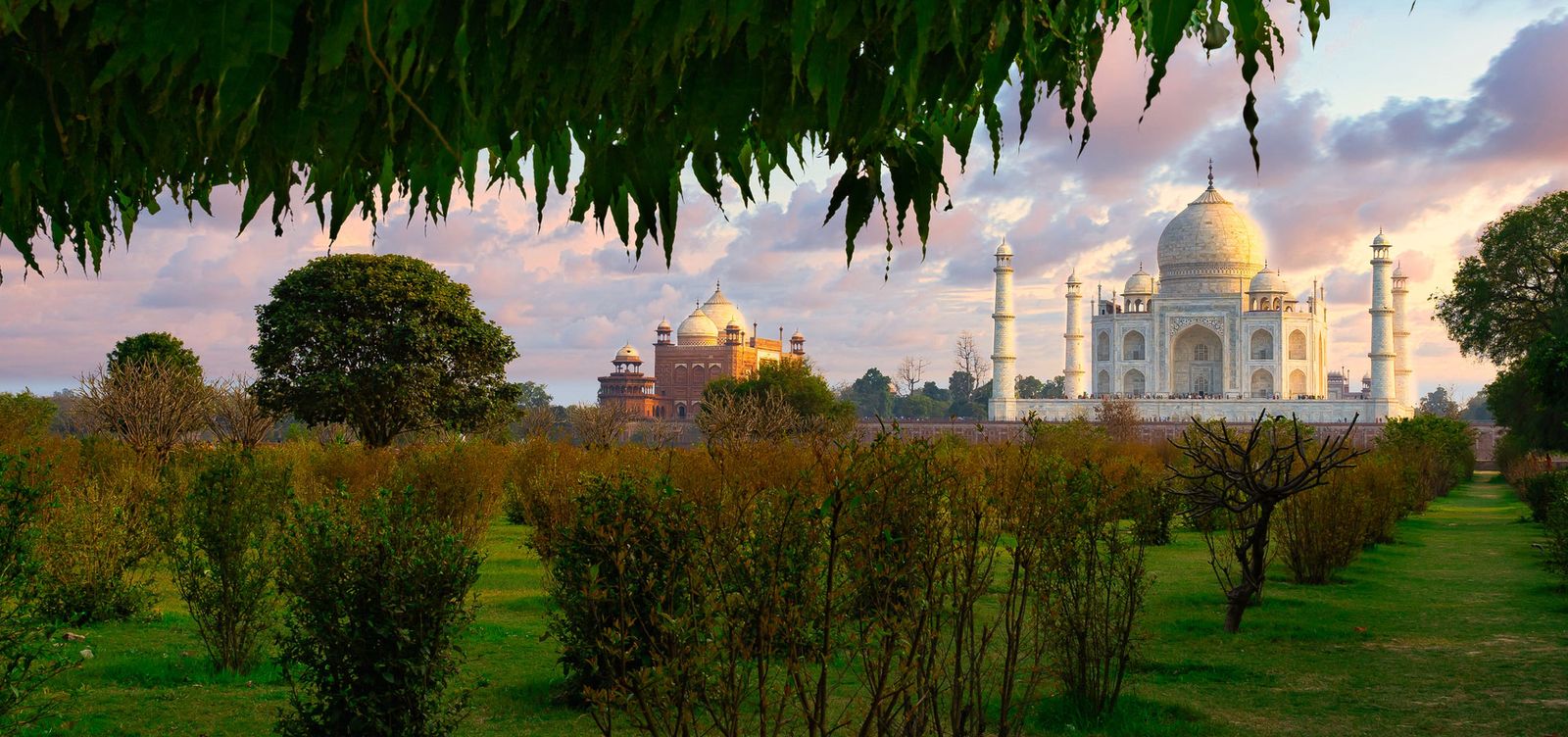
Most people who visit the Taj Mahal never cross the river. That's a mistake. On the opposite bank of the Yamuna, directly aligned with the mausoleum's central axis, Mehtab Bagh offers something the main complex cannot — distance. And distance, it turns out, is exactly what the Taj Mahal needs to be fully understood. From here, the white marble dome doesn't loom over you. It floats, suspended above the riverbank like something not quite of this world, especially at sunset when the stone turns the color of ripe apricots.
Mehtab Bagh — "Moonlight Garden" — was designed as the final piece of a grand symmetrical puzzle conceived by Emperor Shah Jahan in the 1630s. Not an afterthought, not a royal whim. It was the answer to a geometric obsession that defined Mughal aesthetics: the conviction that paradise could be plotted on a grid.
A Reflection, Not a Replica
For decades, a seductive legend held that Shah Jahan intended to build a second Taj Mahal here in black marble, his own tomb mirroring his wife's across the water. The story is irresistible. It's also almost certainly fiction. Archaeological excavations conducted by the Archaeological Survey of India in the 1990s turned up no trace of a black marble structure. What they did uncover was far more revealing — the remains of a large octagonal pool lined with fountains, positioned precisely to catch the Taj Mahal's reflection in still water.
Sit with that a moment. Shah Jahan didn't want a copy. He wanted the original, captured and held in a sheet of water at his feet. The pool no longer functions, but its footprint survives in the garden's central terrace — a shallow depression where you can stand and grasp the emperor's intent without a single placard explaining it to you.
What Three Centuries of Neglect Look Like
Mehtab Bagh spent most of its existence under dirt. After the Mughal decline, the Yamuna's floods buried the garden beneath layers of silt. By the twentieth century, the site was little more than a sandy mound with a few crumbling walls poking through. The ASI's restoration work in the 1990s peeled back centuries of sediment to expose the original charbagh layout — four quadrants divided by walkways, with the octagonal pool at the center and a large baradari, or pavilion, anchoring the northern edge.
Today, the garden doesn't pretend to be what it once was. The flowerbeds are replanted but simplified. Sandstone pathways run intact but weathered. No fountains arc water into the air, no intricate marble inlays survive. What remains is the bones of the place — the proportions, the sight lines, the calibrated relationship between earth and water and white marble across the river. The restraint of the restoration is, honestly, what makes it work. Nobody tried to fake grandeur, and the honesty of that choice gives the space a dignity that over-restored monuments rarely achieve.
The Best Seat in Agra
Arrive around 4:30 in the afternoon during the cooler months. The light shifts fast here, and the Taj Mahal's appearance changes with it — ivory at first, then gold, then a deep amber that lasts only minutes before the whole structure dissolves into grey-blue dusk. Photographers crowd the central pathway for the classic symmetrical shot, but the better vantage point is slightly to the left, near the garden's western wall, where the dome and minarets frame against open sky without a thicket of tourist heads in the foreground.
Here's the thing about Mehtab Bagh that nobody warns you about: it's a garden, but the garden itself isn't the draw. The manicured lawns and young trees are pleasant enough, though they pale beside the elaborate Mughal plantings at the Taj complex. You come here for perspective — literally. The 300-meter gap across the Yamuna strips away the crowds, the hawkers, the security queues, and returns the building to you as Shah Jahan's architects intended it to be experienced. Alone. Framed by sky and water.
What the River Tells You
The Yamuna between Mehtab Bagh and the Taj Mahal is not the crystalline waterway of Mughal miniature paintings. Depending on the season, it ranges from a sluggish grey-green ribbon to a wide brown flood. During the dry months, the riverbed exposes cracked mud flats where water buffalo lounge in the heat. None of this diminishes the view. If anything, it introduces a layer of honesty that the manicured Taj complex carefully scrubs away. The Taj Mahal was always a monument built beside a working river in a living city, and from this bank you see both the masterpiece and its context — without the surgical separation that modern tourism prefers.
Migratory birds use the riverbanks between the two sites. In winter months, you might spot egrets and kingfishers working the shallows. The garden itself draws parakeets that settle noisily in the neem trees along the perimeter walls — a flash of green against red sandstone that no guidebook photograph quite captures.
Getting There Without the Hassle
Mehtab Bagh sits about 6 kilometers from Agra's city center on Nagla Devjit Road. Auto rickshaws know the route well, and the fare from the Taj Mahal's eastern gate shouldn't run more than 100 to 150 rupees if you negotiate before climbing in. The entrance fee for international visitors is 50 rupees — a fraction of the Taj Mahal's 1,100-rupee ticket. Indian nationals pay 30 rupees. The garden opens at sunrise and closes at sunset, with no artificial lighting after dark.
Plan about an hour here, though some travelers stretch it to ninety minutes during the golden hour. There are no food stalls inside the garden, so carry water. A few vendors operate just outside the entrance gate, selling chai and packaged snacks, but don't expect variety. Restroom facilities exist on-site, though basic is a generous description.
The best months to visit fall between October and March, when Agra's punishing heat relents and the air carries less haze. During monsoon season, from July through September, the Yamuna swells and the humidity can be suffocating — but washed skies occasionally produce dramatic cloud formations stacked behind the Taj's dome. That's a trade-off that rewards the patient.
The Last Word
Mehtab Bagh isn't competing with the Taj Mahal. It never was. Shah Jahan conceived this garden as a frame, a place from which the mausoleum could be contemplated rather than merely observed. That purpose survives intact. For the price of a chai and a short rickshaw ride, you gain what millions of visitors standing inside the Taj complex never receive — the full composition, river included, exactly as a grieving emperor once saw it. Cross the water. The finest view of the most famous building on earth belongs to a quiet garden that most people walk right past.