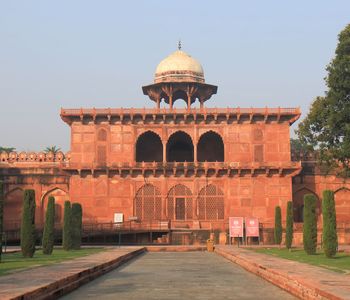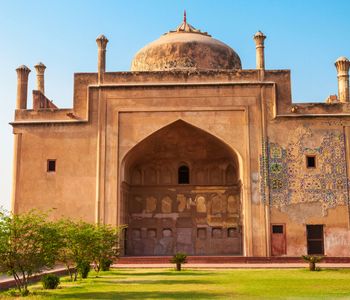
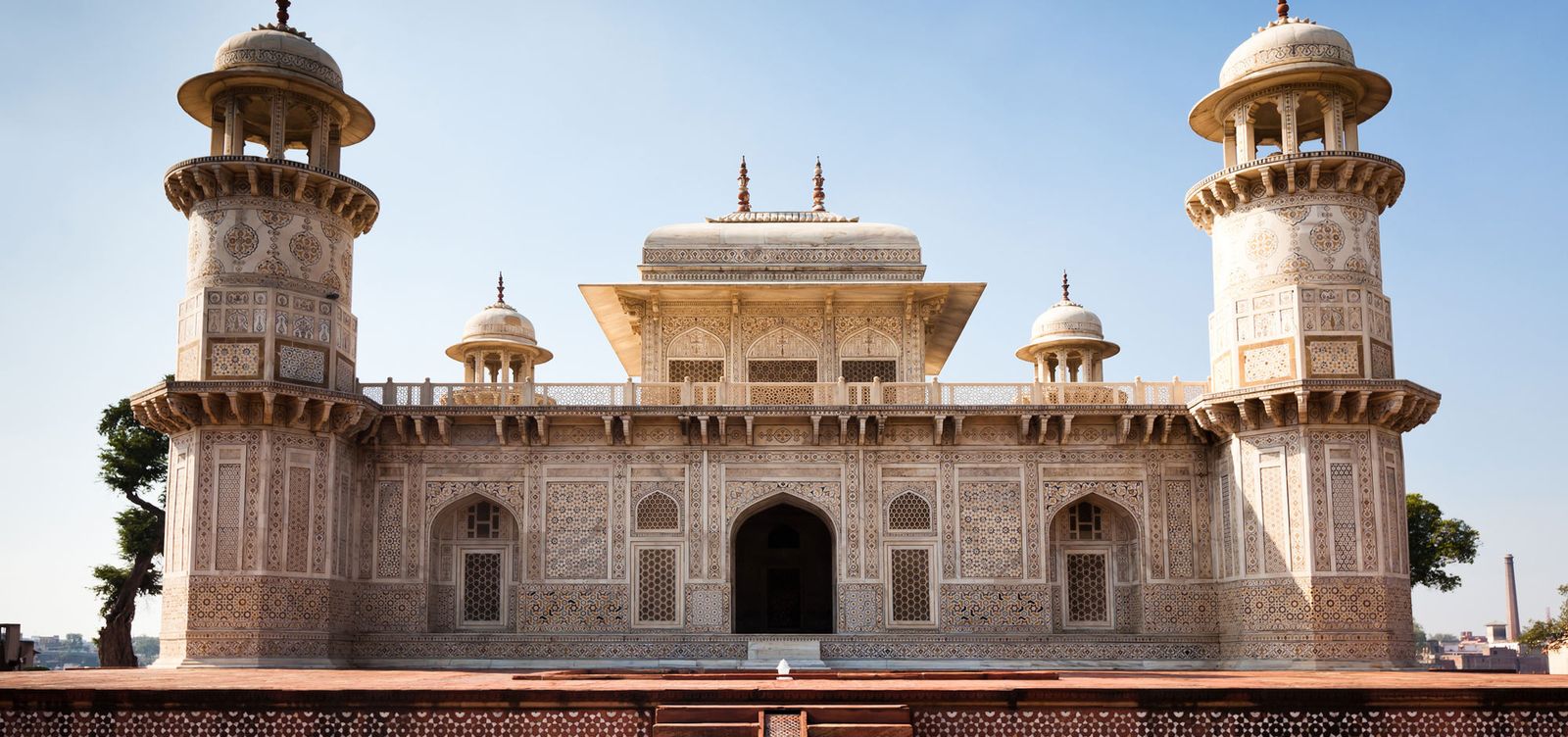
Before the Taj Mahal existed even as a thought in Shah Jahan's grief-stricken mind, a smaller monument rose on the eastern bank of the Yamuna River. Itmad-ud-Daulah's Tomb, completed in 1628, introduced marble inlay work to Mughal architecture — a technique that would later define its more famous neighbor downstream. Here's the thing that nags at you as you stand in its garden: the building that pivoted Indian architecture forever is the one most people drive past with their faces pressed against taxi windows, already dreaming of the Taj. Empress Nur Jahan commissioned this tomb for her father, Mirza Ghiyas Beg, who served as chief minister to Emperor Jahangir. What her architects delivered broke with every Mughal tomb that came before it, and remains more intimate than anything that followed.
From Persian Exile to Imperial Memorial
Mirza Ghiyas Beg arrived in India as a Persian immigrant, nearly destitute. His daughter Nur Jahan would eventually become one of the most powerful women in Mughal history, effectively governing the empire while her husband Jahangir dissolved into opium and wine. When Ghiyas Beg died in 1622, Nur Jahan funneled imperial resources into his memorial — not as political theater, but as something vanishingly rare in Mughal court life: a daughter's unadorned grief.
Construction consumed six years. The tomb inherited Ghiyas Beg's honorific, Itmad-ud-Daulah — "Pillar of the State." What emerged wasn't merely a mausoleum. It was a proof of concept. The first Mughal structure built entirely of white marble, abandoning the red sandstone that had governed every significant tomb from Humayun's onward.
Where Stone Forgets It's Stone
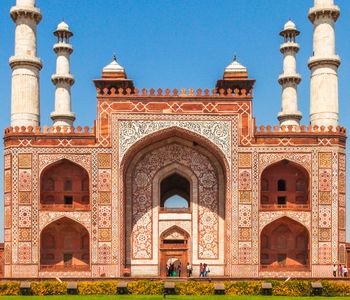
Press close to the walls and you'll see why art historians go slightly weak at the knees over this building. The marble surfaces carry pietra dura — an inlay technique where semi-precious stones (carnelian, jasper, lapis lazuli, onyx) are cut and seated into carved recesses, forming elaborate patterns. Cypress trees, wine vessels, fruit bowls, floral arabesques — they rise from the white marble as if painted, except they're flush with the surface and will outlast any pigment by centuries.
The precision is unnerving. Some inlay pieces are no wider than a fingernail, yet the joints between stone and marble hold tight after nearly four hundred years. Run your hand across a panel. Nothing — no ridge, no gap. Just smooth, unbroken surface where six different minerals meet as though they grew together.
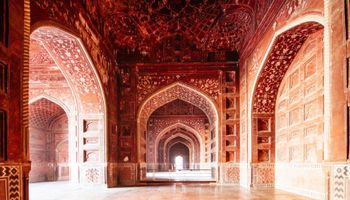
Inside, lattice screens carved from single marble slabs shatter the daylight into geometric constellations across the floor. The central chamber holds the cenotaphs of Ghiyas Beg and his wife Asmat Begum, dressed in the same inlay work that covers the exterior. Come in the late afternoon, when low-angle light turns the interior amber, and the tomb stops feeling like architecture. It feels like a jewelry box that someone forgot to keep small.
The Building the Taj Borrowed From
Historians habitually call Itmad-ud-Daulah the "Baby Taj," a nickname that cheats the building of its real importance. It wasn't a rough draft for the Taj Mahal. It was the experiment that made the Taj Mahal thinkable. Before Nur Jahan's craftsmen proved that white marble and pietra dura could carry a full monument, no Mughal patron had dared attempt it at scale.
The tomb also introduced the charbagh garden enclosed by walls on all four sides, with the mausoleum placed at its center rather than pushed to one end. Shah Jahan's architects would sharpen this layout two decades later, but the blueprint started here. Even the four minarets at each corner — squat, hexagonal towers rather than the soaring cylinders the Taj made famous — represent the first Mughal use of corner towers flanking a central tomb.
And here's the thing nobody tells you: Itmad-ud-Daulah is actually easier to love than the Taj Mahal. The Taj overwhelms with scale. This tomb rewards closeness. Its artistry reveals itself at arm's length — in the delicacy of a carved rosette, in the way topaz meets marble within a single vine leaf. You don't crane your neck here. You lean in.
The Garden's Quiet Argument
The grounds follow the classic Mughal four-quadrant design, sandstone pathways cutting the space into symmetrical quarters. Water channels once fed by the Yamuna connect the quadrants, though the flow is intermittent now — a trickle where there was once a mirror. Mature trees throw shade along the walkways, and the relative hush compared to the Taj complex across the river lets you actually hear yourself think.
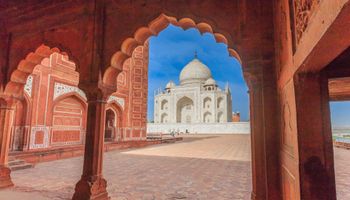
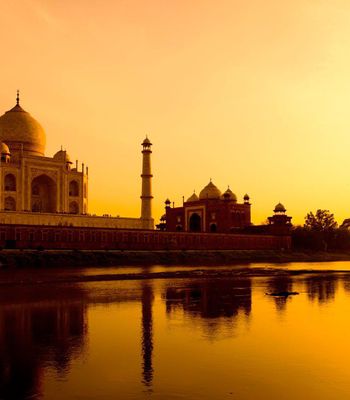
On the riverside, a narrow terrace runs along the tomb's eastern edge. From here, you look across the Yamuna toward the distant shape of the Taj Mahal. The two buildings face each other over the water — grandmother and grandchild, separated by a muddy river and twenty years of architectural ambition. It's a view that puts the whole arc of Mughal imagination into proportion better than any lecture could.
Getting There Without Losing Your Mind
Itmad-ud-Daulah sits on the eastern bank of the Yamuna, roughly three kilometers upstream from the Taj Mahal. Auto rickshaws from the Taj's eastern gate reach the tomb in about fifteen minutes, traffic permitting. Settle your fare before you climb in — expect somewhere around 100 to 150 rupees. Taxis and ride-share apps work in Agra too, and drivers know the tomb well even if they seem genuinely baffled that you'd choose it over the Taj.
The tomb opens daily from sunrise to sunset. Indian citizens pay 30 rupees for entry; foreign nationals pay 310 rupees, with slight discounts for online bookings. Mornings are your best window, particularly between 7 and 9 a.m., when early light warms the marble and tour groups are still pushing through hotel buffets. Weekday mornings can leave you nearly alone in the garden — a solitude that would be physically impossible at the Taj.
October through March offers the most civilized conditions for a slow visit. Agra's summers push well past 40 degrees Celsius, and standing on white marble in that heat is exactly as brutal as it sounds. Give yourself at least an hour. The tomb is compact, but the inlay panels demand the kind of looking that can't be rushed, and the lattice screens change character with every shift in the sun.
A Monument That Stands on Its Own
Itmad-ud-Daulah deserves your attention on its own terms — not as a footnote to the Taj Mahal. Nur Jahan built something that hadn't existed before: a tomb where refinement outweighed grandeur, where craft mattered more than size. Stand in its central chamber with afternoon light filtering through carved marble, and you'll feel something the Taj's crowds rarely permit. Stillness. This is where Mughal architecture quietly changed direction, on the banks of a slow river, paid for by a daughter who understood that elegance doesn't require enormity.