Most rulers leave their tombs to the living. Akbar the Great didn't trust anyone else with the job. The third Mughal emperor reportedly began planning his own mausoleum while he still had a pulse, choosing a site at Sikandra — about eight kilometers north of Agra's center — and supervising early construction before his death in 1605. His son Jahangir finished the project in 1613, though he reworked the original design considerably. What you get is a monument caught between two temperaments: Akbar's syncretic vision and Jahangir's decorative impulse. That tension, rather than weakening the tomb, gives it an architectural personality unlike anything else in the Mughal canon. It doesn't compete with the Taj Mahal. It doesn't need to.
A Building That Breaks Its Own Rules
The first thing you notice is what's missing. Every major Mughal mausoleum before and after this one features a dome, yet Akbar's tomb rises in five stories of tiered red sandstone, each level smaller than the last, crowned by an open marble courtyard exposed to nothing but sky. The effect is more Buddhist pyramid than Islamic tomb.
Scholars have argued over this for centuries. Was it Akbar's intention — a structural echo of his famous religious tolerance and the syncretic faith he called Din-i-Ilahi? Or did Jahangir simply scrap his father's dome plan and never replace it? Nobody knows. The ambiguity is part of the spell.
Standing on that open rooftop terrace, you feel the wind cross directly over the white marble cenotaph. Sunlight falls on it unfiltered, with an unmediated intensity a dome would have softened. It's startlingly direct — as though the building refuses to intervene between Akbar and whatever lies above.
Below, the real burial chamber sits underground in near-total darkness. You descend a narrow, sloping passage where your footsteps throw back echoes against painted walls. The air cools abruptly. A single lamp illuminates the actual grave, and the silence down there has physical weight. The contrast between the sunlit terrace above and this subterranean vault is deliberate — and it's the most affecting architectural moment in Agra that doesn't involve the Taj.
Where Geometry Meets Garden
The tomb occupies a sprawling Charbagh Garden, divided by raised walkways and water channels into the traditional four quadrants representing paradise. But unlike the manicured precision of the Taj's grounds, Akbar's garden has a wilder grain to it. Langur monkeys patrol the pathways with an air of bureaucratic authority, as though they've been appointed to management positions no one bothered to revoke. Spotted deer graze the lawns — real ones, not ornamental sculptures. A small population lives here, and their presence transforms what could feel like a static monument into something unexpectedly breathing.
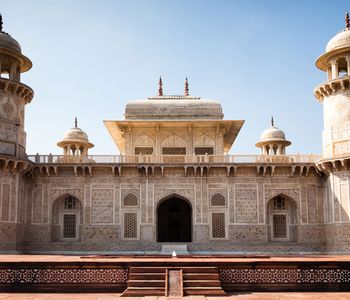
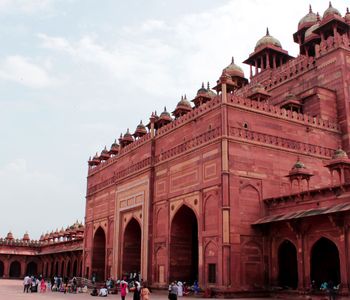
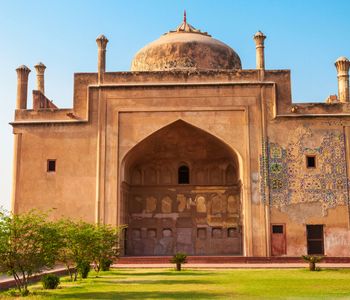
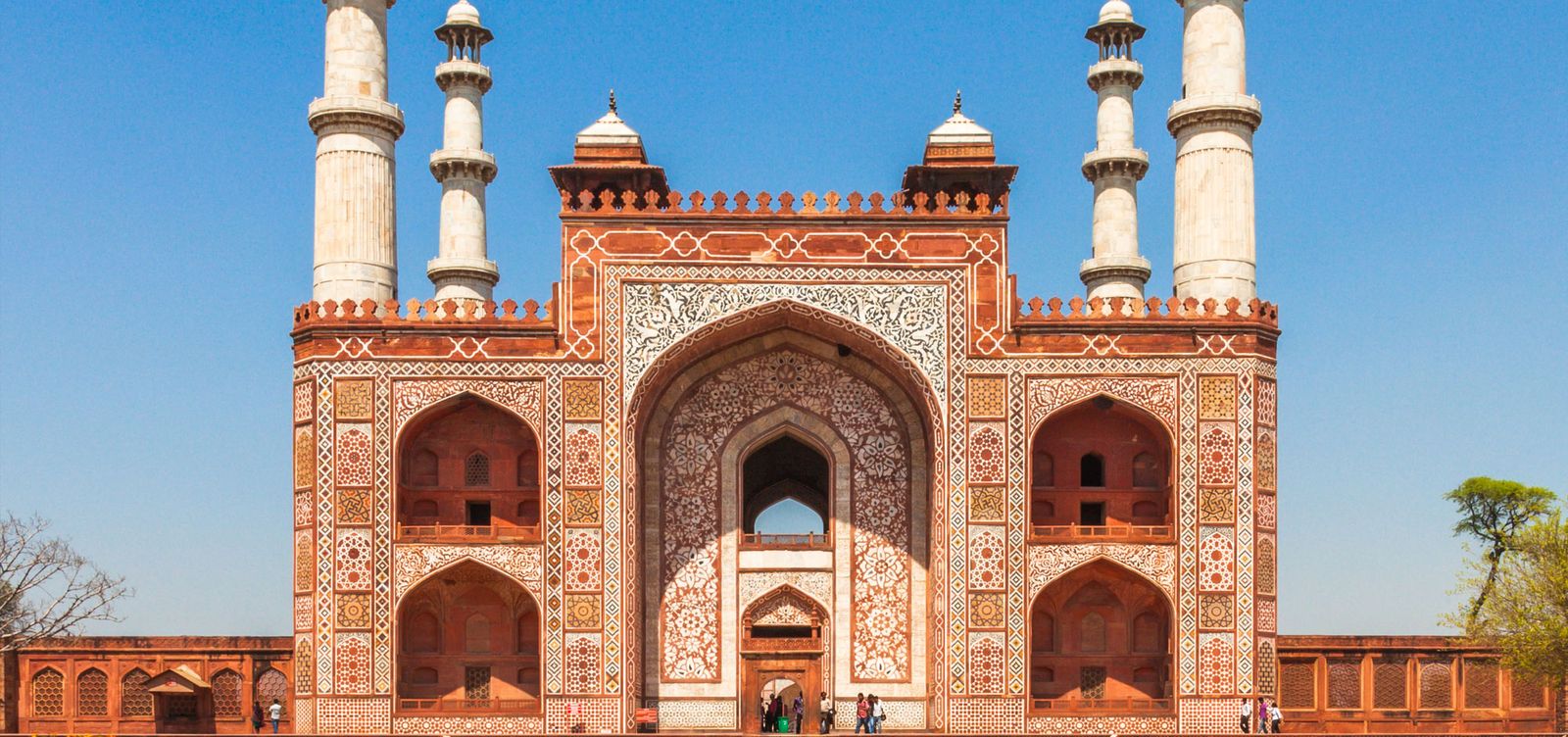
At each corner of the garden's outer wall, slender minarets rise, capped with marble chattris. The southern gateway — the main entrance — demands a full stop. Its red sandstone facade carries inlaid white marble in geometric and floral patterns, and four slim marble minarets at its corners anticipate, some argue inspired, the gateway design Shah Jahan later used at the Taj Mahal. If you've already visited the Taj, you'll recognize the DNA here. This is the prototype.
The Inscriptions Akbar Never Wrote
Jahangir was responsible for most of the decorative program, and he wasn't subtle about it. Arabic calligraphy blankets the southern gateway — verses from the Quran and the ninety-nine names of God rendered in black marble against white. This is revealing, because Akbar himself had drifted far from orthodox Islam during his later years. The inscriptions read less like a tribute to the father and more like the son reasserting religious convention over a man who had spent decades trying to transcend it. There's something almost corrective about them.
Inside, the walls of the upper stories carry painted floral patterns in red, blue, and gold — traces of Jahangir's taste for Persian miniature aesthetics. Time and moisture have faded portions, but enough survives to sense the original opulence. On the ground floor, Christian imagery appears alongside Islamic and Hindu motifs, a decorative acknowledgment of Akbar's ecumenical court, which employed artists from Goa alongside Persian masters. It's the one place in the building where the father's instincts still hold.
Getting There Before the Buses Do
Sikandra sits along the Mathura Road, the main highway connecting Agra to Delhi. From central Agra, an auto rickshaw takes roughly twenty minutes and should cost between 150 and 200 rupees — negotiate before you climb in, not after. Taxis from Agra Cantt railway station or the airport are straightforward, and most drivers know the route without prompting. If you're hitting multiple sites, hiring a car for the full day makes sense; Akbar's tomb pairs naturally with Mariam's Tomb nearby or the Agra Fort back in the city center.
Entrance fees for international visitors run 310 rupees; Indian citizens pay 50 rupees. The site opens at sunrise and closes at sunset, and those early morning hours are genuinely worth setting an alarm. By 10 a.m., tour buses start rolling in. Before that, you might have the underground burial chamber entirely to yourself — and solitude changes its character completely. In a crowd, it's a curiosity. Alone, it's something else.
When the Light Does the Work
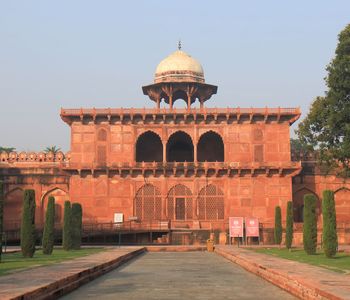
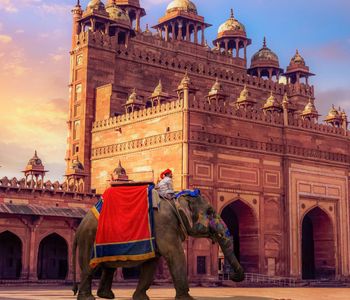
Late afternoon turns the sandstone facades a deep amber, particularly across the southern gateway. The inlaid marble patterns sharpen as the sun drops lower and shadows deepen the relief work, pulling out details you'd walk right past at noon. Morning light, by contrast, flatters the rooftop terrace, where the white marble cenotaph practically glows against the pale sky.
Avoid the midday hours from May through September entirely. Temperatures in Agra regularly exceed 40 degrees Celsius in summer, and the open rooftop terrace offers no shade whatsoever — it becomes a kiln. The October-to-March window provides the most forgiving conditions, with December and January mornings cool enough to warrant a light jacket.
What Stays With You
The Tomb of Akbar doesn't overwhelm you the way the Taj Mahal does. It persuades. Its five-tiered silhouette grows on you slowly, and the interplay between its open-air rooftop and its dark burial vault lingers in the mind long after you've left Sikandra. Here is a monument shaped by a father's ambition and a son's revision, by Islamic tradition and deliberate departure from it.
The deer wandering the gardens, the monkeys claiming the walkways, the calligraphy speaking on behalf of a man who might not have chosen those words — all of it makes Akbar's tomb feel less like a museum piece and more like an unfinished conversation between generations, between faiths, between control and surrender. Step into it. The tomb has plenty left to say.