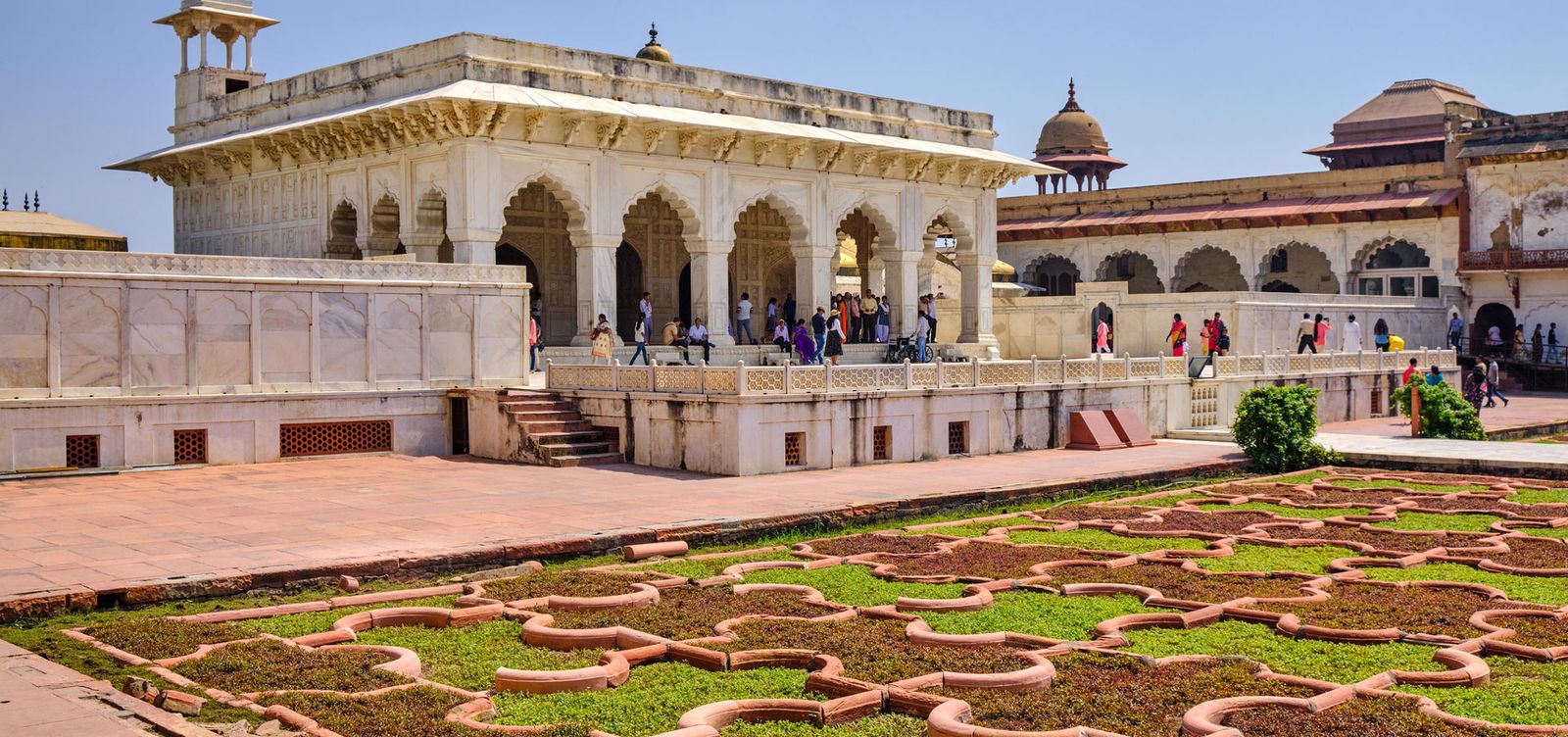
Most visitors to Agra Fort rush past the Anguri Bagh with barely a downward glance, eyes fixed on the marble pavilions and imperial chambers that line its edges. That's a mistake. This geometric garden — its name translates to "Grape Garden" — is one of the most deliberately designed outdoor spaces in Mughal India, a living grid of stone pathways and sunken flowerbeds that once held grapevines imported at enormous expense. The grapes are long gone. The geometry remains, sharp as the day it was carved, and it tells you more about the Mughal obsession with order and paradise than any palace wall ever could.
Shah Jahan had it built during the mid-seventeenth century, deep within the private quarters of the Agra Fort complex. This was never a public space. It existed for an emperor's solitary hours — a place where the scent of ripening fruit and the murmur of channeled water could dissolve the weight of empire, if only for an afternoon.
Geometry as a Form of Worship
Stand at the elevated terrace on the garden's eastern edge and look down. The layout surrenders itself at once: 85 perfectly symmetrical squares, divided by narrow stone walkways intersecting at precise right angles. Each square once held soil, plants, and small water channels fed by an intricate irrigation network. The Mughals called this the charbagh style — four quadrants echoing the four gardens of paradise described in the Koran.
What sets Anguri Bagh apart, though, is compression. Unlike the sprawling charbagh at the Taj Mahal, this garden condenses the cosmic design into a courtyard you could cross in under a minute. That intimacy changes everything. You're not admiring paradise from across a reflecting pool. You're standing inside it.
The white marble channels that once carried water through the grid are still visible, though dry now. Run your hand along them and you'll feel the precision — edges that remain crisp after nearly four centuries. Wherever water once flowed, small carved niches in the channel walls held oil lamps or scattered flower petals during evening gatherings. Shah Jahan didn't simply walk through this garden. He choreographed it.
The Buildings That Serve the Grass
Anguri Bagh doesn't exist in isolation. It functions as the courtyard for three of Agra Fort's most significant structures. To the north sits the Khas Mahal, Shah Jahan's private palace, with its white marble facade and painted ceiling. Flanking it on either side are two golden pavilions — the Bangla-i-Jahanara and the Bangla-i-Roshanara, named for his daughters. Their curved copper roofs, shaped to mimic Bengali bamboo huts, look almost playful against the stern fortress walls.
Here's the thing that inverts every assumption: the garden was the point, not the buildings. Mughal architects designed these pavilions with open facades specifically so that the view of Anguri Bagh remained unobstructed from every room. The architecture served the planting beds, not the other way around. Step inside the Khas Mahal and look out through its scalloped arches — the garden's grid locks into the frame like a painting commissioned for that exact wall. The buildings are picture frames. The garden is the picture.
What the Grapes Tell Us
The choice of grapevines wasn't decorative whimsy. Grapes carried deep symbolic weight in Mughal culture, appearing frequently in miniature paintings and carved stone reliefs across the empire. They represented abundance and the pleasures of earthly life — a theme Shah Jahan returned to repeatedly in his architectural commissions.
Growing them in the scorching heat of the Gangetic plain required something close to stubbornness. Agra's summers push well past 45 degrees Celsius, and the soil runs alkaline. Maintaining a vineyard here demanded constant irrigation, imported rootstock, and dedicated gardeners whose sole task was keeping vines alive in a climate that fought them at every turn. The garden was, in its way, a declaration of imperial will — nature bent into submission through design and labor.
Today, the Archaeological Survey of India maintains the flowerbeds with simpler plantings. Grapes haven't grown here for centuries. But the raised stone borders of each bed still carry faint traces of the floral patterns once painted on their surfaces — geometric arabesques in faded red and blue that you'll miss entirely unless you crouch down close enough to smell the dust.
Walking the Grid at the Right Hour
Anguri Bagh rewards patience and timing. Most tour groups sweep through between 10 a.m. and noon, when the sun sits directly overhead and flattens the garden into a bleached-white glare. Come instead in the late afternoon, around 4 p.m., when the light drops low enough to drag shadows along every stone walkway. Suddenly, every channel, every carved edge, every slight depression in the marble catches a line of shade, and the garden's three-dimensional structure snaps into focus like a developing photograph.
The Agra Fort complex opens daily from sunrise to sunset. Entry for international visitors is 650 rupees; Indian nationals pay 50 rupees. Your ticket covers the entire fort, so Anguri Bagh requires no separate admission. Budget at least 30 minutes for the garden alone — more if you're photographing. The best shots come from the Khas Mahal terrace looking down, where the grid fills the frame edge to edge.
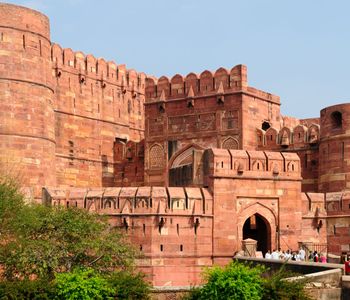
From the Taj Mahal, an auto rickshaw gets you to Agra Fort in roughly ten minutes, and drivers know the route without prompting. The fort's Amar Singh Gate, on the southern side, is the only public entrance. From there, count on a ten-minute walk through the fort's corridors before you reach the garden level. Wear shoes with decent grip — the marble pathways around Anguri Bagh turn treacherous during the monsoon months of July and August.
The Detail Everyone Misses
Before you leave, find the small marble platform at the garden's center where the main water channels converge. It's barely raised — perhaps fifteen centimetres off the ground — and most people step over it without a thought. This was the garden's focal point, the exact spot where all four quadrants met, where water pooled before distributing outward. In Mughal cosmology, this center represented the source of life itself.
Stand there for a moment. The symmetry radiates outward from your feet. The pavilions frame the sky. The fort walls block the noise of modern Agra — the horns, the hawkers, the diesel haze. For a few seconds, the garden does exactly what Shah Jahan intended it to do nearly four hundred years ago. It makes the world outside disappear.
Why This Garden Stays With You
Anguri Bagh won't overwhelm you the way the Taj Mahal does. It doesn't try. Its power is quieter, more architectural than emotional — a reminder that the Mughals didn't just build monuments, they built atmospheres. In a fort designed for war and governance, this small courtyard of stone and soil was the one space built purely for pleasure. Skip the rushed walk-through. Sit on the terrace edge, let the afternoon shadows do their slow work, and give this garden the attention its emperor once demanded of everyone who entered.