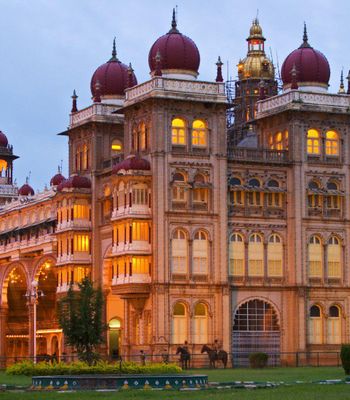
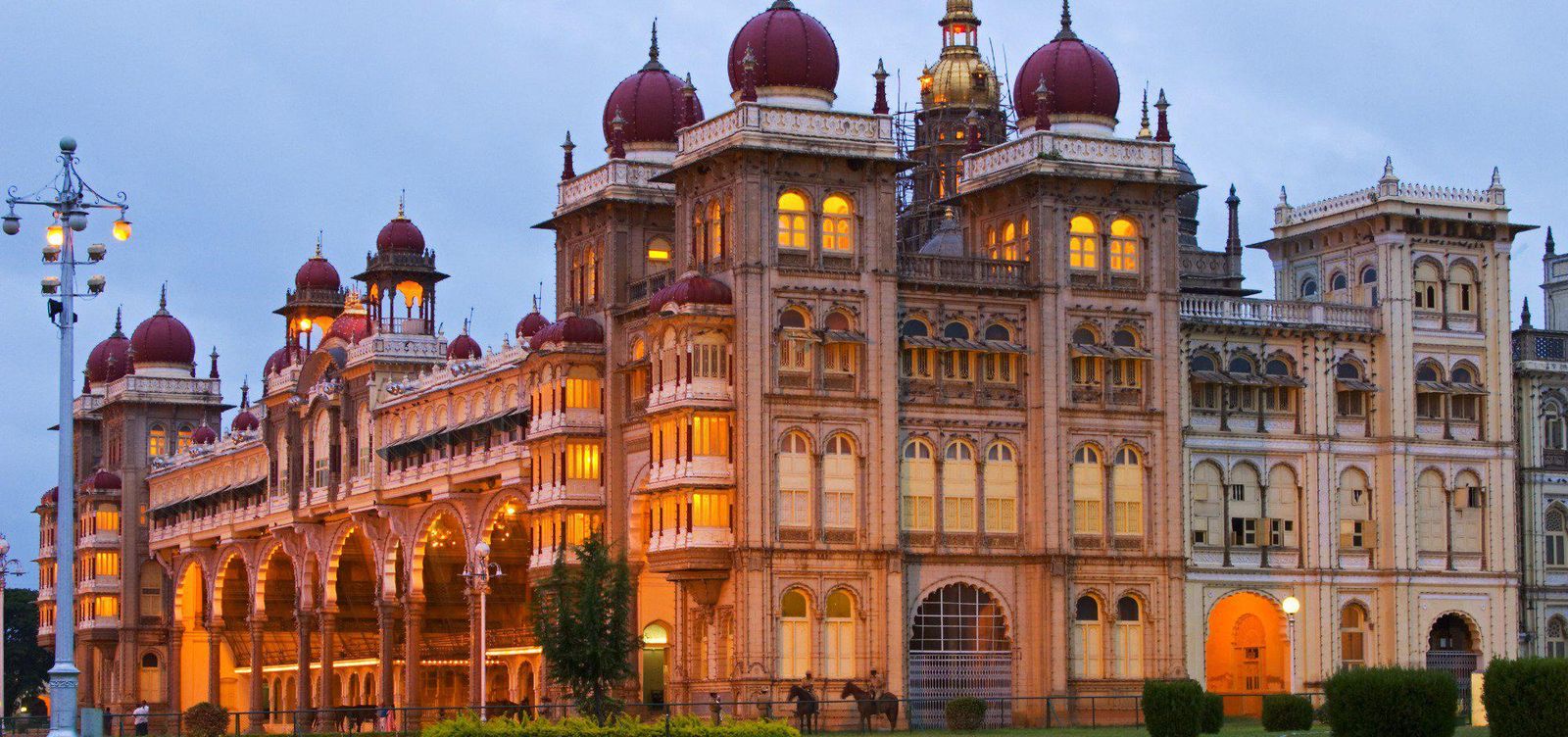
Most palaces seduce you with subtlety — a carved archway here, a quiet courtyard there. Mysore Palace doesn't bother with restraint. It hits you the moment you pass through the main gate: a three-story Indo-Saracenic façade of grey granite, its domes rounded like the helmets of some extravagant army, its arches wide enough to swallow the afternoon light whole. On Sunday evenings and during the Dasara festival, nearly 100,000 light bulbs outline every dome, arch, and turret, turning the structure into something closer to a hallucination than a building. The effect is unapologetic. This is a palace that was designed to announce power, and even a century after the monarchy dissolved, it hasn't stopped talking.
Three Stories, Three Centuries of Ambition
The palace you see today isn't the original. That one burned down in 1897 during a royal wedding — a detail so perfectly dramatic it almost sounds invented. The Wodeyar dynasty, which ruled the Kingdom of Mysore for over five centuries, commissioned British architect Henry Irwin to build its replacement. What Irwin delivered defied every expectation: Hindu temple grandeur fused with Islamic dome architecture, Rajput detailing threaded through Gothic arches, the whole thing held together by an Edwardian structural confidence that somehow never buckles.
Construction finished in 1912 at a cost of roughly 42 lakh rupees — astronomical at the time. The twenty-fourth Wodeyar king, Krishnaraja Wodeyar IV, oversaw the project himself. His obsessions mark every surface, from the imported stained glass to the mosaic floors ordered from England. He wanted a palace that could stare down any European court while remaining unmistakably Indian. He got exactly that.
Where Gold Becomes Architecture
Step inside the Durbar Hall on the first floor and your eyes need a moment to adjust — not to darkness, but to excess. The ceiling is an elaborate composition of painted and gilded surfaces, with columns that look less painted than dipped bodily in gold. Arches frame the hall on both sides, each one layered with turquoise and gold. At the far end sits the golden throne — the gravitational center of the entire palace — displayed publicly only during the Dasara celebrations in September or October.
That throne weighs over 200 kilograms. Fig wood plated in gold, studded with precious stones. During Dasara, it's assembled from individual pieces and placed on a raised platform where the royal family once received subjects. The rest of the year, it sits in careful storage. Seeing the empty platform without the throne is oddly affecting — a reminder that ceremony and power are temporary things, even in a room built to argue the opposite.
A Dome That Fights Your Feet for Attention
The Kalyana Mantapa, the marriage hall, occupies the ground floor beneath a peacock-themed stained glass dome. Octagonal in shape, its glazed tile floor is patterned in geometric designs so absorbing they pull your gaze downward even as the dome hauls it up. The result is a strange vertigo of attention — you can't decide whether to study your feet or the ceiling, so you end up standing motionless in the center, which is probably the point.
Throughout the palace, Italian marble mixes freely with local stone. Belgian crystal chandeliers hang above Mysore-style paintings depicting Dasara processions, hunting expeditions, court life in full theatrical swing. These paintings, rendered in vivid golds and greens, function as a visual record of how the Wodeyars wanted to be remembered: magnificent, benevolent, perpetually in motion.
The Rosewood Doors Nobody Stops For
Here's what most guides skip entirely: the palace doors. The main entrance to the Durbar Hall features carved rosewood panels so dense with detail that twenty minutes of looking still won't exhaust them. Silver filigree covers parts of the surface, forming images of Hindu deities. Most people walk straight through, eyes already locked on the throne platform beyond. Don't. These doors were the palace's opening statement — if they failed to arrest you, nothing beyond them would.
The palace's twelve temples, scattered across the grounds, also reward your patience. The Shwetha Varahaswamy Temple, dedicated to Vishnu, predates the current palace by several centuries. Its presence is a quiet corrective: this ground was sacred long before anyone thought to make it political.
When 100,000 Bulbs Rewrite the Night
The illumination happens every Sunday from 7 p.m. to 7:45 p.m. and throughout the Dasara festival. Arrive early — the grounds fill fast. From the south side, you get the widest unobstructed view, the full façade reflected faintly in the manicured lawns. The transformation takes about thirty seconds once the switch is thrown. Grey granite vanishes. In its place, an outline of golden light makes the palace look like it was drawn against the sky with a hot stylus.
During Dasara, everything sharpens further. A torchlight parade of caparisoned elephants, military bands, and dance troupes moves through the streets, the illuminated palace hovering behind it all like a stage set no designer could invent. The festival runs for ten days in September or October. If you can time your visit to coincide, the entire city reorganizes itself around this building — one of those rare spectacles that no amount of prior description quite prepares you for.
Getting Through the Door
The palace sits in the heart of Mysore, roughly 150 kilometers southwest of Bangalore. Trains from Bangalore take about three hours; buses run slightly faster but trade comfort for speed. From Mysore railway station, an auto rickshaw covers the distance to the main entrance on Purandara Dasa Road in about ten minutes.
Entry costs 100 rupees for Indian citizens and 200 rupees for international visitors. Cameras aren't allowed inside — a frustrating rule, but one that forces you to actually look at what's in front of you instead of framing it. The palace opens at 10 a.m. and closes at 5:30 p.m. daily. Plan roughly ninety minutes for the interior, more if you intend to wander the temple grounds. Shoes come off before you enter, so wear something easy to slip on and off. The stone floors stay cool even in the Mysore heat, which hovers around 30 degrees Celsius for much of the year — one of those small mercies you don't appreciate until you're standing barefoot in a marriage hall, staring up at a peacock dome, grateful for the cold beneath your soles.
A Palace Still Performing
Mysore Palace draws nearly six million visitors annually, making it the second most visited attraction in India after the Taj Mahal. That comparison is inevitable but slightly misleading. The Taj Mahal is a monument to grief — quiet, symmetrical, contemplative. Mysore Palace is a monument to confidence, loud and deliberate and saturated with color. It doesn't ask you to reflect. It asks you to look. Then it gives you more to look at than you bargained for.
Leave time for the grounds, stay for the lights, and resist the urge to rush through those rosewood doors. The palace has been making its argument since 1912. The least you can do is listen.