

The boulders came first — hundreds of millions of years before anyone thought to carve a god into granite. They sit heaped across the landscape like the aftermath of some celestial tantrum, rust-colored and improbable, balancing on each other in ways that seem to mock physics. Then, six centuries ago, an empire decided to build its capital among them. The result is Hampi.
What remains today across these 26 square kilometers in northern Karnataka is neither ruin nor museum. It's something stranger: a living village threaded through the skeleton of a city that was once larger than Rome. Temples share the horizon with banana plantations. Coracle boats drift past carved elephants. The scale disorients — you turn a corner expecting a small shrine and find yourself at the foot of a structure that took generations to complete.
This guide covers everything you need to plan a trip that does the place justice — its history, its UNESCO significance, the best season to arrive, how to get there, where to eat, and what to do once the temples have had their say and the afternoon light turns the rocks to copper.
The Ruins That Refuse to Be Ruined
Millions of years before any king scouted this terrain, the granite forced itself skyward in formations that defy intuition — colossal boulders balanced atop one another like a god's abandoned game of dice. Then someone looked at this surreal terrain and decided it was exactly the right place to raise one of the largest cities the medieval world had ever seen. That decision still echoes off every crumbling wall and carved pillar.
What strikes you first isn't the scale, though the scale is absurd — over 1,600 surviving monuments spread across 26 square kilometers of boulder-strewn ground on the south bank of the Tungabhadra River. It's the dissonance. Temple corridors of extraordinary mathematical precision sit beside rocks that look flung there by a drunk giant. You walk through a royal elephant stable with eleven domed chambers, then scramble up a granite slope where the only company is a langur watching you with mild contempt.
Most historical sites feel preserved. Hampi feels interrupted — as though everyone simply left one afternoon and never came back. Which, in a sense, is exactly what happened. The Vijayanagara Empire's capital was sacked in 1565, and the city was abandoned so completely that jungle swallowed it for centuries. What remains doesn't ask for your reverence. It earns it.
India has 42 UNESCO World Heritage Sites, and most travelers can name Agra, Jaipur, maybe Khajuraho. Hampi rarely makes that first list. This is a mistake. No other site in India delivers this particular collision of raw geological drama and human ambition — a place where the landscape feels like architecture, and the architecture dissolves back into landscape.
An Empire That Outshone Rome — Then Vanished in Five Months
In 1520, the Portuguese traveler Domingo Paes arrived at Vijayanagara and declared it "as large as Rome, and very beautiful to the sight." He wasn't exaggerating. At its peak, this was one of the wealthiest cities on earth — a capital of perhaps half a million people, its markets heaped with diamonds traded as casually as grain, its temples rising in granite ambition that rivaled anything being built in Renaissance Europe.
The empire began in 1336, founded by two brothers, Harihara and Bukka, on the southern bank of the Tungabhadra. What started as a defensive Hindu kingdom against the Bahmani sultanates to the north grew into a commercial juggernaut spanning most of peninsular India. The rulers taxed everything — spice exports, cotton, iron — and poured that wealth into monumental architecture and a standing army that reportedly numbered over a million.
Then came January 1565. At the Battle of Talikota, a coalition of Deccan sultanates crushed the Vijayanagara forces. The king, Aliya Rama Raya, was beheaded on the battlefield. What followed wasn't conquest. It was annihilation. For five months, the victors systematically dismantled the capital — smashing sculptures, torching palaces, scattering a population that never returned. The destruction was so thorough the city simply ceased to function as a living place.
Walk through Hampi today and you see both the grandeur and the violence. Pillars still bear the chisel marks of deliberate defacement. Temples stand roofless, their gopurams sheared off. Yet the sheer volume of what survives — over 1,600 structures across 26 square kilometers — tells you something the sultanates couldn't erase: this place was built to outlast its builders. It has.
More Than Ruins — Why the World Decided to Protect This Place
In 1986, UNESCO inscribed Hampi not because it was old, but because it was unprecedented. The Group of Monuments at Hampi sprawls across 4,187 hectares of boulder-strewn terrain along the Tungabhadra River, comprising over 1,600 surviving structures — temples, aquatic installations, fortifications, royal complexes, and bazaar streets that together form one of the most extensive medieval urban layouts anywhere in South Asia.
What separates Hampi from other heritage sites on the subcontinent is sheer architectural range. Dravidian temple towers stand alongside Islamic-influenced Elephant Stables. Hydraulic engineering once fed an entire capital through stone-lined aqueducts. Secular structures — markets, mints, bathing enclosures — reveal how ordinary people actually lived. Most Indian heritage sites privilege the sacred. Hampi preserves the profane too.
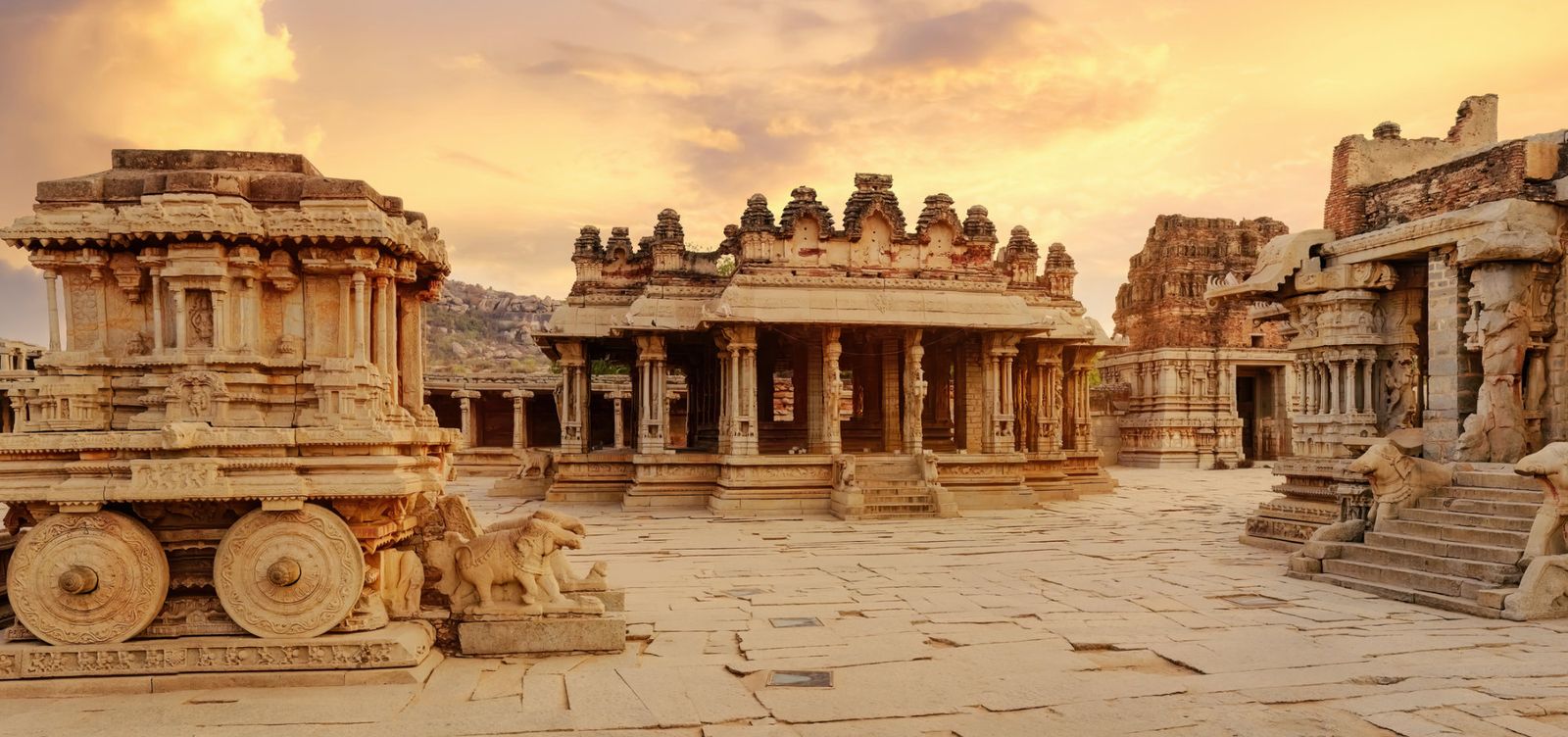
The craftsmanship alone justified the inscription. The stone chariot at the Vittala Temple complex, carved from a single granite block, still shows the delicate turning of its original wheels — an engineering flex from the 16th century that required no mortar, no metal joints, just the patience of sculptors who understood load and balance at a molecular level. Nearby, 56 musical pillars produce distinct tones when struck, each column cut to a precise diameter.
UNESCO also recognized the landscape itself as inseparable from the monuments. The granite boulders predate the empire by billions of years, and the Vijayanagara architects didn't fight the terrain — they built with it, carving shrines directly into rock faces and routing water through natural fissures. Remove the boulders, and the architecture loses its logic. That fusion of human ambition with geological accident is what makes Hampi irreplaceable rather than merely impressive.
When the Light and the Ruins Strike a Deal
October through February is when Hampi becomes itself. The Deccan Plateau heat retreats to something manageable — mid-twenties to low thirties Celsius — and the boulders take on that particular amber glow during golden hour that makes every ruin look engineered for photography. Mornings are cool enough to walk for hours without feeling wrung out. Evenings invite lingering on Hemakuta Hill as the sun drops behind the temple spires.
March changes the contract. By mid-month, temperatures push past 35°C, and by April, the rocks radiate heat long after dark. The landscape bleaches. Your enthusiasm for climbing Matanga Hill at dawn evaporates somewhere around the halfway point when you realize the air is already thick and punishing at 6 a.m. I've watched tourists abandon the Vittala Temple complex after twenty minutes in May, defeated by the open exposure and zero shade.
The monsoon — June through September — is a gamble worth considering if you don't mind unpredictability. The Tungabhadra swells, coracle rides suspend, and some paths turn slippery and impassable. But the landscape transforms. Green creeps over grey granite, the sky turns theatrical, and you'll share the ruins with almost no one. There's a loneliness to monsoon Hampi that suits it — an empire in ruins deserves a little drama overhead.
November remains the sweet spot. Post-monsoon vegetation is still lush, the crowds haven't peaked, and the Hampi Utsav festival often falls in this window, filling the ruins with music, dance, and puppet shows against a backdrop no stage designer could improve upon. Book accommodation early if you're targeting festival dates — the town's limited rooms disappear fast.
Getting There Is Half the Story
Hampi doesn't make it easy. There's no airport, no direct express train, no smooth highway depositing you at the temple gates. You earn this place, and the approach — through scrubby Deccan plateau and granite boulder fields — is part of the reward.
The nearest railway station is Hospet Junction (now officially Hosapete), about 13 kilometers southeast. Trains connect Hospet to Bangalore, Hyderabad, and Goa, though "connect" is generous — the overnight Hampi Express from Bangalore takes roughly ten hours and arrives at an hour only insomniacs appreciate. From Hospet, auto-rickshaws to Hampi Bazaar run about 300 rupees, and local buses make the trip for next to nothing. Take the bus if you want to watch the landscape shift from small-town Karnataka to something ancient and alien in real time.
Coming from Goa, the most popular route is the bus to Hospet via Hubli — a grinding eight-to-ten-hour ride that tests your devotion. Private sleeper buses run overnight and drop you close enough. The roads have improved in recent years, but "improved" is relative when you're bouncing through the Western Ghats on a bus with ambitions beyond its suspension.
Driving from Bangalore takes six to seven hours on NH44 and NH50, and the final stretch through Hospet is the slowest part — trucks, tractors, and an indifference to lane markings that requires either total confidence or total surrender. Many travelers hire a car with a driver, roughly 4,000–5,000 rupees one way, which saves your nerves for the ruins.
One honest suggestion: fly into Hubli (the closest airport, about 140 kilometers away) if time matters more than money. A taxi from there runs about two and a half hours and delivers you with energy still left for exploring.
The Argument for Staying Longer Than You Planned
Two days is the standard recommendation. It's also wrong. Two days lets you tick boxes — Vittala Temple, the Stone Chariot, a sunset from Hemakuta Hill. You'll leave with photographs and the nagging sense that you barely scratched the surface of what's scattered across these 26 square kilometers of granite and ruin.
Three full days is the honest minimum. On the first day, cover the Sacred Centre — the temples clustered along the south bank of the Tungabhadra, where the scale of Vijayanagara's ambition hits hardest. Day two belongs to the Royal Enclosure and the sprawling ruins southeast of the river, where you'll walk for an hour between monuments and encounter almost no one. The third day is for the things no itinerary tells you about: renting a bicycle, getting lost on dirt paths between boulder fields, finding a 15th-century gateway standing alone in someone's banana plantation.
That third day is where Hampi actually happens. The first two days you're a tourist. On the third, you slow down enough to notice how light shifts across the stonework at different hours, how the river sounds different at dawn than at dusk, how a carved ceiling you walked past yesterday reveals an entirely new scene when you look up from a different angle.
If you can stretch to four days, cross the river to the Anegundi side. The pace there is slower, the landscape rawer, and the ancient Durga temple on Hemakuta's lesser-known cousin hill rewards the climb with a solitude the main ruins can't offer anymore. Hampi doesn't reveal itself to people in a hurry. It rewards those who sit still long enough to let the stone speak.
Stone That Refuses to Stay Silent
The Virupaksha Temple is still alive. That's the thing most people don't expect — while nearly everything around it lies in ruin, this temple has functioned without interruption since the 7th century. Priests perform rituals each morning, incense curls through the gopuram's shadow, and an elephant named Lakshmi blesses visitors with her trunk for a coin. It's not a museum piece. It breathes.
Walk south toward the Vittala Temple complex and you'll encounter Hampi's most photographed structure: the stone chariot. It deserves the attention. Carved from granite to resemble a wooden processional cart, it sits in the courtyard with an eerie lightness, as though it might roll forward if you looked away. The musical pillars inside the main hall are stranger still — strike them and each produces a distinct note. Authorities have cordoned most off now, but you can still hear guides demonstrate on the few that remain accessible.
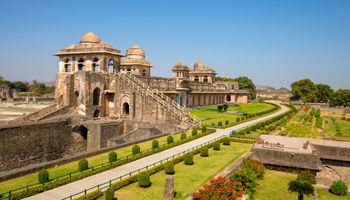
Over in the Royal Enclosure, the Lotus Mahal shifts the mood entirely. Its arched windows blend Islamic and Hindu architectural grammar so seamlessly that scholars still argue over who designed it. The building feels more like a palace pavilion in Isfahan than anything you'd expect in a Deccan capital. Nearby, the Elephant Stables stretch out in a long, domed row — eleven chambers built to house the empire's war elephants, each dome slightly different from the last, as if the architects couldn't resist showing off.
Then there's the Hemakuta Hill group of temples, which most visitors rush past on their way to Virupaksha. Don't. These squat, unadorned Jain and Shaiva shrines predate the Vijayanagara Empire altogether. At sunset, when the boulders around them turn the color of rust, they become the quietest place in Hampi. That silence is worth more than any chariot.
When the Ruins Release You — What Else Hampi Holds Back
At some point, your eyes glaze over from granite. That's when Hampi shifts register. Rent a bicycle from one of the shops near the Virupapura Gaddi side — the flat terrain and empty roads on the northern bank make it one of the few places in India where cycling feels genuinely relaxing rather than life-threatening.
The Tungabhadra River deserves more than a passing glance from a temple platform. Hire a coracle — those absurd, perfectly round basket boats — and let the boatman spin you through the boulder-strewn channels. The ride is short, maybe fifteen minutes, but there's something disorienting about floating past 600-year-old ruins in a vessel that predates them. Here's the counterintuitive part: the coracles feel safer than they look, and the river here is calm enough that even anxious swimmers relax.
Boulder climbing draws a quiet but devoted crowd to Hampi's southern bank. The massive granite formations are a natural playground, and several local operators offer guided sessions for beginners. The rock grips well — rough-grained and dependable under dry hands. Sunset from a high boulder beats any temple viewpoint, frankly, because nobody else is up there.
On the hippie side of the river, small cafes double as live music venues after dark, with traveling musicians cycling through on the backpacker circuit. The vibe owes more to Goa circa 2005 than to any temple town you've visited. Walk through the banana plantations separating these cafes from the riverside, and the shift from sacred to bohemian happens in about two hundred meters.
If you're here on a Tuesday or Friday, the local market near Hampi Bazaar draws farmers from surrounding villages. Skip the souvenir stalls. Watch the trade instead — it tells you more about the region than any monument plaque.
Rice Plates, Sugarcane Juice, and the Best Thali You'll Eat on a Plastic Table
Hampi doesn't do fine dining. What it does is feed you astonishingly well for almost nothing, in open-air shacks where the ceiling is a tarpaulin and the view is a 600-year-old temple. The food here is South Karnataka to its core — rice-heavy, coconut-laced, and unapologetically spicy.
Start your mornings with a plate of idli-vada at any of the small joints along Hampi Bazaar. The coconut chutney comes ground fresh and coarse, and the sambar has a tamarind bite that wakes you faster than coffee. For lunch, the unlimited thali is the move — a steel plate loaded with rice, rasam, two or three vegetable preparations, pickle, papad, and buttermilk. Mango Tree, set right along the Tungabhadra on the Virupapur Gaddi side, serves exactly this kind of meal while you sit cross-legged on floor cushions watching coracles drift past.
The hippie island across the river runs its own food economy — banana pancakes, shakshuka, Israeli salads — catering to the backpacker crowd settled in for weeks. Decent, if predictable. The real eating happens on the temple side, where the dosas are thin as paper and slicked with ghee, and where a full meal rarely costs more than a hundred rupees.
Sugarcane juice vendors park their carts near the main ruins, and on a 40-degree afternoon, a glass pressed with ginger and lime is genuinely restorative. After sunset, the options thin out fast. Hampi shuts down early. Grab dinner by seven, or you'll be negotiating with a shopkeeper for biscuits and bananas. Nobody comes here for the cuisine. But somehow, eating in this place — simple food, slow pace, ancient stone everywhere you look — satisfies in a way no restaurant menu can replicate.
Hampi doesn't ask for your admiration. It simply stands there — granite and sky and the slow brown river — and lets you arrive at awe on your own schedule. I've walked through ruins across four continents, and few places deliver that particular gut-punch of scale meeting silence the way Hampi does at dawn, when the boulders throw long shadows and you're the only human among stones that remember an empire.
Go before the new infrastructure smooths away its rough edges. Go when it's too hot, because the empty temples at noon belong entirely to you. Bring water, sturdy shoes, and no itinerary worth defending. The place will rearrange your plans anyway.
Hampi isn't convenient. It isn't comfortable. It's the kind of place that repays every inconvenience tenfold — and then follows you home.