

The first thing Mumbai gives you is noise. Not the ambient hum of a city waking up, but a full-throated roar — horns layered over horns, the clatter of a BEST bus lurching past, a chai wallah's aluminium cup striking steel somewhere below the din. I stepped off a train at Chhatrapati Shivaji Maharaj Terminus at seven in the morning and was shoulder-to-shoulder with humanity before my feet found the platform. There was no easing in. Mumbai doesn't do preambles.
This is a city that operates at a frequency most places can't sustain for a weekend, let alone centuries. It's simultaneously falling apart and rebuilding itself — a place where a fisherman's village and a glass-walled skyscraper share the same postal code without a trace of irony. The contradictions aren't a flaw. They're the architecture.
What follows isn't a highlight reel. It's an attempt to pin down a city that refuses to sit still: the food that defines it, the contrasts that shape its people, the pockets of unlikely silence, and the after-dark energy that makes every other city's nightlife feel like a dress rehearsal. Mumbai doesn't care whether you're ready for it. But if you lean in — genuinely lean in — it'll rearrange your understanding of what a city can be.
No Gentle Introductions Here
Nobody lands softly in Mumbai. Whether you arrive by air, rail, or road, the city's opening statement is the same: density. Not just of people, though there are twenty-odd million of those, but of information. Every square metre throws more visual data at you than your brain can process — hand-painted signs advertising everything from gold loans to astrology, laundry hanging from Art Deco balconies, stray dogs sleeping with the calm authority of tenured professors beneath banyan roots.
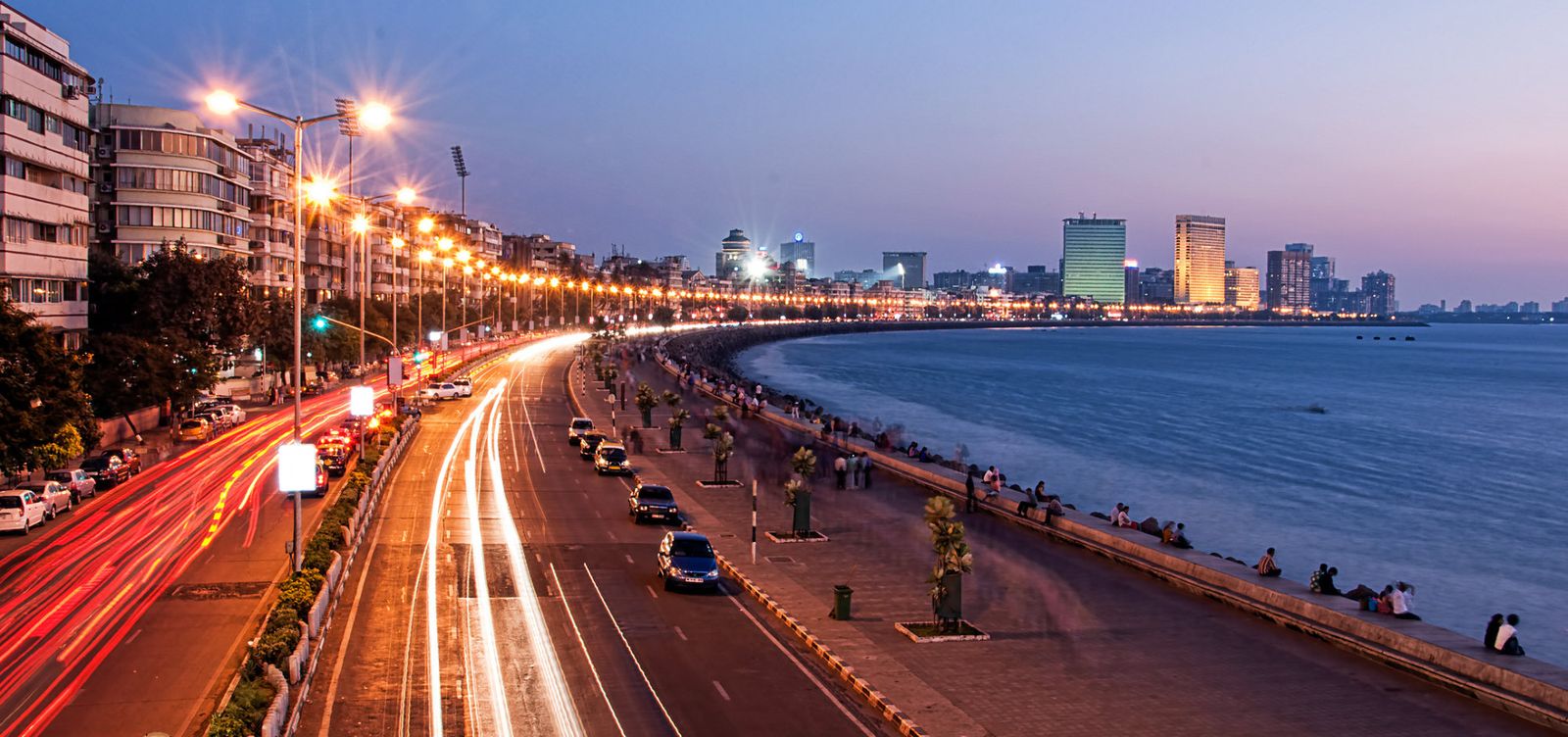
The light is different here too. It's coastal and heavy, a white glare off the Arabian Sea that flattens shadows by midday and turns the stone facades along Marine Drive into something that looks carved from bone. The city's famous crescent of seafront — locals call it the Queen's Necklace after dark, when the streetlights trace its curve — hits differently at noon, when the concrete retaining wall is lined with couples, loners, and men selling sliced raw mango dusted with red chili powder and black salt.
What catches you off guard isn't the scale. You expect that. It's the intimacy. A city this vast has no business being this personal, yet within an hour of arriving, a stranger will have offered you directions, an opinion on the best vada pav within walking distance, and possibly their phone number in case you get lost. The aggression is structural — the traffic, the crowds, the sheer volume of it all. The people, paradoxically, are softer than the city they've built.
Here's the counterintuitive part: Mumbai's chaos has a legibility to it. Stand at a junction long enough and patterns emerge — the auto-rickshaws cluster, the pedestrians surge in waves timed to invisible signals. There's a grammar to the disorder. Learning to read it is the first real step toward understanding the place.
Seven Million Commuters and a System Held Together by Instinct
Mumbai's local train network carries over seven million passengers a day. Let that number sit. That's more than the entire population of Denmark being funnelled through a colonial-era rail system every twenty-four hours. The trains are the city's circulatory system — miss the 8:47 from Andheri and your entire morning recalibrates. During rush hour, bodies compress into carriages with an efficiency that would make a Tetris champion weep.
I've ridden these trains at peak times, gripping the overhead bar with one hand, my bag crushed against someone's shoulder, the wind screaming through open doors as the city blurred past. It's terrifying until it isn't. There's an unwritten choreography: you step aside for the person exiting two stops early, you shift your weight when the train lurches, you learn which side the platform falls on before the announcement. Nobody teaches you this. You absorb it or you don't move.
The roads are another negotiation entirely. Auto-rickshaws north of Bandra operate on a meter — theoretically. Taxis south of Bandra still run on a tariff card that drivers keep folded in the glovebox, a relic that somehow persists alongside GPS navigation. But the real revelation is walking. Mumbai's footpaths are obstacle courses of broken paving, street vendors, and sleeping bodies, yet walking is how the city reveals its layers — you catch a Portuguese-era doorway on a side street in Bandra, the scent of fresh jasmine garlands outside a temple in Dadar.
The trick is surrendering the illusion of control. You will not arrive on time. You will get sweaty. But you'll see more of actual Mumbai in one chaotic commute than in a week of air-conditioned transfers.
The Vada Pav Verdict: Mumbai Eats Like It Means It
There's a stall outside Kirti College in Dadar that sells vada pav — a spiced potato fritter jammed into a soft bread roll with garlic chutney and a fried green chili on the side. It costs less than a bottle of water. It's better than most meals I've eaten in restaurants charging fifty times the price. The bun tears slightly as the chutney bleeds through, the fritter crunches and then gives way to turmeric-yellow warmth, and the green chili — if you're brave enough — detonates about four seconds after you bite into it.
Mumbai's street food isn't a sideshow. It's the main event. The pav bhaji at Juhu Beach, where a slab of butter melts across a spiced vegetable mash on a flat griddle, carries a smoky sweetness no kitchen can replicate — partly because the ocean wind carries salt into the cooking. Bhel puri vendors on Chowpatty assemble each plate to order, tossing puffed rice with tamarind and coriander in a rhythm that's closer to percussion than cooking.
The sit-down institutions matter too. Britannia & Co. in Ballard Estate serves a berry pulao — basmati rice studded with Iranian barberries and layered with chicken — that's been on the menu since the restaurant opened in 1923. The berries are tart, almost sour, against the fragrant rice, and the dish arrives on chipped crockery under ceiling fans that look original. Nothing about it has been updated. Nothing needs to be.
What surprises most people: Mumbai's best meals don't require a reservation. They require standing on a pavement at the right hour, pointing at the right thing, and trusting a cook whose name you'll never know.
The Antilia Problem: Inequality as Urban Geography
Stand on Pedder Road in South Mumbai and look up. Antilia — the Ambani family's twenty-seven-story private residence — rises like a vertical rebuke to the skyline, a billion-dollar tower with helipads, a ballroom, and reportedly a staff of six hundred. Now look down. Across the road, past the security barriers, life continues at pavement level: a cobbler stitches sandals, a woman sells marigolds from a plastic sheet, a child naps on a folded blanket in the shade of a parked car. Neither world acknowledges the other's absurdity.
This duality defines Mumbai more than any landmark ever could. Malabar Hill's silent, gated mansions overlook the Banganga Tank, a thousand-year-old freshwater pool surrounded by crumbling temples where priests still perform rites. The glass towers of Lower Parel — repurposed textile mills, every one — cast long shadows on the narrow lanes of Worli's fishing villages, where Koli women dry bombil on bamboo racks and the air hangs thick with brine and smoke.
Dharavi complicates the narrative further. Routinely called Asia's largest slum, it's actually one of Mumbai's most productive neighbourhoods — a dense network of micro-industries turning over an estimated annual revenue in the hundreds of millions, making everything from pottery to recycled plastics to leather goods. Walking through its lanes, you hear sewing machines, smell fresh bread from communal ovens, and realize that the word "slum" carries none of the energy or enterprise you're witnessing.
Mumbai doesn't hide its inequalities. It stacks them vertically, laterally, sometimes within the same city block. That honesty is unsettling. It's also, in a way no brochure would phrase it, the most truthful thing about the place.
Silence in a City That Forgot How to Whisper
At six in the morning, before the city remembers what it is, Sanjay Gandhi National Park is almost implausibly quiet. A hundred square kilometres of tropical forest inside a metropolis — leopards live here, actual leopards, an estimated forty of them stalking through the green canopy while suburban trains rattle past the park's boundary. The Kanheri Caves, carved into basalt hillsides over two thousand years ago, sit inside this forest: Buddhist viharas with stone beds and rain-collecting cisterns, their walls darkened by centuries of lampblack. You can stand in one of these caves and hear nothing but birdsong and your own breathing. In Mumbai. It feels impossible.
The Oval Maidan offers a different kind of quiet — not silence, exactly, but a slowing down. On weekday afternoons, cricket matches unfold on its patchy grass while the gothic spires of the Bombay High Court and the Art Deco facades of Marine Drive face each other across the field like rival architectural arguments. Nobody hurries here. The bowler ambles in, the batsman taps his crease, and time briefly bends toward something gentler.
Then there's the Bandra-Worli Sea Link at dusk, seen from the Worli seaface promenade. The cable-stayed bridge stretches across Mahim Bay in a clean sweep of engineering, and the light at that hour turns the water beneath it copper and grey. Fishermen cast nets from the rocks below your feet. The scale shrinks you. That's the relief.
Mumbai's escapes don't require leaving the city. They require knowing where the city forgets to perform — and arriving before the crowds remember these places exist.
What Happens When the Rest of India Sleeps
Around ten at night, when most cities are winding toward sleep, Mumbai shifts into a different register. The traffic thins just enough to let the taxi move, and suddenly you're sweeping down Marine Drive with the windows down, the sodium-lit arc of the seafront unspooling beside you, wet salt air filling the car. This is the city's most cinematic hour.
The bars tell the story. Colaba has its dive institutions — Leopold Cafe, still bearing the bullet holes from the 2008 attacks in its walls, now filled with backpackers nursing Kingfishers and arguing about tomorrow's itinerary. Lower Parel's rooftop lounges operate at a different frequency: cocktails mixed with kokum and fennel, views across the mill district's illuminated cranes and half-built towers. In Bandra, the lanes around Pali Hill host bars that change concept every eighteen months because Mumbai's nightlife audience gets bored faster than anywhere I've seen.
But the real after-dark experience is the street. Mohammed Ali Road during Ramadan, when food stalls run until three in the morning, serving malpua dripping with rabri and kebabs that have been slow-cooking since afternoon. Girgaon Chowpatty at midnight, where families still sit on the sand eating kulfi, unbothered by the hour. A paan stall in Grant Road where the owner constructs each betel leaf with surgical precision, folding in rose petal jam and candied fennel seeds.
Here's what nobody tells you: Mumbai after midnight is safer than you'd expect, and more alive than you'd imagine. The city's insomnia isn't a lifestyle choice. It's metabolic. The place simply cannot stop.
What Mumbai Leaves Behind in You
Mumbai takes your patience first. It takes your personal space, your schedule, your assumption that a two-kilometre journey should take less than forty-five minutes. It takes your certainty that you understand how cities work. The sensory overload doesn't relent — it simply becomes the baseline, and you realize that what you mistook for chaos was actually a civilization operating at higher RPM than you were built for.
What it gives back is harder to name. There's a recalibration that happens. After Mumbai, other cities feel like they're running at half speed. You find yourself more alert, more tolerant of disorder, more attuned to the human signals beneath the noise. The woman who made your morning chai near Churchgate — the one who remembered you took less sugar on the second day — she stays with you. So does the sound of the call to prayer drifting across the rooftops of Bhendi Bazaar at dusk, competing with a Bollywood playback song from a tailor's radio two floors below.
The city doesn't sentimentalize itself. It doesn't need your approval. A Marathi proverb roughly translates to: "Mumbai doesn't give you time to cry." There's a toughness in that, but also a strange kindness — the insistence on forward motion, on resilience as a default setting rather than an achievement.
You leave Mumbai exhausted. You also leave it reconfigured. That's not a transaction most cities can offer, and it's the reason people keep coming back to one that, on paper, should be unliveable. Something here works. Not smoothly. Not quietly. But completely.
Don't come to Mumbai looking for beauty. Come looking for truth — about cities, about survival, about the astonishing elasticity of human beings sharing space. The beauty arrives uninvited, in moments you didn't plan for: a sunset through the scaffolding of a construction site, a stranger's laughter on a crowded train, the particular amber of chai poured from a height into a small glass. You won't Instagram most of it. That's how you'll know it was real.
Mumbai doesn't wait for you to be ready. Go anyway.