

For decades, Rajasthan's tourism pitch was simple: come see where kings lived. It worked. The state drew millions to Jaipur's Amber Fort, Udaipur's lakeside palaces, Jaisalmer's sandstone citadel. But sometime around the early 2010s, a shift began — not from the top down, but from operators on the ground who understood that Rajasthan's geography was being criminally underused.
The Thar Desert covers roughly 200,000 square kilometers of the state's western half. The Aravalli Range — one of the oldest mountain chains on Earth — slices through its center. To the south and east, forested plateaus hold tiger reserves and leopard country. Between all of it: rivers, lakes, and canyons that most travelers drive past without a second look. This is terrain built for adventure, not just admiration.
What changed things was infrastructure, and a generation of young Rajasthani entrepreneurs who'd rather run a rock-climbing outfit than another heritage hotel. Jodhpur now has certified rappelling instructors. Pushkar's thermals attract serious paragliders. Jaipur has hot air balloon operations that would hold up anywhere in the world. The state government, to its credit, backed adventure tourism with licensing frameworks and safety standards that gave the industry legitimacy.
Here's the counterintuitive part: the heat actually helps. Rajasthan's dry climate means reliable flying conditions, predictable thermals, and clear skies nearly year-round from October through March. The same aridity that makes the desert unforgiving also makes it one of the most dependable adventure environments in South Asia. The kings would have approved.
1. Where the Dunes Breathe: A Night in the Thar
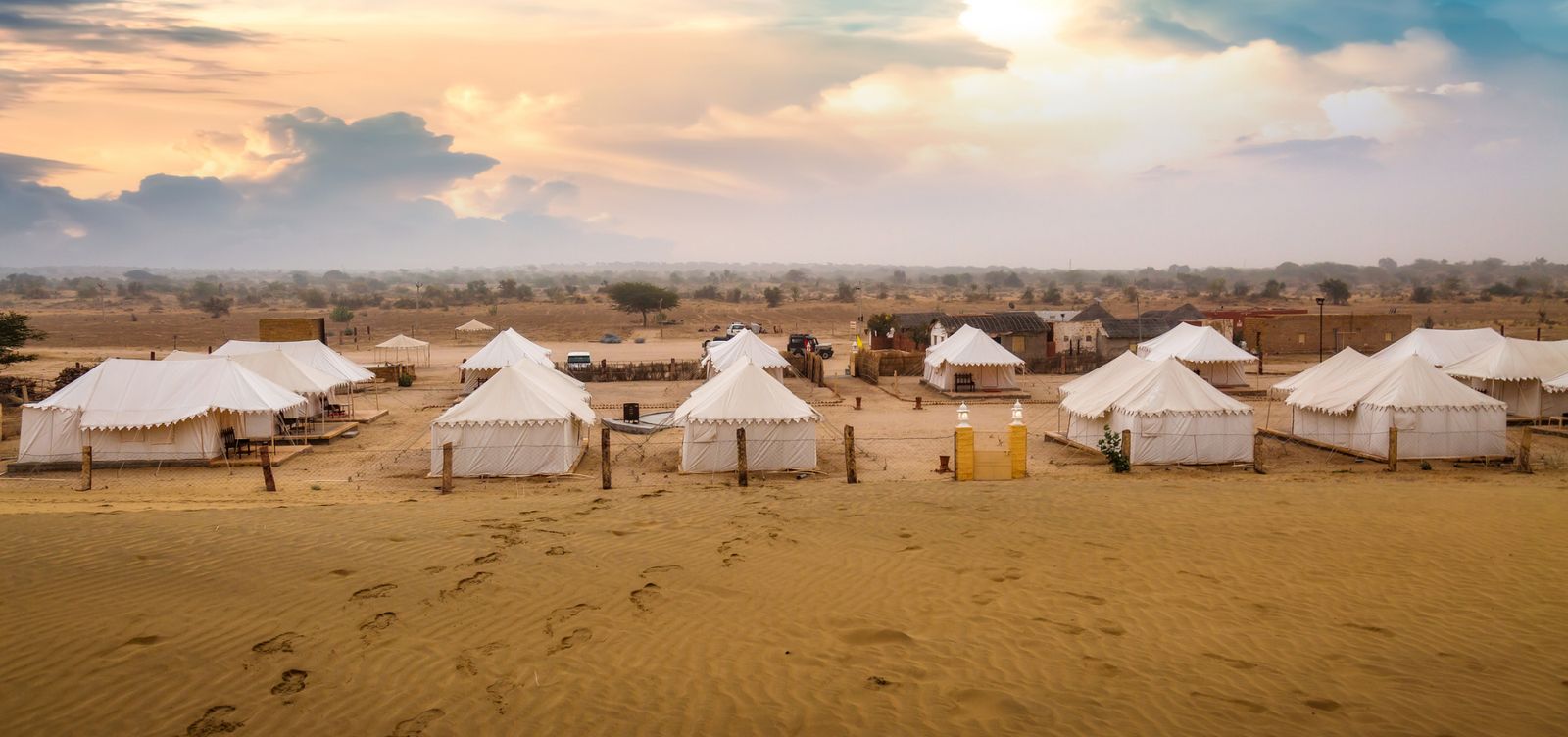
A desert safari in the Thar isn't a zoo visit on sand. It's a slow, deliberate confrontation with emptiness — the kind that makes your phone feel absurd in your pocket. The real thing starts from Jaisalmer or the Sam sand dunes, about 40 kilometers west, where the landscape finally commits to being a desert rather than just threatening to become one.
You ride out on camelback in the late afternoon, when the sand cools from white-hot to merely warm underfoot and the shadows of the dunes stretch into theatrical proportions. The camels move with an arrogant, rocking gait that takes twenty minutes to stop hating and an hour to love. Your guide — usually from the local Bhil or Rajput community — knows the dunes by shape, not by name, because the shapes change.
Night is the point. Camp gets set up on the leeward side of a high dune, and once the sun drops, the temperature follows fast. The sky out here is so dark it almost hurts — you can see the Milky Way with the naked eye, a milky smear so vivid it looks fake. Dinner is dal-baati-churma cooked over an open fire, the baati blackened and cracked, the ghee poured without restraint.
What surprises most people is the sound. Or rather, the total absence of it. No generators, no traffic hum, no ambient anything. Just wind and the occasional grunt of a camel settling down for the night. It's not comfortable, exactly. The sand gets everywhere — in your hair, your food, the folds of your blanket. But comfort was never the point. The Thar asks you to be small for a while. You should let it.
2. Flying Over Forts: Paragliding the Aravalli Thermals
Jodhpur's paragliding scene doesn't get the attention it deserves, mostly because nobody expects to fly in the desert. But the thermals rising off the Aravalli foothills near the city create lift conditions that pilots describe, without exaggeration, as exceptional. The primary launch sites sit on ridges overlooking the Blue City, which means your first few seconds of flight include a view of Mehrangarh Fort from an angle no Mughal emperor ever saw.
Pushkar is the other serious option, particularly during the cooler months between October and February when air currents stabilize into clean, predictable patterns. Tandem flights here last fifteen to twenty-five minutes depending on conditions, and the landing zones spread across open farmland where the worst obstacle is a startled goat. Operators in both cities now follow standardized safety protocols, with pre-flight briefings that actually mean something.
The sensation itself is quieter than you'd expect. No engine noise, no rotor wash — just the creak of the harness and the whisper of nylon overhead. You feel the thermal as a gentle push from below, like an invisible hand lifting you higher. Jodhpur's brown-and-blue geometry unfolds beneath, and from altitude, the city's famous painted walls read as a single blue wash against the desert beige.
Here's what nobody tells you: the landing is the best part. You come in low over scrubland, feet dangling, the ground rushing up, and then you're running — actually running — until the canopy deflates behind you and it's over. The whole experience reframes Rajasthan from something you look at to something you move through, three-dimensionally. It costs a fraction of what you'd pay in Himachal or Goa for comparable flights.
3. The Silence Up There: Floating Over Rajasthan in a Balloon
Hot air ballooning in Rajasthan is an exercise in enforced patience — you rise slowly, you drift where the wind decides, and you watch a landscape that usually overwhelms at ground level finally organize itself into something comprehensible. The main operation runs out of Jaipur, with flights launching at dawn from open fields near the city's outskirts. The timing isn't optional; the calm morning air is the only safe window before thermals begin to churn.
What makes Jaipur's ballooning distinct from, say, Cappadocia or the Serengeti is context. You don't float over anonymous countryside. You float over the Amber Fort corridor, over the geometric gardens of Jal Mahal's surroundings, over rose-pink walls that look exactly the shade the brochures promise — but only from the air. The Aravalli hills frame the western horizon in a jagged blue line. Below, the morning routines of a city of three million play out in miniature: tea stalls firing up, school buses threading through lanes, cows establishing territorial rights on roads.
Pushkar also hosts balloon flights during its famous camel fair in November, and the aerial view of ten thousand camels and a temporary city of tents is genuinely surreal — like a medieval encampment painted by a fever dream.
The flight itself lasts roughly an hour. The burner fires in sharp, loud blasts that contrast violently with the silence between them. When it's quiet, you can hear dogs barking from villages below, the bells of temple morning prayers carrying upward with startling clarity. You land wherever the wind puts you, which usually means a farmer's field and a champagne toast among mustard crops. It's theatrical. It's supposed to be.
4. Vertical Ambitions: Scaling the Aravalli's Rocky Spine
Rock climbing in Rajasthan happens on some of the oldest geological formations on the planet. The Aravalli Range dates back roughly 350 million years, and erosion has carved its granite and quartzite faces into formations that would make a climbing route setter weep with gratitude — natural overhangs, clean crack systems, and friction slabs that grip like sandpaper under a rubber shoe.
The action centers around a few key spots. Near Jodhpur, the cliffs around Deh and the rocky outcrops below Mehrangarh Fort offer routes ranging from beginner-friendly to genuinely demanding. Kumbhalgarh, famous for its wall-that-isn't-the-Great-Wall-of-China, sits amid forested hills where climbing and rappelling operations use natural cliff faces with drops of forty to eighty feet. Around Mount Abu, Rajasthan's only hill station, the cooler temperatures and denser vegetation create a completely different climbing atmosphere — almost temperate, a word you don't expect to use in this state.
Rappelling tends to draw beginners more than climbing does, largely because the psychological challenge is immediate and legible: you lean backward over an edge, and gravity does the rest. The sensation of walking down a cliff face while the Aravalli landscape spreads out below you is primal. Your brain objects. Your harness disagrees.
What's genuinely surprising is how few people know about this. The same travelers who'll queue for hours at a fort entrance will drive right past climbing-grade rock without a glance. The operations running here are small, personal — often a guide, a rope bag, and a thermos of chai at the base. No gift shops. No waivers thicker than a novel. Just rock, gravity, and a very honest assessment of your grip strength.
5. Pedaling Through the Pink City (and Beyond)
The best way to understand Jaipur's old city isn't from an auto-rickshaw. It's from a bicycle seat, where the pace is slow enough to notice things — the carved jharokha windows three stories up, the sweet shops stacking jalebis at six in the morning, the particular chaos of a cow deciding to change direction at an intersection. Several local operators now run guided cycling tours through the old walled city at dawn, when the light turns the pink sandstone genuinely pink rather than the dusty salmon it becomes by noon.
Outside the cities, mountain biking in the Aravallis is a different animal entirely. The trails around Udaipur wind through dry deciduous forest, past small Bhil tribal settlements, along reservoir edges where kingfishers work the shallows. Near Bundi — a town that deserves ten times its current visitor count — dirt tracks connect stepwells and crumbling havelis through countryside so quiet you can hear your own tires on gravel from a hundred meters away.
The terrain is forgiving enough for intermediate riders but interesting enough to keep experienced cyclists honest. Short, sharp climbs give way to fast descents on packed earth, and the lack of traffic on rural roads means you can actually look around without risking your life. The winter months between November and February offer ideal temperatures — mornings start cool, almost cold, before the sun asserts itself by ten.
One detail that stays with me: on a rural stretch near Pushkar, I stopped to refill my water bottle at a village hand pump. A woman filling her brass vessels looked at my spandex and helmet, considered the situation carefully, and laughed — not unkindly, but with the certainty that I was doing something fundamentally unnecessary. She wasn't wrong.
6. Where the Leopard Watches: Jungle Camps and Wildlife Drives
Rajasthan's wildlife doesn't have the marketing budget of its palaces, which is precisely why it remains compelling. Ranthambore National Park, three hours from Jaipur, is the headliner — a former royal hunting ground where Bengal tigers walk through the ruins of a tenth-century fort with the proprietary calm of landlords inspecting their property. The park's tiger density is among the highest in India, and sightings, while never guaranteed, happen with startling regularity during the dry months of April and May when animals converge on shrinking water sources.
But Ranthambore isn't the only game. Sariska Tiger Reserve, closer to Jaipur and far less crowded, holds its own tiger population along with leopards, sambar deer, and langur monkeys whose alarm calls — a sharp, barking cough — are often the first sign that a predator is near. At Jawai, in the Pali district, leopards have adapted to living alongside marble miners and pastoral communities in a coexistence that sounds impossible until you see a leopard lounging on a granite boulder fifty meters from a working quarry.
Jungle camping at these reserves means tented accommodations that range from basic to absurdly luxurious, depending on your budget and your feelings about thread counts in the wilderness. The basic camps are better. You hear more. The nighttime soundtrack of a Rajasthani forest — the repeated call of the Indian nightjar, the rustle of porcupines in dry leaves, the distant territorial roar of a tiger carrying across the valley — is worth more than Egyptian cotton.
Dawn safaris start before first light, when the forest is cold and the jeep's headlights catch the reflective eyes of deer standing motionless in the mist. Everything feels provisional. The forest decides what you see, not the other way around.
7. Mallets, Hooves, and Controlled Chaos: Polo, Rajasthani Style
Polo was born here. Not metaphorically — the modern Indian version of the game evolved directly from the mounted cavalry exercises of Rajput warrior kings, and Rajasthan's royal families still maintain some of the country's oldest polo grounds. In Jaipur, the Rambagh Polo Club has hosted matches since the 1930s, and during the winter season, you can watch chukkers played by riders whose grandfathers played against British viceroys.
Horse polo remains largely a spectator sport for visitors, unless you're willing to commit weeks to training. Camel polo, however, is a different proposition entirely — less exclusive, more absurd, and infinitely more entertaining. Played primarily during the Jaisalmer Desert Festival and the Pushkar Camel Fair, it follows modified polo rules adapted to the inconvenient fact that camels do not want to play polo. They stop without warning. They turn with the aerodynamic grace of a shipping container. The riders work heroically against their mounts' total indifference to competition.
Some operators in Jaisalmer and Jodhpur now offer camel polo experiences for small groups, with brief instruction followed by an actual match. The instruction, honestly, is beside the point — within five minutes, everyone abandons technique in favor of simply staying mounted while swinging a mallet. The camels tolerate this with an expression of philosophical contempt.
What makes both forms of polo worth seeking out isn't the sport itself but its rootedness. This isn't a transplanted activity or an imported thrill. The horses are Marwari breeds with their distinctive inward-curving ears. The grounds are often attached to old palaces. The whole thing carries a weight of continuity that adventure sports rarely have. You're not just playing a game. You're participating in an argument about horsemanship that's been running for centuries.
8. Water in the Desert: Rajasthan's Improbable Lakes
Tell someone you went kayaking in Rajasthan and they'll check your geography. But Udaipur sits at the center of a lake system that makes the city function less like a desert outpost and more like a freshwater Venice built by stubborn optimists. Lake Pichola, Lake Fateh Sagar, Jaisamand Lake — these aren't ponds. They're substantial bodies of water surrounded by hills, palaces, and the kind of dramatic backdrops that make every photo look professionally composed.
Kayaking and paddleboarding on Lake Pichola put you at water level with the Lake Palace and The City Palace ghats, an angle that reveals the engineering behind Udaipur's seemingly effortless beauty — the massive retaining walls, the water intake systems, the careful gradient of the ghats descending into still water. Motor-free watercraft keep the experience quiet, which matters when you're paddling past a four-hundred-year-old palace at sunrise.
At Jaisamand Lake — one of the largest artificial lakes in Asia, built in the seventeenth century by Maharana Jai Singh — motorboating and speed boating operate during the winter tourist season. The lake's scale is disorienting; the far shore disappears into haze, and islands dot the surface like afterthoughts. Near Kota, the Chambal River offers boat safaris where the main attraction is the gharial — a critically endangered, impossibly long-snouted crocodilian that looks like evolution's first draft, left in by accident.
The surprise of water sports in Rajasthan is precisely why they work. Expectation matters in travel. You arrive braced for sand and heat, and instead you're floating on a lake watching kingfishers dive while a palace glows amber on the shore. The contrast does half the work.
9. Walking History Into Your Legs: Treks and Heritage Trails
The Aravalli Range doesn't announce itself like the Himalayas. It doesn't tower or intimidate. Instead, it presents a landscape of medium difficulty and maximum atmosphere — rolling ridges covered in dry thorn forest, punctuated by medieval watchtowers, crumbling walls, and the occasional forgotten temple where monkeys have taken permanent residence. Trekking here is less about altitude and more about texture.
The Kumbhalgarh to Ranakpur trek is the standout — a two-to-three-day walk through the Aravallis that connects one of India's most impressive fortifications (Kumbhalgarh's thirty-six-kilometer wall) to one of its most extraordinary Jain temples (Ranakpur's 1,444 individually carved marble pillars, no two alike). The trail passes through patches of forest where leopards are present but wisely invisible, past Bhil villages where trail hospitality means chai and an interrogation about where you're from and why you're walking.
Heritage walks within cities offer a different kind of physical engagement. Jaipur's old city walks decode the grid-plan layout of a city designed in 1727 by Maharaja Sawai Jai Singh II, who was also an astronomer — which explains why the city's orientation is calibrated to cardinal directions with mathematical precision. In Jodhpur, walking the lanes below Mehrangarh Fort means navigating a maze of blue-painted houses where the blue originally signaled Brahmin households but has since been adopted by everyone, because it works.
Bundi's heritage walks are the most underrated. The town's stepwells — there are dozens — descend into the earth in geometrically perfect symmetry, each one a small masterpiece of hydraulic engineering disguised as architecture. Walking between them on a cool morning, through streets where the only traffic is a man on a bicycle carrying an improbable quantity of marigolds, is one of the quietest pleasures Rajasthan offers.
10. The Leap of Faith: Zip Lining Across Rajasthani Forts
Zip lining at Mehrangarh Fort in Jodhpur is probably the single most visceral tourist experience in Rajasthan, and it works because of context rather than height. The six zip lines operated by Flying Fox descend from the fort's massive battlements across the rocky ravine below, covering about a kilometer and a half total. The drops aren't extreme by global standards — the longest line runs around three hundred meters. But you're not zipping over anonymous jungle canopy. You're zipping over the walls of a fort that's been standing since 1459, with the Blue City spreading out below like a spilled paint can.
The route takes you along the fort's exterior, passing close enough to the sandstone walls to see the chisel marks. From the lines, you look down on the rooftops of houses that have been inhabited continuously for five centuries. Laundry dries on lines strung between medieval battlements. Satellite dishes cling to walls built to withstand cannon fire. The juxtaposition is constant and wonderful.
Neemrana Fort, between Delhi and Jaipur, offers a similar zip line experience across its restored fifteenth-century ramparts. It's more polished, more managed, and lacks Jodhpur's raw, living-city backdrop — but it makes a convenient stop on the Delhi-Jaipur highway and the lines themselves are well-engineered and professionally operated.
What stays with you isn't the speed or the height. It's the sound. Halfway across the longest line at Mehrangarh, the pulley hum fades and for a few seconds you're gliding in near-silence, the fort behind you, the desert ahead, and five hundred years of history directly beneath your feet. Then gravity reasserts itself, and you land on a platform where a guide unclips your harness and offers you a glass of water as if you'd just done something perfectly ordinary.
Rajasthan doesn't need the adventure tourism pitch. Its forts and palaces will keep drawing crowds regardless. But the state's geography — that vast, varied, geologically ancient terrain — has always demanded more than passive admiration. It demands participation. The ten experiences here aren't add-ons or diversions from the "real" Rajasthan. They are the real Rajasthan: physical, confrontational, occasionally uncomfortable, and more honest than any palace tour. Book the camel safari. Clip into the zip line. Get on the bicycle at dawn. You'll come home with sand in your luggage and a version of Rajasthan that no photograph could have given you.