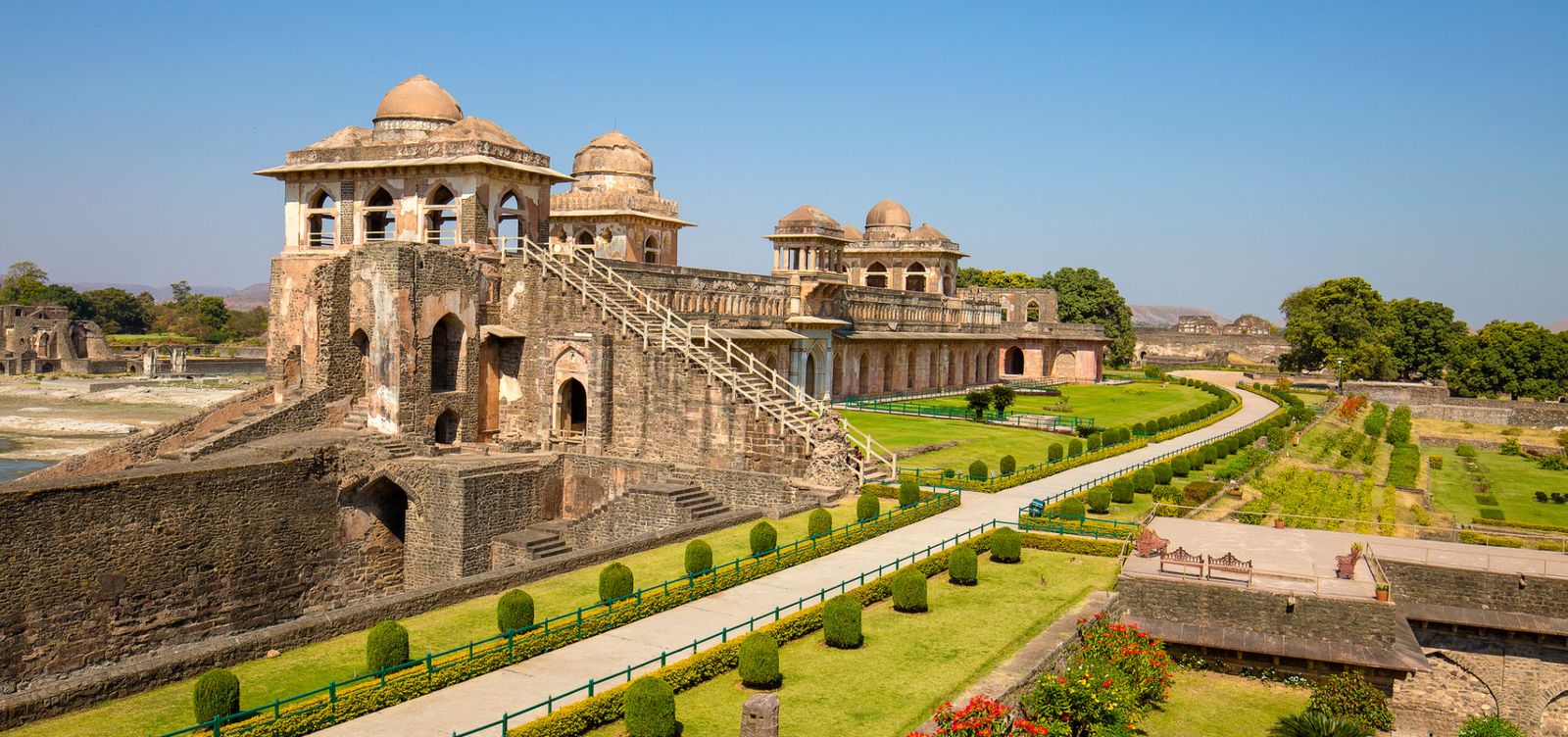


The first thing you notice about Mandu isn't a monument. It's the silence. A silence so total that when a langur crashes through the canopy of a banyan tree, you flinch as if someone's fired a gun. This plateau fortress, sprawled across 45 square kilometers of the Vindhya Range in Madhya Pradesh, doesn't announce itself the way Rajasthan's forts do — no postcards, no Instagram campaigns, no camel rides at the gate. Mandu simply sits there, ancient and indifferent, waiting for you to figure it out on your own.
I've walked its baobab-lined paths in every season — the monsoon months when the gorges fill with waterfalls that appear from nowhere, and the April heat when the stone pavilions radiate warmth long after sundown. Each time, the place reveals something different. Not because it changes, but because I do.
This piece isn't a monument checklist. It's an attempt to show you the Mandu that lives between the ticket counters — the tribal villages inside the fort walls, the histories that complicate the romance, the corners where no tour bus stops. If you're looking for a quick itinerary, scroll elsewhere. If you want to understand why this place gets under people's skin and stays there, read on.
The Fortress That Punishes Impatience
Mandu was not built for the weekend tripper who races from monument to monument with a phone held vertically. Its ruins are spread across a forested plateau so vast that you can drive for twenty minutes between sites and see nothing but scrubland and the occasional goatherd. There's no efficient route. No logical loop. The geography itself demands that you slow down or miss the point entirely.
Most visitors arrive from Indore — about 90 kilometers away — treat the place as a day trip, photograph Jahaz Mahal at noon when the light is flat and brutal, and leave believing they've "done" Mandu. They haven't. They've driven through it. The difference matters.
Mandu rewards the traveler who stays two nights. Not one — two. The first evening, you're still recalibrating. By the second morning, something shifts. You stop looking for the next monument and start noticing the spaces between them: the ravine behind Hoshang Shah's tomb where local kids swim in the rains, the particular way afternoon light enters the arched windows of the Hindola Mahal, the sound of a bicycle bell echoing across stone that Sultans once walked.
Here's the counterintuitive truth: Mandu's best moments aren't at its famous structures. They're on the unnamed paths between them, where wild custard apple trees grow over crumbling walls and the air smells of dry earth and neem. The place functions almost as a test of attention. Rush, and you'll leave with photographs that look like everyone else's. Linger, and you'll take home something a camera can't hold.
One night, I sat on the edge of the plateau near Rewa Kund as the sun dropped behind the Narmada valley. No other person in sight. No sound except wind. That moment cost me an extra day and a rescheduled train. It was worth every hour.
Before Sultans, Before Stones
Long before the first Islamic dynasty raised a single arch here, this plateau belonged to the Paramara Rajputs, who called it Mandapa-Durga — the "hall of forts." The name Mandu is a contraction, a linguistic shorthand that erased centuries of Hindu and Jain habitation in a single syllable. Most histories begin with the Sultanate period, as if nothing before it mattered. That's a convenient omission, not an accurate one.
The Paramaras ruled from roughly the 10th to the 13th century, and traces of their presence still surface if you know where to look. Fragments of temple sculpture appear embedded in later mosque walls — not as decoration, but as building material. The great Sultanate builders were pragmatists. When they needed dressed stone, they used what was available, and what was available was often sacred to someone else. This isn't unique to Mandu — it happened across medieval India — but here the evidence is unusually visible.
Before even the Paramaras, the plateau was likely significant to tribal communities. The Bhil and Bhilala peoples, who still inhabit the area, have oral histories that predate any stone inscription. Their relationship with this land isn't architectural. It's ecological and spiritual — tied to specific trees, water sources, and seasonal patterns rather than monuments.
Walking through Mandu with this layered awareness changes everything. That wall you're photographing isn't just Sultanate architecture. It's a palimpsest — written over, scraped clean, written over again. The ground beneath your feet holds more stories than any single plaque can accommodate. The Archaeological Survey of India does its best, but plaques deal in dynasties and dates. They don't have room for the unnamed people who actually quarried, carried, and laid the stone.
The Chapters That Got Edited Out
The signboards at Mandu tell you that Hoshang Shah built this, that Ghiyasuddin Khilji expanded that. Clean narratives. Neat timelines. What they don't tell you is how the sausage was made — and in medieval statecraft, sausage-making involved considerable blood.
Take Ghiyasuddin Khilji, the sultan most associated with Mandu's golden age. He's remembered for the Jahaz Mahal and for maintaining a harem of reportedly 15,000 women. Guidebooks mention this number with something approaching admiration, as if it were an achievement in logistics. What it actually represents — the systematic acquisition of women through conquest, purchase, and tribute — rarely gets the scrutiny it deserves. The Jahaz Mahal, that graceful ship-shaped palace between two lakes, was pleasure architecture built on coercion. Both things are true simultaneously.
His son, Nasiruddin, murdered him. Then Nasiruddin's own nobles plotted against him. The Khilji dynasty of Malwa wasn't a golden age — it was a series of violent power transfers punctuated by extraordinary building campaigns. The architecture survived; the humans who built it were mostly expendable.
The Mughal conquest added another layer of erasure. When Akbar took Mandu in 1562, the Sultanate's independent identity was absorbed into a larger imperial narrative. The monuments became way stations for Mughal emperors on campaign, not the capitals they once were. Jahangir visited and left descriptions of the baobab trees, seemingly more interested in botany than in the political history crumbling around him.
Knowing this doesn't diminish Mandu. It deepens it. Every archway carries the weight of its own contradictions — beauty and brutality, craftsmanship and conquest. The signboard version is easier. The real version is more interesting.
The Famous Faces of the Plateau
You already know about Jahaz Mahal. Every Mandu article leads with it, and fairly — the long, narrow palace reflected in its flanking lakes is genuinely arresting, particularly in the monsoon when the water rises and the building appears to float. But go early. By ten in the morning, tour groups from Indore have arrived, and the atmosphere shifts from contemplative to carnival.
Hoshang Shah's tomb deserves more time than most visitors give it. Completed in the mid-15th century, its white marble dome and restrained geometry are said to have influenced the design vocabulary that would eventually produce the Taj Mahal. Shah Jahan reportedly sent his architects to study it. Stand inside and look up at the dome's interior — the proportions create an acoustic stillness that muffles the outside world. It's less a tomb than a meditation chamber.
The Hindola Mahal — the "Swinging Palace" — gets its name from the inward lean of its massive walls, which create the optical illusion of movement. The engineering is remarkable, but what struck me most was the quality of light inside. The T-shaped windows filter afternoon sun into geometric patterns on the floor that shift as hours pass. Bring a book. Sit on the stone ledge. Stay awhile.
Rani Roopmati's Pavilion, perched at the southern edge of the plateau, offers a view down to the Narmada valley that earns its reputation honestly. The pavilion itself is modest — a few domed chambers, nothing ornate. Its power is entirely about placement. Someone chose this exact spot knowing that the land fell away dramatically here, and that choice, six centuries later, still works. The valley below stretches into haze, and on clear winter mornings, you can trace the Narmada's silver thread through the plains.
The Mandu That Exists Between the Ticket Counters
Nobody tells you about the baobab trees. Mandu has the largest concentration of baobabs in India — massive, bulbous African trees whose presence here remains botanically debated. Some theories credit Arab traders; others point to the Sultanate's trade connections with East Africa. Whatever the origin, these trees are surreal. Their swollen trunks, some over a thousand years old, look like they belong on a different continent. Because they do.
The cave systems along the plateau's edges get almost no tourist traffic. South of Rewa Kund, where the land drops sharply, shallow caves and rock shelters show signs of much older habitation — soot-blackened ceilings, worn stone surfaces. No signboards. No tickets. Just the quiet evidence that people were here long before anyone thought to build a palace.
During monsoon, Mandu transforms so completely it might as well be a different place. The dry ravines become waterfalls. The lakes fill. The stone turns dark with moisture, and every surface grows a skin of bright moss. The plateau, bone-dry and brown in April, becomes impossibly green by August. If you visit only once, visit in the rains — and bring shoes that can handle mud.
At dusk, if you're near the Sagar Talao group, watch for the fruit bats. Thousands of them roost in the older trees, and as twilight arrives they pour out in long, ragged streams against the darkening sky. It's one of the most theatrical natural spectacles I've seen anywhere in central India, and I've never read a single mention of it in any travel guide. The bats don't care about your itinerary. They have their own.
Where People Still Live Inside the Ruins
Here's what most visitors don't realize: Mandu is not a dead heritage site. People live here. Several small villages exist within the fort walls — communities of Bhilala tribal families, Muslim households, and others whose ancestors have occupied this plateau for generations. Their homes sit among the ruins, not in opposition to them but in continuation of them.
In the village near the Jami Masjid, children play cricket in clearings bordered by 500-year-old walls. Women wash clothes at tanks that Sultanate engineers designed. A man I spoke with — a farmer who grows maize on a terrace that was once part of a royal garden — described the monuments the way you might describe your neighbor's house: familiar, unremarkable, just there. His indifference was more illuminating than any guided tour.
The relationship between these communities and the Archaeological Survey of India is complicated. Conservation imperatives sometimes clash with the realities of people who were born inside a protected monument. Restrictions on construction, grazing, and land use affect daily life. From Delhi, the policy makes sense. From inside a village where your family has lived for two centuries inside a fort that's been a ruin for four, the logic feels different.
Walk through these villages slowly. Don't photograph people without asking. Buy chai if someone offers to make it. You'll learn more about Mandu in a half-hour conversation with a Bhilala elder than in an entire shelf of guidebooks. The monuments are the skeleton of this place. The villages are its pulse. One without the other is incomplete, and anyone who visits only the ticketed sites has seen the architecture but missed the life.
Love, Power, and the Convenient Legend
Every guide in Mandu will tell you the love story of Baz Bahadur and Roopmati — the last Sultan of Malwa and the Hindu singer whose voice supposedly stopped him mid-hunt. He built her a pavilion so she could see the Narmada each morning, the river sacred to her. When the Mughal general Adham Khan invaded in 1561, Roopmati poisoned herself rather than be captured. Romance. Tragedy. A clean narrative arc.
Locals tell it differently. Not all of them, but enough. In some tellings, Roopmati wasn't a willing companion but a woman taken by a king who had the power to take what he wanted. The "love story" is a court narrative — written by poets who served the sultan, not by anyone who asked Roopmati what she thought. Her pavilion, in this reading, isn't a love token. It's a gilded cage with a view.
This doesn't mean affection was impossible. Power and genuine feeling coexist messily in human relationships, and they always have. But the uncritical romance — the version where the sultan is a sensitive artist and Roopmati is his devoted muse — flattens a more interesting and more honest story into greeting-card territory.
What's undeniable is Roopmati's agency in her death. She chose poison over capture. That act — defiant, irreversible — is the one moment in the story where she is unambiguously the author of her own fate. It deserves more weight than the pretty legend that precedes it. Stand at her pavilion, look out at the valley, and hold both versions in your mind. The truth, as usual, is more uncomfortable and more compelling than the tale.
Getting There, Staying There, Surviving There
Mandu sits about 35 kilometers from the town of Dhar and roughly 90 kilometers from Indore, which has the nearest airport and major railway station. From Indore, the drive takes around two and a half hours, winding through the Vindhya hills for the final stretch. State buses run from both Indore and Dhar, but they're slow and infrequent. Hiring a car from Indore is the most practical option and gives you flexibility on the plateau itself, where distances between sites are significant.
Accommodation is limited and mostly basic. The MPTDC (Madhya Pradesh Tourism) properties offer the most reliable options — the Malwa Retreat and the Tourist Cottages near the Sagar Talao are functional if unspectacular. Don't expect luxury. Expect clean rooms, decent vegetarian food, and the sound of insects at night. A few private guesthouses exist in the village, and these tend to offer more character if less consistency.
Bring water. Bring sunscreen. The plateau has almost no shade between monuments, and from March through June the heat is serious — midday temperatures regularly cross 40 degrees Celsius. Winter months, November through February, are the most comfortable for walking. The monsoon, July through September, is the most beautiful but also the most unpredictable — roads can flood, and some sites become difficult to access.
Entry tickets are handled by the ASI, and a composite ticket covers the major monument groups. Carry cash; digital payment infrastructure is thin. There are no ATMs inside Mandu itself. Eat at the small dhabas near the main village — the dal-bati is honest and filling, and nobody's pretending to be something they're not. Which is, when you think about it, the most Mandu thing of all.
Mandu doesn't try to impress you. It doesn't need to. The plateau has been sitting here for centuries, outlasting every dynasty that claimed it, every army that breached its gates, every empire that folded it into a footnote. It will outlast your visit too, unchanged. What changes is you — if you let it. Come with patience. Come with questions. Leave the itinerary loose enough that an unmarked path or an unexpected conversation can reroute your entire day. That's not wasted time in Mandu. That's the whole point.