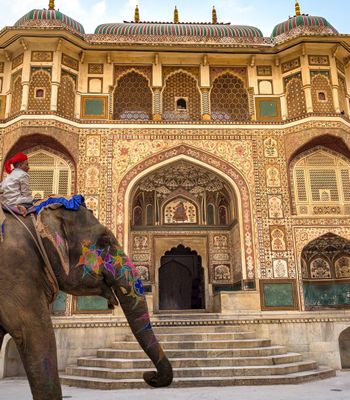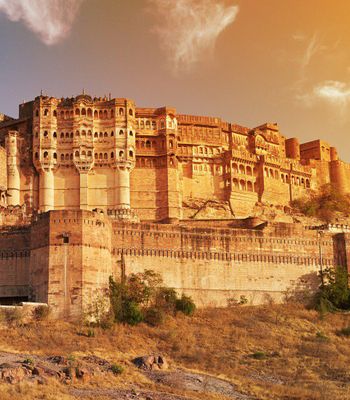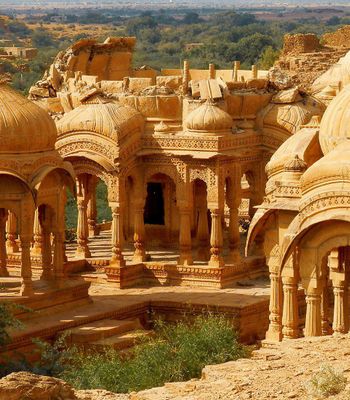
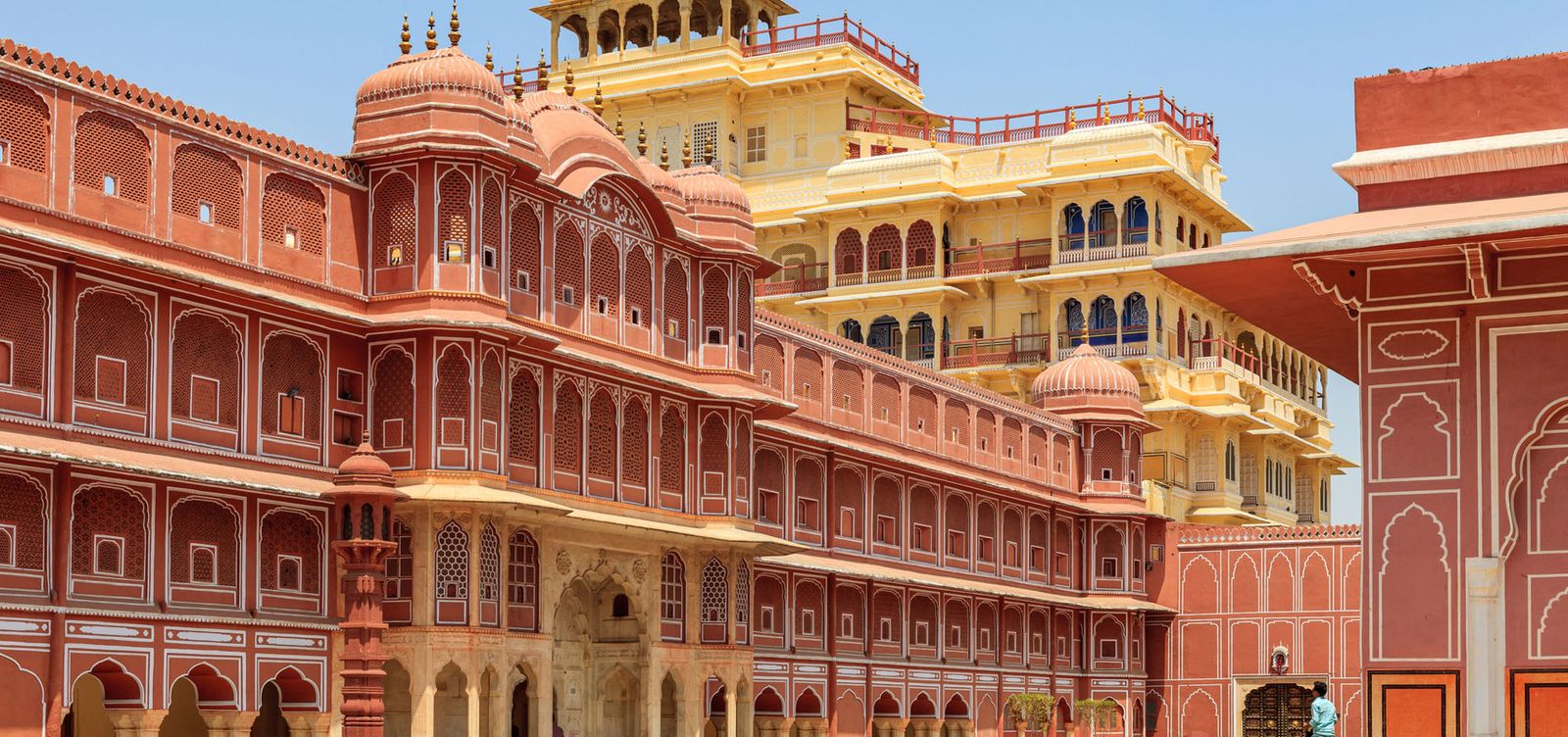
The moment you step through the towering gates of Jaipur's City Palace, centuries of royal splendor hit you all at once — the glint of gold leaf catching the Rajasthani sun, the cool shade of carved marble archways, the faint echo of footsteps across courtyards where maharajas once held court. This isn't a relic frozen behind velvet ropes. A portion of this sprawling complex is still home to Jaipur's former royal family, and that living, breathing connection to India's regal past is something you can genuinely feel in every corridor.
A magnificent collision of Mughal grandeur and Rajput pride, the City Palace sits at the very center of Jaipur's old walled city — commanding, unmissable, and utterly magnetic.
Centuries Written in Stone and Color
Maharaja Sawai Jai Singh II broke ground on this palace around 1729, just as he was building his ambitious new capital from scratch. He'd moved his court from the hilltop fortress of Amber down into the plains, and the City Palace rose alongside Jaipur itself — twin expressions of a ruler obsessed with order, beauty, and forward thinking.
What you see today isn't the work of a single vision, though. Each successive maharaja layered on new halls, courtyards, and flourishes, like chapters added to an evolving epic. The result is a complex that feels wonderfully unpredictable — turn one corner and you're surrounded by Rajput sandstone carvings; turn another and Mughal arches frame your view of the sky.
Remarkably, the royal family still resides in the upper floors of the Chandra Mahal. Few historic monuments anywhere in the world can claim that kind of unbroken continuity.
Where Every Archway Tells a Different Story
The architecture here refuses to sit still. Rajput tradition forms the backbone, but Mughal elegance and European neoclassical touches weave through the complex in surprising ways, keeping your eyes constantly searching for the next detail.
The Mubarak Mahal — A Welcome Fit for Kings
Your first encounter inside the palace grounds is the Mubarak Mahal, the "Welcome Palace," and it earns its name instantly. Built in the late 19th century as a reception hall for royal guests, its facade is a lacework of carved stone so intricate you could stand before it for twenty minutes and still notice something new.
Today, the building houses the Maharani Palace textile museum. Behind glass cases, royal garments shimmer — silk saris embroidered with threads of real gold, ceremonial robes worn by maharajas and maharanis across generations. Each piece feels less like a costume and more like a story stitched into fabric.
The Chandra Mahal — Seven Stories Reaching for the Moon
Soaring above everything else in the complex, the seven-story Chandra Mahal — the Moon Palace — dominates the skyline. Every floor has its own name and personality: one dazzles with mirror work that fractures light into a thousand tiny stars, another glows with vibrant murals depicting scenes of courtly life.
Only the ground floor is open to general visitors, since the upper levels remain the royal family's private residence. However, if curiosity gets the better of you (and it will), a special guided tour of additional floors can be arranged in advance. Don't skip the ground-floor museum — its collection of royal artifacts and artwork is genuinely absorbing.
The Halls of Audience — Silver Urns and Sword Collections
Two halls within the complex stop visitors mid-stride. The Diwan-i-Khas, the Hall of Private Audience, holds a pair of massive silver urns that earned a spot in the Guinness World Records as the largest silver objects on Earth. Maharaja Sawai Madho Singh II had them crafted for a wildly specific reason: he needed to carry sacred Ganges water with him on his voyage to England in 1901. Standing beside them, you realize each urn rises to roughly chest height — the sheer ambition of their creation is staggering.
Across the way, the Diwan-i-Aam, the Hall of Public Audience, displays centuries' worth of royal weaponry, hand-woven carpets, and artwork that once decorated the court. Curved daggers with jeweled hilts catch the light, and you can almost hear the clatter of a Rajput war council echoing off the walls.
A Palace That Still Celebrates
The City Palace isn't merely a monument to what was — it remains a beating heart of Jaipur's cultural life. Festivals, ceremonies, and community events still unfold within these walls, and the royal family actively participates in local celebrations, maintaining ties that stretch back three centuries.
Thousands of artifacts fill the palace museums: illuminated manuscripts, oil paintings of hunting expeditions, ornate costumes heavy with embroidery, weaponry that ranges from elegant to fearsome. Taken together, these collections don't just preserve Rajasthani heritage — they immerse you in the texture and swagger of Rajput royal life.
The Peacock Courtyard — Jaipur's Most Dazzling Photo Op
Deep within the complex, the Pritam Niwas Chowk — better known as the Peacock Courtyard — stops every visitor in their tracks. Four spectacular gateways frame the courtyard, each one representing a different season and dedicated to a different Hindu deity.
The Peacock Gate steals the show. Dedicated to Lord Vishnu and symbolizing autumn, it blazes with deep blues and iridescent greens that seem to shift as the light changes throughout the day. Intricate mosaic patterns fan outward like actual peacock feathers, and no matter how many photos you've seen beforehand, the real thing hits differently. Morning light, golden hour, harsh midday sun — this courtyard rewards your camera at any hour.
How to Get There Without the Hassle
Tucked inside Jaipur's old walled city, the City Palace is blissfully central. Hail an auto rickshaw from almost anywhere in the Pink City, and the driver will weave you through the bustling streets straight to the main entrance — haggle the fare first, and enjoy the ride through Jaipur's kaleidoscopic traffic.
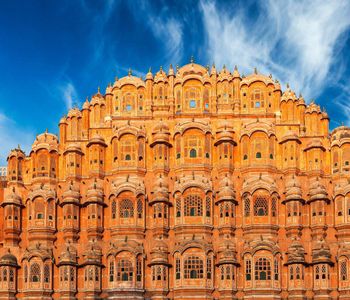
Ride-sharing apps work smoothly here too, offering air-conditioned comfort if the Rajasthani heat is getting to you. Staying near the old city? Lace up your walking shoes. Hawa Mahal and Jantar Mantar are both just a short stroll away, and the route between them is half the experience — spice vendors, chai wallahs, fabric shops spilling bolts of color onto the sidewalk.
Block out a full day for the old city area. Walking between landmarks lets you soak in the streetside energy that makes Jaipur feel so gloriously alive.
Insider Tips to Elevate Your Experience
Beat the heat and the crowds by arriving right when the gates open in the morning. By mid-morning, tour buses start unloading, and those serene courtyards fill with voices and selfie sticks. An early start gives you space to linger — and trust me, you'll want to linger.
Take your time in each museum section rather than rushing through. The collections are thoughtfully curated, and small details — a handwritten letter from a maharaja, the delicate brushstrokes on a miniature painting — reward patience.
If your travel dates align with a local festival like Diwali or Teej, consider yourself extraordinarily lucky. The palace comes alive with extra color, music, and ceremony, transforming an already extraordinary visit into something truly unforgettable. More than a monument, more than a museum, the City Palace is the living soul of Jaipur — and no trip through Rajasthan is complete without walking its ancient, storied grounds.