Imagine descending into the earth through a labyrinth of perfectly symmetrical stairs, each step worn smooth by centuries of bare feet. The city noise fades. The air cools. And suddenly, you're standing inside a geometric masterpiece that most visitors to Jaipur never even know exists. Welcome to Panna Meena Ka Kund — one of Rajasthan's most breathtaking stepwells, hiding in plain sight just minutes from the famous Amber Fort.
A Well Born from Necessity and Brilliance
Built in the 16th century, Panna Meena Ka Kund wasn't designed to dazzle — it was designed to survive. In a land where monsoons could vanish and droughts could stretch for months, Rajasthani communities engineered these extraordinary subterranean structures to capture every precious drop of rain.
But stepwells were never just about water. They were the beating hearts of their neighborhoods — cool, shaded gathering places where women exchanged gossip while filling clay pots, where children played along the lower tiers, and where the relentless Rajasthani sun couldn't quite reach.
Named after a devoted maidservant connected to the royal households of old Jaipur, the kund carries that intimate, personal thread through time. As modern plumbing slowly rendered stepwells obsolete, many crumbled into ruin. Panna Meena Ka Kund refused to disappear. It stands today almost exactly as it did hundreds of years ago — proud, intact, and utterly mesmerizing.
A Geometry That Plays Tricks on Your Eyes
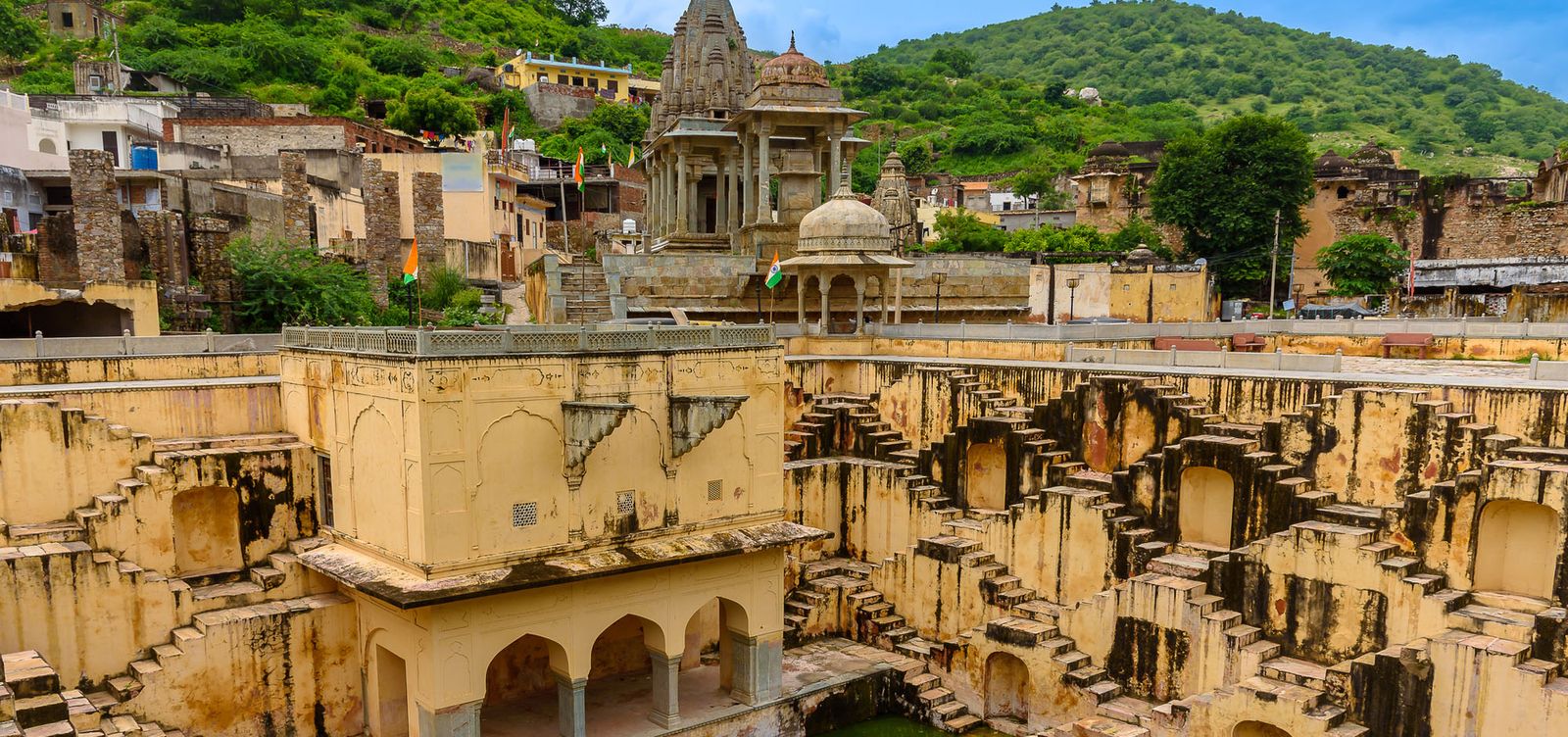
The first thing that hits you isn't the depth — it's the pattern. Symmetrical staircases zigzag down all four walls in alternating directions, creating a dizzying, almost Escher-like grid that seems to shift and multiply the longer you stare. Your eyes trace one staircase only to discover it interlocking seamlessly with the next, a visual rhythm so precise it feels more like mathematics than masonry.
The golden-yellow sandstone glows warm in the morning light, blending the stepwell into Jaipur's sun-drenched palette as if it grew straight from the earth. Look closer and you'll spot carved niches and small alcoves tucked into the walls at various levels — delicate ornamental touches that soften all that satisfying geometry.
At the very bottom sits a small rectangular pool, once brimming with life-sustaining rainwater. Today it holds only a shallow mirror of sky, but it anchors everything above it with quiet purpose.
Now here's the shot everyone comes for: stand at the base and look straight up. The open sky frames itself perfectly inside the descending stone tiers, like peering through a kaleidoscope carved from sandstone. You'll understand instantly why this angle has filled thousands of Instagram feeds — and why no photo quite captures how it feels to stand there yourself.
More Than Stone — A Place That Still Breathes
Stepwells — called baoris or kunds in the local tongue — are a form of architecture found almost nowhere else on Earth outside Western India. Panna Meena Ka Kund ranks among the finest surviving examples in all of Rajasthan.
There's a spiritual dimension here too. Water worship rituals and seasonal festivals have unfolded at sites like this one for generations. You can feel it as you descend — something shifts. The honking auto-rickshaws and chattering crowds of nearby Amber Fort dissolve into silence, replaced by the cool stillness of stone and shadow. It's less like visiting a monument and more like slipping into a meditation.
Getting There: Easier Than You Think
Panna Meena Ka Kund sits in Amer, the historic town perched about 11 kilometers from central Jaipur. If Amber Fort is already on your itinerary — and it should be — the stepwell is literally a short walk away. Tacking it on takes almost no extra effort but adds an entirely different dimension to your day.
From Jaipur, you've got plenty of options to reach Amer:
- Local buses that run regularly and cost next to nothing
- Auto-rickshaws — haggle a little, smile a lot
- Taxis or app-based ride services like Ola and Uber for an air-conditioned escape
- Hired private vehicles, ideal if you're traveling with family or a group
Don't zone out during the drive, either. The road between Jaipur and Amer winds through scrubby hills and sun-baked countryside dotted with old temples and crumbling walls. Ask your driver about the landmarks you pass — chances are, they'll have a story for every one.
Smart Tips for the Perfect Visit
Entry to Panna Meena Ka Kund is free — yes, completely free — and the site is generally open throughout the day. That said, always double-check current access guidelines before heading over, as conditions can occasionally shift.
Here's how to make the most of it:
- Show up at sunrise or just after. The soft golden light pours down the stairways like liquid honey, and you'll likely have the entire stepwell to yourself before the Amber Fort crowds spill over.
- Wear shoes with real grip. Those sandstone steps look beautiful, but they can turn treacherous when slick — especially after a rain shower.
- Charge your phone. Bring your camera. Both. The interplay of light, shadow, and geometry changes with every level you descend. You will take more photos than you planned.
- Time your trip between October and February when Jaipur's weather softens into pleasant warmth — perfect for wandering outdoors without wilting.
- Steer clear of midday in summer. Temperatures in Rajasthan can rocket past 100°F, and climbing down into a sun-baked stone well at noon is nobody's idea of a good time.
Turn It Into an Unforgettable Day
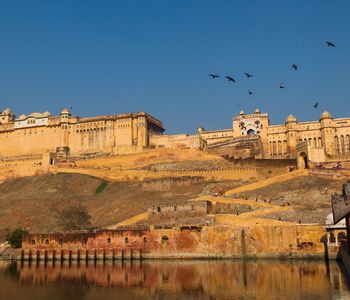
Start your morning at the stepwell while it's still cool and quiet. Let the geometry sink in, take your time on the stairs, and soak up that impossibly photogenic light. Then walk over to the grand Amber Fort, where sweeping views of the Aravalli Hills and Maota Lake spread out before you like a painted backdrop.
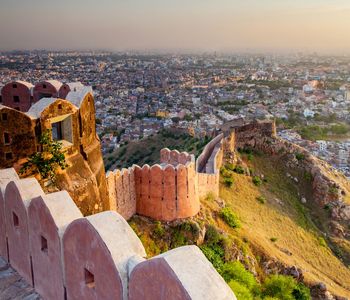
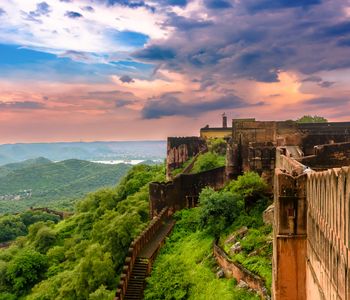
Feeling ambitious? Jaigarh Fort and Nahargarh Fort sit nearby, each offering their own window into Rajasthan's royal saga of power and grandeur.
When hunger hits — and it will — duck into one of the tea stalls lining the roads around Amer. Wrap your hands around a steaming cup of masala chai, fragrant with cardamom and ginger, and grab a plate of crispy kachori or spiced samosas from a roadside vendor. For a proper feast later, head into Jaipur's old city and order a traditional Rajasthani thali — a silver platter overflowing with dal baati churma, tangy gatte ki sabzi, and enough chutneys to keep your taste buds guessing. Trust me, you won't regret it.
The Quiet Wonder That Stays With You
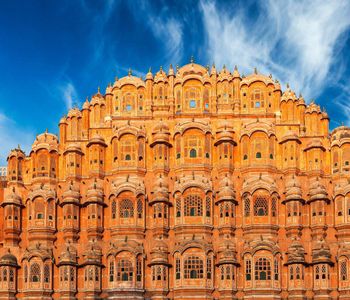
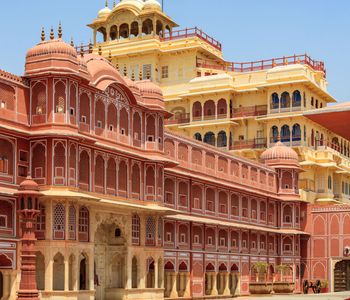
Panna Meena Ka Kund doesn't compete with the City Palace's opulence or Hawa Mahal's rosy facade — and it doesn't need to. Its power is quieter, deeper, and entirely its own.
As you descend those ancient stairs, trace your fingers along the warm sandstone, and feel the temperature drop with every level, you're walking the same path that generations of Rajasthani women, children, and merchants walked before you — people who depended on this very structure for their survival.
This isn't just a photogenic ruin. It's a testament to human ingenuity, to community, and to the timeless, sacred relationship between people and water in one of India's most extraordinary regions. Some places you visit. Panna Meena Ka Kund is one you carry home with you.