Golden Triangle with Rajasthan Family Package – Delhi, Jaipur & Agra

5 Nights / 6 Days
Delhi (2N)Agra (1N)Jaipur (2N)
Starting from ₹38,000
Compare quotes from top 3 travel agents

Delhi doesn't introduce itself gently. It arrives all at once — the diesel haze mixing with jasmine garlands at the airport exit, the autorickshaws arguing geometry with SUVs, the Mughal tombs standing quiet behind walls while the city roars past them. Jaipur is a different animal entirely: slower, more deliberate, its pink sandstone facades the colour of dried terracotta after rain. The city was built on a grid in 1727, and that sense of order still holds, even as camels occasionally share road space with delivery trucks. Agra, for its part, has spent centuries living in the shadow of a single building, but the city's own character reveals itself if you stay long enough — the kinetic energy of its leather workshops, the scent of petha cooking in steel vats near Sadar Bazaar, the way the Yamuna bends wide and flat behind the Taj. These three cities form a triangle measured in more than kilometres. Each one represents a distinct chapter of the subcontinent's long argument with itself about power, beauty, and who gets to build what where.

This six-day itinerary covers roughly six hundred kilometres and six centuries, moving from the layered capital through Rajasthan's most geometrically satisfying city to the Mughal masterwork on the Yamuna. The pace is calibrated for families — mornings hit the major sites before the heat and the school groups arrive, afternoons shift into something slower and more tactile, evenings leave room for rooftop dinners and early bedtimes. Your children will climb the ramps of Amber Fort and learn why elephants were better than horses for siege warfare. They'll watch block printers stamp fabric in Sanganer and understand that a phone case starts as a cotton bolt. They'll stand inside the Taj Mahal's echo chamber and test it with their own voices. The journey builds from the urban density of Delhi through the desert light of Jaipur to the riverine calm of Agra, each transfer day offering its own landscape shift — scrubland giving way to mustard fields, highway dhabas serving dal you won't forget.
Itinerary

Day 1Delhi — Arrivals, Old Walls, and the First Evening

Morning

Your car meets you at Indira Gandhi International and drives you through the strange green corridor of Lutyens' Delhi — roundabouts wide enough to land aircraft on, bungalows hidden behind bougainvillea. Check in, drop bags, drink the welcome nimbu pani without asking what's in it. It's lime, salt, sugar, and cumin. Trust it.

Afternoon

Head to Humayun's Tomb before the light turns flat. This is the building the Taj Mahal studied — the same octagonal symmetry, the same red sandstone and white marble argument, but wilder, less restrained, surrounded by gardens where squirrels outnumber tourists three to one. Let the children run the pathways while you stand in the central chamber and look up at the double dome. Afterward, drive to the Qutub Minar complex, where the iron pillar has refused to rust for sixteen hundred years and nobody can fully explain why. Your kids will try to encircle it with their arms. They won't manage.

Evening

Dinner in the Chandni Chowk area, where the parathas at Paranthe Wali Gali have been fried in ghee since before the 1857 revolt. The lane is narrow, loud, and lit by bare bulbs. Order the rabri paratha — it sounds wrong, tastes right. Walk it off along the edge of the Red Fort's exterior wall, where the sandstone glows amber under the streetlights and the city's volume drops just enough to hear pigeons settling in the crenellations above you.

Day 2Delhi to Jaipur — The Long Road Through Rajasthan's Front Door

Morning

Check out after breakfast and point the car southwest toward Jaipur. The NH48 takes roughly five hours if the trucks cooperate, which they sometimes do. The Delhi sprawl gives way slowly — Gurgaon's glass towers, then Manesar's industrial parks, then suddenly open scrubland dotted with nilgai antelope standing absurdly close to the highway like they're waiting for a bus. Stop at Neemrana if the family needs a break; the stepwell there is worth the detour, its geometric descent into the earth a kind of inverted architecture that children find genuinely thrilling.

Afternoon

You cross into Rajasthan somewhere past Shahpura, and the landscape shifts — drier, flatter, the soil turning ochre. Arrive in Jaipur by early afternoon. Check in, let the air conditioning do its work, then venture to the Albert Hall Museum at the edge of Ram Niwas Garden. It's a Victorian building filled with Mughal miniatures, Egyptian mummies (yes, one real mummy — children will remember this for years), and a gallery of musical instruments that maps every sound the subcontinent ever invented. The gardens outside are populated by families doing exactly what you're doing: walking slowly, eating kulfi from the cart near the south gate.

Evening

Jaipur's evenings belong to the rooftop restaurants along Nahargarh Road. Find one with a view of the illuminated fort above and order laal maas if your family handles spice — it's a slow-cooked mutton in dried red chilli, Rajasthan's signature dish, and it tastes like the desert itself distilled into a gravy. The fort on the hill above glows like a line of fire drawn across the ridgeline. Jaipur is a city that saves its best light for after dark.

Day 3Jaipur — Forts Above, Markets Below

Morning

Leave early for Amber Fort, eleven kilometres north of the city centre. Arrive by 8:30am, before the tour buses stack up at the base of the hill. The climb through the Suraj Pol gateway opens into a series of courtyards that unfold like a puzzle — each one more ornate than the last, culminating in the Sheesh Mahal, the mirror palace, where a single candle flame once lit the entire room through thousands of convex glass pieces embedded in the plaster. Your children will want to test this with a phone flashlight. Let them. The effect still works. Walk the ramparts overlooking Maota Lake, where the water reflects the fort's honey-coloured walls back at themselves.

Afternoon

Return to the city centre for the trio that defines Jaipur's old quarter: Hawa Mahal first, because it's best photographed with the early-afternoon sun hitting its 953 small windows head-on from across the street — don't bother going inside, the view is better from the café opposite. Then the City Palace, still partly occupied by the royal family, where the Pritam Niwas Chowk courtyard has four painted gateways representing the seasons, each one a masterclass in Rajput decorative excess. Finish at Jantar Mantar, the astronomical observatory built in 1734, where the sundial is accurate to two seconds and the Samrat Yantra stands twenty-seven metres tall. Explain to the children that this was the eighteenth century's version of a supercomputer. They'll be appropriately sceptical.

Evening

Spend the last hour of daylight in the Johari Bazaar, where the gem traders still sit cross-legged on white cushions, sorting rubies and emeralds under desk lamps. You're not here to buy — you're here to watch the sorting, the weighing, the quiet negotiation that hasn't changed in three hundred years. Dinner tonight should be at a traditional Rajasthani thali place in the old city, where the servers circle endlessly with bowls of gatte ki sabzi and ker sangri, refilling your plate until you physically cover it with your hand. The children will eat more dal than they've ever eaten in their lives, and they won't complain once.

Day 4Jaipur to Agra — Through the Flatlands, Past Fatehpur Sikri

Morning

The Jaipur-to-Agra drive runs roughly five and a half hours via the NH21, cutting through country that looks like a Mughal miniature painting come to life — flat wheat fields, distant ridgelines, women in saris the colour of traffic lights walking single-file along the road edge. Leave after an early breakfast. The highway is decent, and the dhaba at Bharatpur junction serves aloo parathas with white butter and achaar that will recalibrate your understanding of what roadside food can be.

Afternoon

Break the drive at Fatehpur Sikri, the sandstone ghost city that Emperor Akbar built in 1571 and abandoned fourteen years later — possibly because the water ran out, possibly because he got bored. The Panch Mahal is a five-storey pavilion with 176 columns, no two carved alike, open to the wind on all sides. The Buland Darwaza, the Victory Gate, stands fifty-four metres tall at the mosque entrance, and you have to crane your neck to see the top. Your children will sprint up its steps. You'll arrive winded behind them. This place has the eerie beauty of something unfinished — a city that was perfect and then simply stopped. Reach Agra by late afternoon, check in, and let the hotel pool handle the rest.

Evening

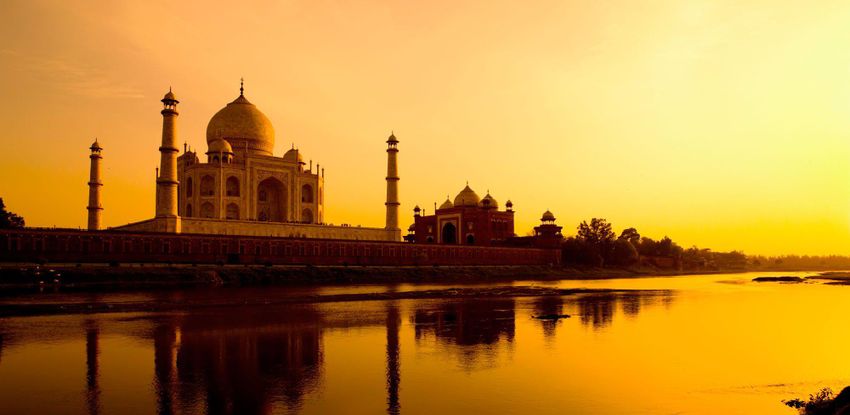
Don't visit the Taj tonight. Save it. Instead, cross to Mehtab Bagh on the north bank of the Yamuna, the garden Shah Jahan originally planned as a mirror-image black marble Taj (a story that's almost certainly apocryphal but too good to correct). From here, the Taj Mahal sits across the river in full profile, and at sunset it shifts from white to gold to pink in the space of twenty minutes. The children will take forty photographs. You'll take one, and it'll be the right one. Walk back through the garden as the bats emerge from the neem trees overhead.

Day 5Agra — The Taj at Dawn, the Fort by Noon

Morning

Set your alarm for 5:15am. The Taj Mahal opens at sunrise, and the first thirty minutes inside the complex — before the crowds build, before the heat presses down — are worth the lost sleep ten times over. Enter through the main gate and watch the building reveal itself in stages through the red sandstone archway: first the dome, then the minarets, then the full reflecting pool. The marble is cool underfoot (shoes off on the platform), and the inlay work — carnelian, lapis lazuli, jasper, forty-three types of stone set into white Makrana marble — rewards close looking. Stand at the base of the southeast minaret and notice how the tower leans slightly outward. This was deliberate. If it ever fell, it would fall away from the tomb. That's the kind of engineering anxiety only love produces.

Afternoon

Agra Fort sits two kilometres upstream, and it's the Taj's necessary counterpart — the political power behind the poetic gesture. The Diwan-i-Khas, the private audience hall, contains the throne terrace where Shah Jahan spent his final imprisoned years staring downriver at his wife's tomb through a small octagonal window. Point this out to your children: the man who built the most beautiful building on earth spent his last decade unable to visit it, catching only its reflection in a gemstone held at the right angle. After the fort, walk to Agra's Kinari Bazaar for marble inlay demonstrations — the craftsmen use the same pietra dura technique the Taj's builders used, and they'll show your family exactly how a stone flower is cut, ground, and set. This is not a tourist performance; these workshops supply restoration projects worldwide.

Evening

Your last proper evening of the trip calls for something unhurried. Dinner on a rooftop with a Taj view — yes, it sounds like a cliché, but the building earns it. Order the Mughlai dishes: kakori kebabs, biryani sealed with dough, shahi tukda for dessert — bread pudding soaked in reduced milk and saffron. The Taj, illuminated at night, hovers in the distance like something that shouldn't quite exist. Tomorrow is the last day. Let this one end slowly, with second helpings and the kind of conversation that only happens when everyone is tired and full and far from home.

Day 6Agra — Morning on the Yamuna, Then Homeward

Morning

You have a few hours before the car takes you to the airport or railway station, and Agra rewards the early riser one more time. Walk down to the Yamuna ghats behind the Taj, where the river runs wide and shallow and the dhobi wallahs lay white sheets across the sand to dry. The Taj from this angle — from below, with the riverbank in the foreground and water buffalo wading in the shallows — is the photograph that never appears on postcards, and it's the truest view of the building in its landscape. If time allows, stop at Itimad-ud-Daulah's tomb on the west bank, the small marble mausoleum often called the "Baby Taj." It predates its famous neighbour by two decades, and the lattice screens here are carved from single sheets of marble so thin that light passes through them like muslin.

Afternoon

Final packing, final checkout. Your driver loads the car and points it toward whichever departure hub the journey demands — Delhi's airport is roughly three and a half hours by expressway, Agra's own station considerably closer. The Yamuna Expressway is flat, fast, and monotonous, which is exactly what you want after six days of sensory accumulation. The children will sleep in the back seat. You'll stare out the window at the mustard fields blurring past and replay the week in fragments: the mirror palace catching your phone light, the iron pillar's impossible chemistry, the paratha fried in ghee older than your country.

Evening

You reach your departure point with the trip already rearranging itself in memory — the days collapsing into images, the drives between cities becoming shorter in retrospect than they felt in the moment. The triangle is closed. Delhi to Jaipur to Agra and back again, six centuries of Mughal and Rajput ambition compressed into six days and five nights. Your children will talk about the mummy in the Albert Hall Museum for months. You'll remember the Taj at sunrise, when the marble was still cold and the garden was yours alone. That's the whole trick of travel with family — you see the same places, but everyone takes home a different building.

  • 5 nights' accommodation in well-located family-friendly hotels: 1 night in Delhi, 2 nights in Jaipur, 2 nights in Agra, with interconnecting or family rooms where available
  • Daily breakfast at each hotel, from check-in morning through checkout on Day 6
  • One traditional Rajasthani thali dinner in Jaipur's old city on Day 3
  • One Mughlai rooftop dinner in Agra on Day 5
  • Air-conditioned private vehicle with experienced driver for all transfers and sightseeing: Delhi airport pickup, Delhi to Jaipur, Jaipur to Agra (via Fatehpur Sikri), and Agra to Delhi airport drop-off
  • Licensed English-speaking local guides in Delhi (Day 1), Jaipur (Day 3, Amber Fort and city), and Agra (Day 5, Taj Mahal and Agra Fort)
  • All monument entry fees: Humayun's Tomb, Qutub Minar, Amber Fort, City Palace, Jantar Mantar, Fatehpur Sikri, Taj Mahal, Agra Fort, and Itimad-ud-Daulah
  • Marble inlay workshop demonstration and visit in Agra
  • Mehtab Bagh entry for sunset Taj viewing on Day 4
  • Bottled water and wet towels in vehicle throughout the trip
  • All applicable road tolls, fuel charges, parking fees, and driver allowances

Related Packages