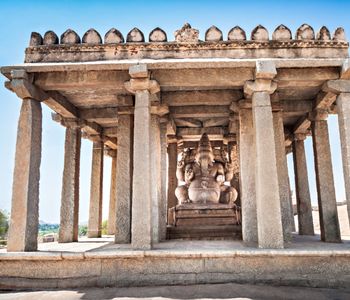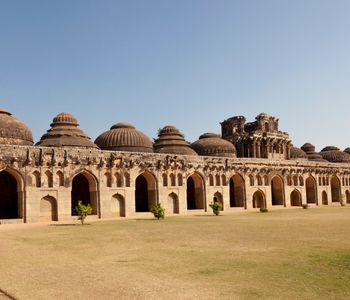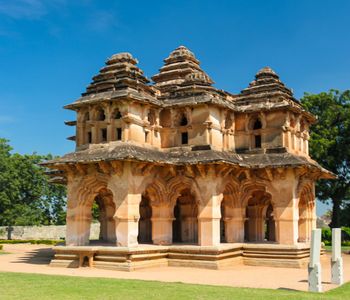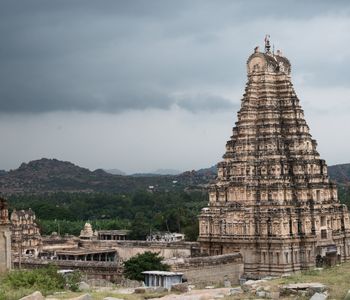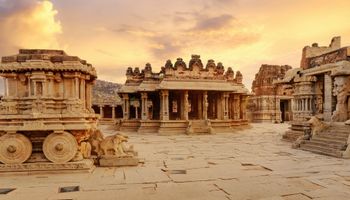
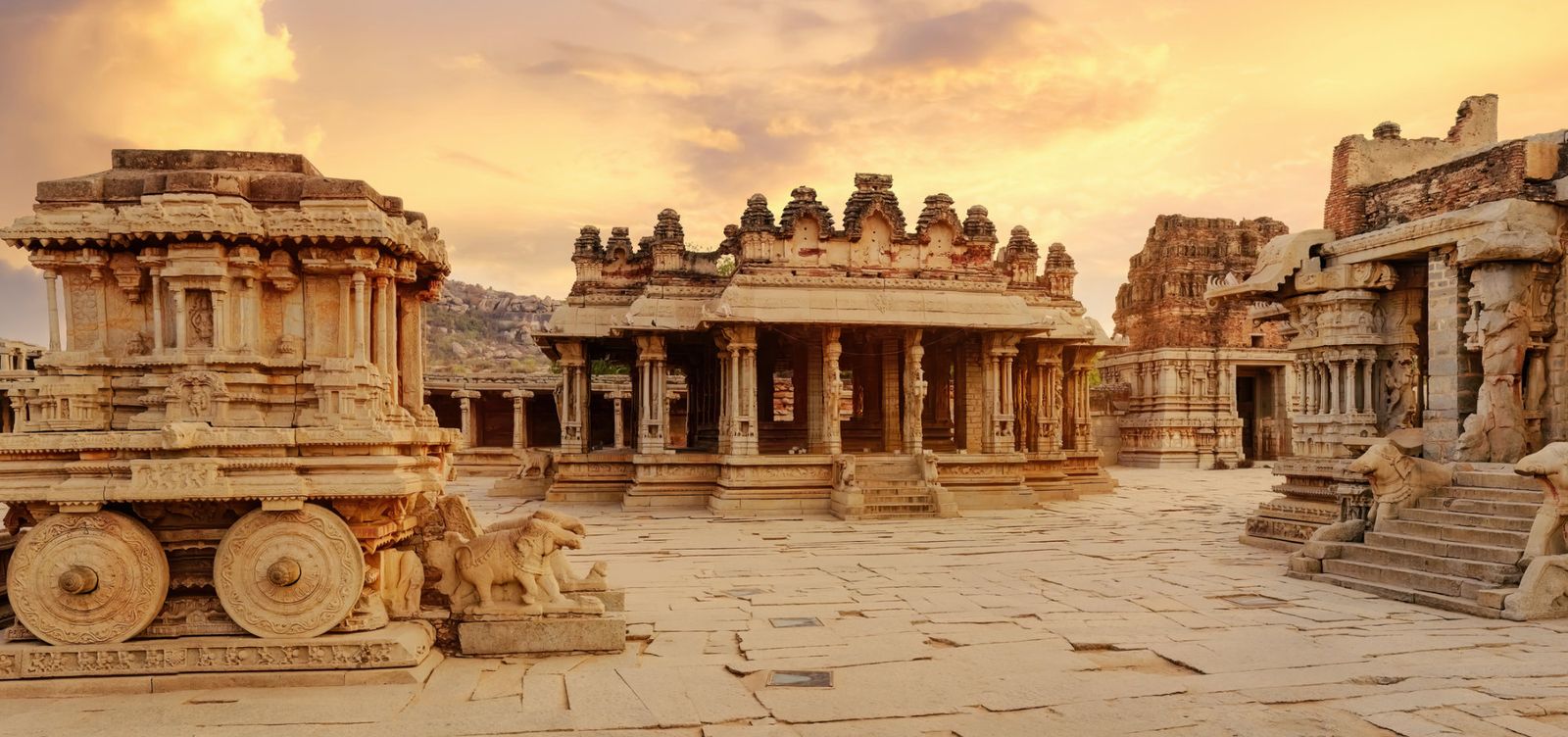
At the eastern end of Hampi's ruins, past crumbling bazaar columns and dusty laterite paths, the Vittala Temple sits in a walled compound that feels like the inside of a jewel box someone forgot to close. Built over several decades during the Vijayanagara Empire's peak in the 15th and 16th centuries, this temple complex wasn't dedicated to a single ruler's ego but to Vittala, a form of Lord Vishnu. The irony is that the deity reportedly refused to reside here, finding the temple too grand even for a god. Whether you believe the legend or not, one glance at the carved stone chariot in the courtyard and you'll understand the sentiment. Nothing about this place exercises restraint.
The temple was never fully completed. Construction stretched across the reigns of multiple rulers, from Devaraya II through Krishnadevaraya and beyond, and some columns remain rough and unfinished — a civilization's ambition frozen mid-sentence.
The Chariot That Stopped a Kingdom
You'll spot it before anything else. The stone chariot standing in the temple courtyard is arguably the most photographed structure in all of Karnataka, and it earns every shutter click. Carved from granite to resemble a wooden processional cart, it once carried a small shrine to Garuda, the eagle mount of Vishnu. The wheels — though stone — were originally functional, spinning freely on their axles. Years of enthusiastic visitors turning them prompted conservation authorities to cement them in place, which feels like a small tragedy.
Get close. Every panel carries relief carvings — battle scenes, mythological episodes, floral arabesques — executed with the kind of precision that makes you question whether the sculptors were working in granite or butter. The structure stands roughly 12 feet tall, and in early morning light, the stone takes on a warm amber tone that no photograph has ever quite captured. Cameras flatten it. Your eyes won't.
Pillars That Sing When Struck
Inside the main mandapa, or hall, stands one of the Vittala Temple's most confounding features: the musical pillars. These are clusters of slender stone columns, each carved from a single block of granite, that produce distinct musical notes when tapped. Some emit the tones of percussion instruments. Others resonate like wind instruments or bells. During the temple's active years, musicians reportedly played these pillars during rituals — the hall itself functioning as a lithic orchestra.
The British, ever suspicious of what they couldn't explain, cut two pillars open to see if something was hidden inside. The sawn pillars remain visible today — hollow, containing nothing but solid granite. Whatever acoustic engineering the Vijayanagara craftsmen understood, they didn't leave instructions. Modern researchers have studied the mineral composition and resonance properties without arriving at a fully satisfying explanation. You can still hear faint tones if you tap gently, though the Archaeological Survey of India discourages it to prevent further erosion.
Here's the thing that really gets under your skin: these aren't decorative afterthoughts. The entire hall was designed as a musical instrument. The spacing, the proportions, the thickness of each pillar — all calibrated. In an age without acoustical modeling software, someone figured this out with their hands and ears alone. That fact should unsettle anyone who assumes sophistication requires technology.
A Kilometre of Ghost Commerce
Approaching the temple from the east, you walk along a wide corridor flanked by stone pillars on both sides. This was once the temple bazaar, where merchants traded gems, spices, silk, and cotton during the empire's commercial zenith. Portuguese traveler Domingo Paes visited Hampi in the early 1500s and described the markets with a mixture of astonishment and envy. He wrote of streets so long you couldn't see where they ended.
Today, those pillars stand bare and roofless, but the scale tells you everything. The bazaar stretches roughly a kilometer in length, its columns casting long shadows across the dirt pathway in late afternoon. Walk it slowly. You can still see carved hooks on some pillars where merchants once hung goods or awnings. The commerce is gone. The infrastructure remains, stoic and indifferent to the centuries — like a skeleton that refuses to forget the shape of its body.
What the Ruins Tell You About Power
The Vijayanagara Empire, at its height under Krishnadevaraya in the early 16th century, controlled most of southern India and maintained diplomatic relations with the Portuguese. The Vittala Temple was its architectural crown. Krishnadevaraya didn't just commission construction here — he poured resources into it as a statement of cultural supremacy against the Deccan Sultanates to the north.
That context matters when you stand in the main sanctum. The carvings along the outer walls depict scenes from the Ramayana and Mahabharata with a narrative sophistication that rivals manuscript illustration. Warriors leap from chariots. Demons writhe. The level of detail extends to the jewelry on individual figures — you can count the strands of a necklace from five feet away. These walls weren't carved for the gods. They were carved so enemies would hear about them.
After the Battle of Talikota in 1565, the victorious sultanates sacked Hampi over a period of months. The Vittala Temple survived better than most structures, though significant damage is visible. Broken columns, headless sculptures, and scorch marks on certain walls serve as reminders that beauty has never been sufficient armor against conquest.
Getting There and Getting In
The Vittala Temple sits about two kilometers northeast of Hampi Bazaar, the main tourist hub. You can walk along the river path from the old market area — a route that passes several smaller shrines and boulder-strewn landscapes worth pausing for. Auto rickshaws and bicycles are both practical alternatives, though the final stretch requires walking regardless.
Entry costs 600 rupees for foreign nationals and 50 rupees for Indian citizens, which also covers admission to other Hampi monuments for the same day. The complex opens at sunrise and closes at sunset. Mornings are best, and not just for the softer light — by midday, the granite compound becomes a furnace. Hampi sits on an exposed plateau, and shade inside the temple is limited. Carry water. Wear a hat. The stone underfoot radiates heat like a griddle by noon.
October through February offers the most bearable temperatures. The monsoon months of July and August bring dramatic skies but also make some paths muddy and slippery around the boulders.
A Monument to Unfinished Ambition
The Vittala Temple doesn't comfort you. It doesn't offer the serene geometry of the Taj Mahal or the spiritual warmth of Varanasi's ghats. What it offers instead is something rarer — evidence of a civilization that reached for an artistic peak it never quite summited. The rough, uncarved sections of pillar sitting beside exquisitely finished panels create an honesty that polished monuments can't match. You're seeing the work in progress, the ambition and the interruption preserved together in granite.
Come here not for peace but for awe — and for the unsettling reminder that even the most extraordinary human achievements can be left unfinished by a single afternoon of war.