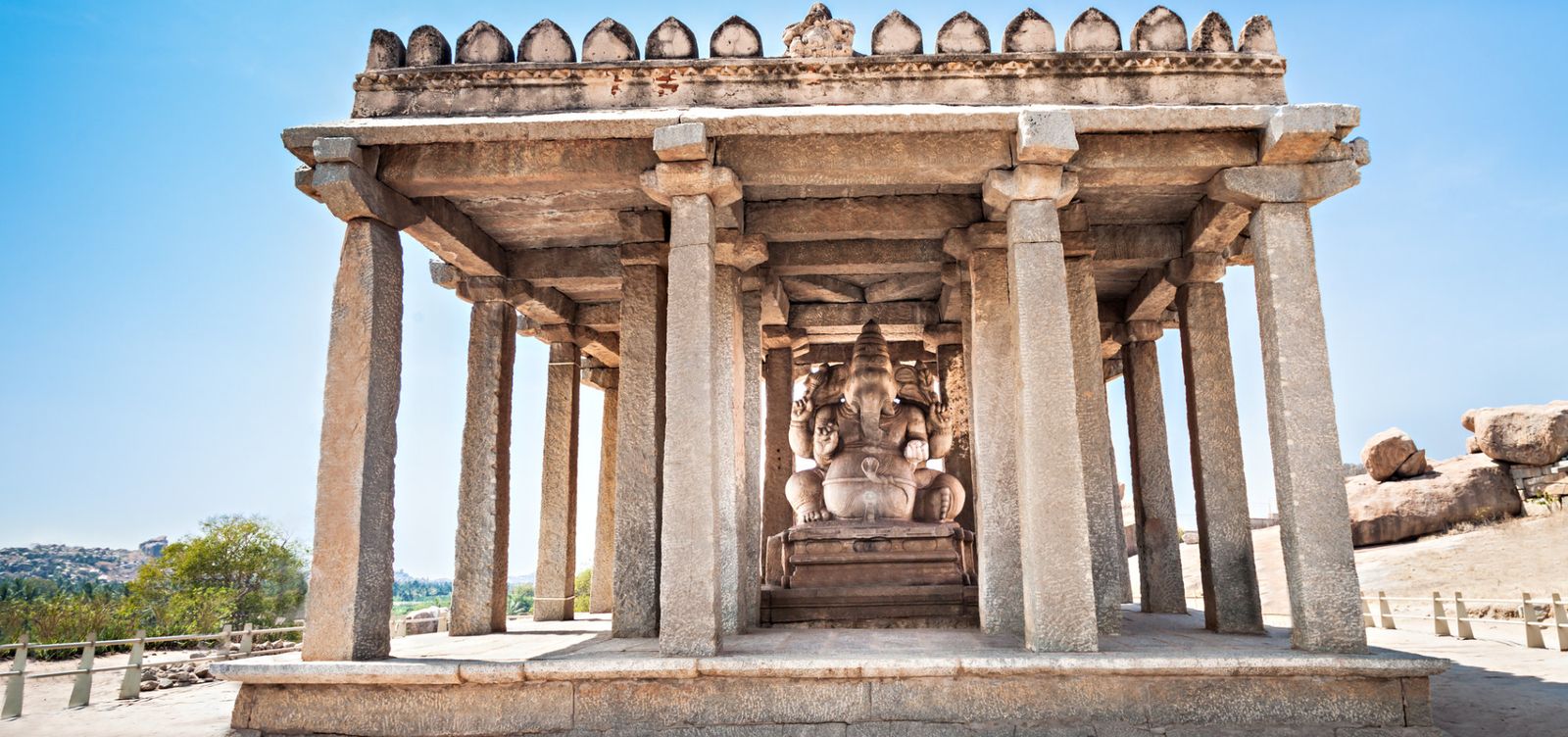
The belly gives it away. Sitting on the southern slope of Hemakuta Hill in Hampi, the Kadalekalu Ganesha is a monolithic sculpture carved directly from an enormous granite boulder, and the deity's rounded stomach — said to resemble a Bengal gram seed, or "kadalekalu" in Kannada — is what earned this particular Ganesha its name. At nearly fifteen feet tall, it's one of the largest Ganesha statues in Hampi, a site already crowded with colossal stone achievements. Yet this one holds your attention differently. There's an intimacy to the carving, a softness in the stone that makes the figure seem less like a monument and more like something breathing. The open-air pavilion that shelters it only amplifies this feeling — you're not entering a dark sanctum here. You're meeting a god in daylight.
The Seed That Named a Deity
The name is oddly specific, and that's what makes it stick. "Kadalekalu" refers to the horsegram or Bengal gram, a small, hard legume common across South India. Look at the sculpture's belly from the right angle, and the resemblance to that seed is unmistakable — a taut, rounded protrusion that dominates the figure's midsection. It's the kind of detail that reveals how the Vijayanagara artisans thought about their work: not abstractly, but through the vocabulary of the kitchen, the marketplace, the morning meal. They named their gods after food.
That earthy sensibility runs through every inch of the sculpture. Ganesha sits in a relaxed posture, trunk curving gently to the left, a broken tusk visible on closer inspection. The snake belt wrapped around that famous belly is carved with startling precision given the scale — you can trace individual coils. Every surface carries chisel marks that remind you a human hand made this, probably in the early sixteenth century during the reign of Krishnadevaraya, the most celebrated ruler of the Vijayanagara Empire.
Stone Without a Temple
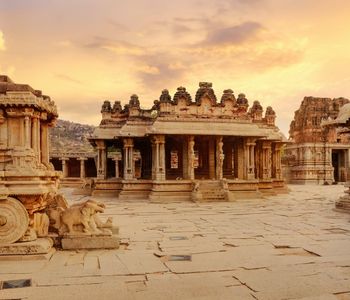
What strikes you first isn't the statue but the absence around it. The Kadalekalu Ganesha sits inside an open mandapa, a pillared pavilion with no enclosing walls. Granite columns hold up the roof, but the sides remain open to the wind, the light, and the dry heat that presses down on Hampi for most of the year. The sculpture exists in permanent dialogue with its landscape. Morning light carves different shadows than the amber glow of late afternoon, and each hour remakes the contours of Ganesha's face.
The mandapa itself shows honest damage. Some pillars have cracked or been repaired. The ceiling, once probably more elaborate, now serves the basic purpose of keeping rain and sun off the stone. None of this diminishes the effect. If anything, the wear makes you trust the place — this isn't a restoration project buffed for tour groups. It's a ruin that still functions as a site of worship, which is a rarer thing than it sounds.
Hemakuta Hill and Its Quiet Authority
You reach the Kadalekalu Ganesha by climbing the rocky paths of Hemakuta Hill, a granite rise scattered with temples, boulders, and some of the finest vantage points in Hampi. The walk isn't strenuous, but it is uneven — wear shoes with grip, not sandals. Along the way, smaller shrines appear between the rocks like afterthoughts, their gopurams barely taller than a person. Hemakuta predates much of Hampi's more famous architecture, and you can feel it in your feet. The stone here is older, rougher, less refined than the ornate carvings at the Vittala Temple complex.
Arriving at the Ganesha from above rather than from the road below changes the experience entirely. You descend toward it, the boulder-sculpture revealing itself gradually between the mandapa's columns. There's a theatricality to this approach that feels deliberate — the Vijayanagara builders understood sight lines the way a film director understands framing.
The Counterargument to Spectacle
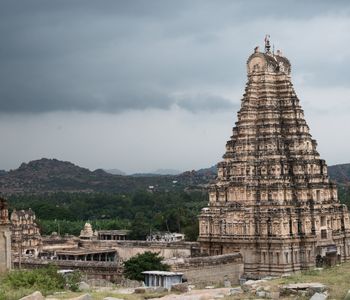
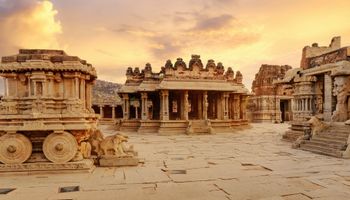
Most travelers come to Hampi for the Vittala Temple, the Stone Chariot, or the Virupaksha Temple with its towering gopuram. The Kadalekalu Ganesha doesn't compete with those landmarks. It doesn't try. What it offers instead is scale without performance. There are no musical pillars here, no chariot wheels, no crowds angling for the same photograph. On a quiet morning, you might share the mandapa with a single priest and a few pigeons.
Here's the thing about this sculpture that catches you off guard: its size makes it more personal, not less. At fifteen feet, Ganesha isn't looming above you from an unreachable height. He's present. Seated. Close enough that you can study the grooves of the snake belt, the way the trunk meets the broken tusk, the faint remnants of what might once have been painted ornamentation on the stone surface. Smaller shrines in Hampi often keep their deities behind metal grates or in dim inner chambers. This Ganesha simply sits in the open and lets you look.
Getting There and What to Know
The Kadalekalu Ganesha is a short walk from the Virupaksha Temple, Hampi's central landmark and the logical starting point for any exploration. Head south up Hemakuta Hill, following the worn stone paths that wind between boulders. The walk takes about ten to fifteen minutes at a comfortable pace. No separate entry ticket is required — the site falls within Hampi's general UNESCO zone, and the sculpture itself is freely accessible.
Come early. By mid-morning, Hemakuta Hill bakes under direct sun, and shade is scarce on the exposed granite. The best light for photography falls between seven and nine in the morning, when the eastern sun angles through the mandapa columns and warms the stone to a deep gold. Carry water. There are no vendors on the hill itself, though small shops and cafes cluster near Hampi Bazaar at the base.
October through February makes the climb far more pleasant, temperature-wise. Hampi's summers, with temperatures regularly exceeding forty degrees Celsius, turn any uphill walk into an endurance test. The monsoon months bring dramatic skies but also slippery rocks and unpredictable access to some hillside paths.
A God Who Stays
Hampi's ruins span twenty-six square kilometers, and it's easy to sprint between the headline attractions without pausing at the quieter sites. The Kadalekalu Ganesha rewards the opposite instinct. Sit on the mandapa's stone platform for a few minutes. Watch the light move across the sculpture's surface. Notice how the granite shifts — grey in shadow, amber in sun, almost pink at dusk. This is a place where the Vijayanagara Empire's artisans took a single boulder and found a god inside it, belly and all. Five centuries later, he's still sitting there. Unhurried. Waiting for you to slow down long enough to notice.