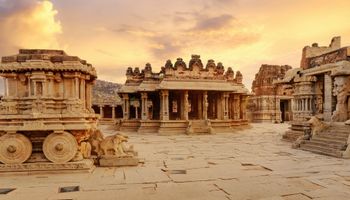
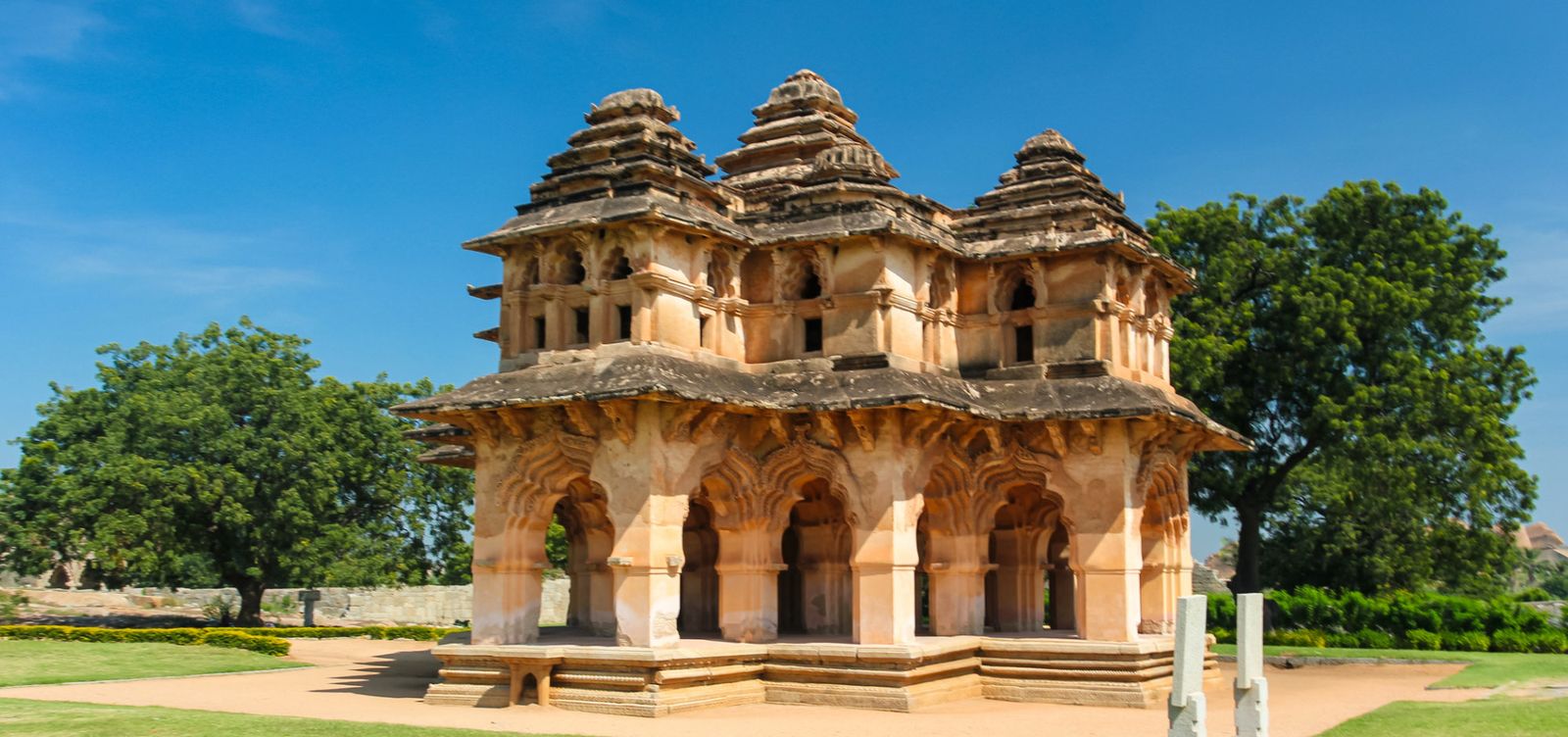
Most monuments in Hampi hit you with scale — massive boulder-strewn landscapes, temples wide enough to swallow entire villages, Elephant Stables built like fortresses. The Lotus Mahal works differently. It seduces with proportion. Standing inside the Royal Enclosure of the Zenana complex, this two-story pavilion barely reaches the height of a nearby palm tree, yet it commands more attention than structures ten times its size. The reason is simple: it doesn't look like anything else in Hampi. While the rest of this ruined Vijayanagara capital leans heavily into Dravidian temple architecture, the Lotus Mahal borrows shamelessly from Islamic design, creating something that belongs fully to neither tradition and entirely to itself. That architectural indecision, it turns out, is exactly what makes it unforgettable.
Where Two Worlds Collide in Stone
The structure's popular name comes from its arched windows and recessed balconies, which fold inward like the petals of a lotus bud when viewed from above. Step closer, and you'll notice the pointed cusped arches running along every facade — unmistakably Indo-Islamic in origin. Look up at the pyramidal tower crowning the roof, and you're staring at something pulled straight from a Hindu temple. The Vijayanagara rulers who commissioned this building in the fifteenth century clearly had no appetite for architectural purity.
What they cared about was staying cool. The Lotus Mahal was an open-air pleasure pavilion, engineered to catch cross-breezes through its symmetrical arched openings on all four sides. Even in Hampi's punishing midday heat — and it gets genuinely brutal here between March and June — the interior remains noticeably cooler than the scorched grounds outside. Some scholars believe water channels once ran beneath the floor, an early form of climate control that would have turned the building into a kind of aristocratic cooling station. Fifteenth-century air conditioning, if you like — rendered in brick and mortar.
The construction material itself tells a story. Unlike Hampi's granite temples, the Lotus Mahal uses a combination of brick, lime mortar, and stucco. This allowed for the delicate ornamentation that granite simply can't achieve — fine geometric patterns, thin arched ribs, and those impossibly graceful window frames that photograph so well when the late afternoon light slants through them at a low angle.
The Women's Quarter and Its Quiet Authority
The Lotus Mahal sits inside the Zenana Enclosure, the area historically reserved for the royal women of the Vijayanagara court. High stone walls still surround the compound, and watchtowers punctuate the corners. This wasn't a prison. It was a fortress of privacy. The women here wielded significant influence over court affairs, and the enclosure's defensive architecture reflects their status as much as their seclusion.
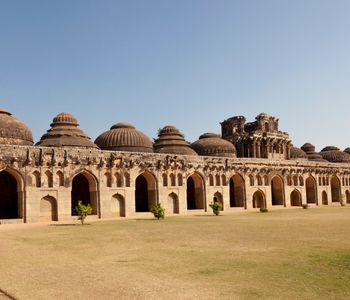
A two-minute walk brings you to the nearby Elephant Stables — eleven domed chambers, each large enough to house a war elephant, sharing the same hybrid aesthetic: Islamic domes sitting atop Hindu structural foundations. Together, the two buildings suggest a court that was cosmopolitan by design, absorbing Persian and Deccani influences without abandoning its own traditions. That cultural flexibility sustained the Vijayanagara Empire for over two centuries, until its catastrophic defeat at the Battle of Talikota in 1565.
What the Invaders Spared, and Why
After Talikota, invading armies systematically dismantled Hampi over months. Temples were defaced, palaces burned, markets abandoned. The Lotus Mahal survived largely intact. Nobody knows precisely why. One theory holds that the conquering Deccani sultans recognized the Islamic elements in its design and spared it out of architectural kinship — a building that spoke, however partially, their own visual language. Whether or not that's true, the building's hybrid identity may have literally saved it from destruction. A mongrel outlasting the purebreds.
Today, the stucco ornamentation has eroded significantly, and the original plasterwork that once covered the exterior is mostly gone. What remains is the skeleton — and it's still enough to stop you mid-stride. The symmetry is almost mathematical in its precision. Stand at the center of the ground floor and look outward through any of the arched openings, and the framing effect is identical in every direction. Whoever designed this understood sight lines the way a cinematographer does.
Getting There Without the Crowds
The Lotus Mahal falls within the Hampi UNESCO World Heritage Site, and the Zenana Enclosure requires a separate ticket. Indian nationals pay 40 rupees; foreign visitors pay 600 rupees — a combined ticket that also covers the Virupaksha Temple complex and other major sites. The enclosure opens at sunrise and closes at sunset, so your visit depends entirely on the season.
Arrive early. By 10 a.m., tour buses begin depositing large groups near the entrance, and the intimate scale of the Lotus Mahal doesn't survive crowds well. The best light for photography falls between 7 and 8 a.m., when the eastern sun catches the arched facades at a low angle and throws sharp shadows across the stucco surface. Late afternoon works nearly as well, though you'll share the space with more people.
Hampi itself sits about 13 kilometers from Hospet, the nearest town with rail connections. Auto rickshaws and local buses make the run regularly. If you're staying in Hampi Bazaar or the backpacker enclave across the Tungabhadra River, renting a bicycle or moped gives you the freedom to reach the Zenana Enclosure on your own schedule. The roads are flat, the distances manageable, and the landscape between sites — all granite boulders and banana plantations — rewards a slower pace. You don't rush through country like this. It won't let you.
The Detail That Stays With You
Here's the counterintuitive thing about the Lotus Mahal: it's better empty than full. Most of Hampi's monuments gain drama from imagining the crowds that once filled them — bazaar streets echoing with merchants, temple corridors thick with devotees. The Lotus Mahal gains its power from silence. It was built for a small number of people to sit, talk, and feel the wind pass through recessed arches. That intimacy is still palpable. Stand alone in the center on a quiet morning, and the building works on you exactly as it was designed to — not as a monument, but as a room.
In a ruined city of epic proportions, the Lotus Mahal argues persuasively for the opposite. Restraint. Elegance. A refusal to overwhelm. Hampi will give you days of wonder, but this small pavilion, barely taller than a house, is the structure you'll sketch from memory long after you've gone. The Vijayanagara builders seemed to understand something instinctively: the most powerful architecture isn't always the largest. Sometimes it's simply the most precise.