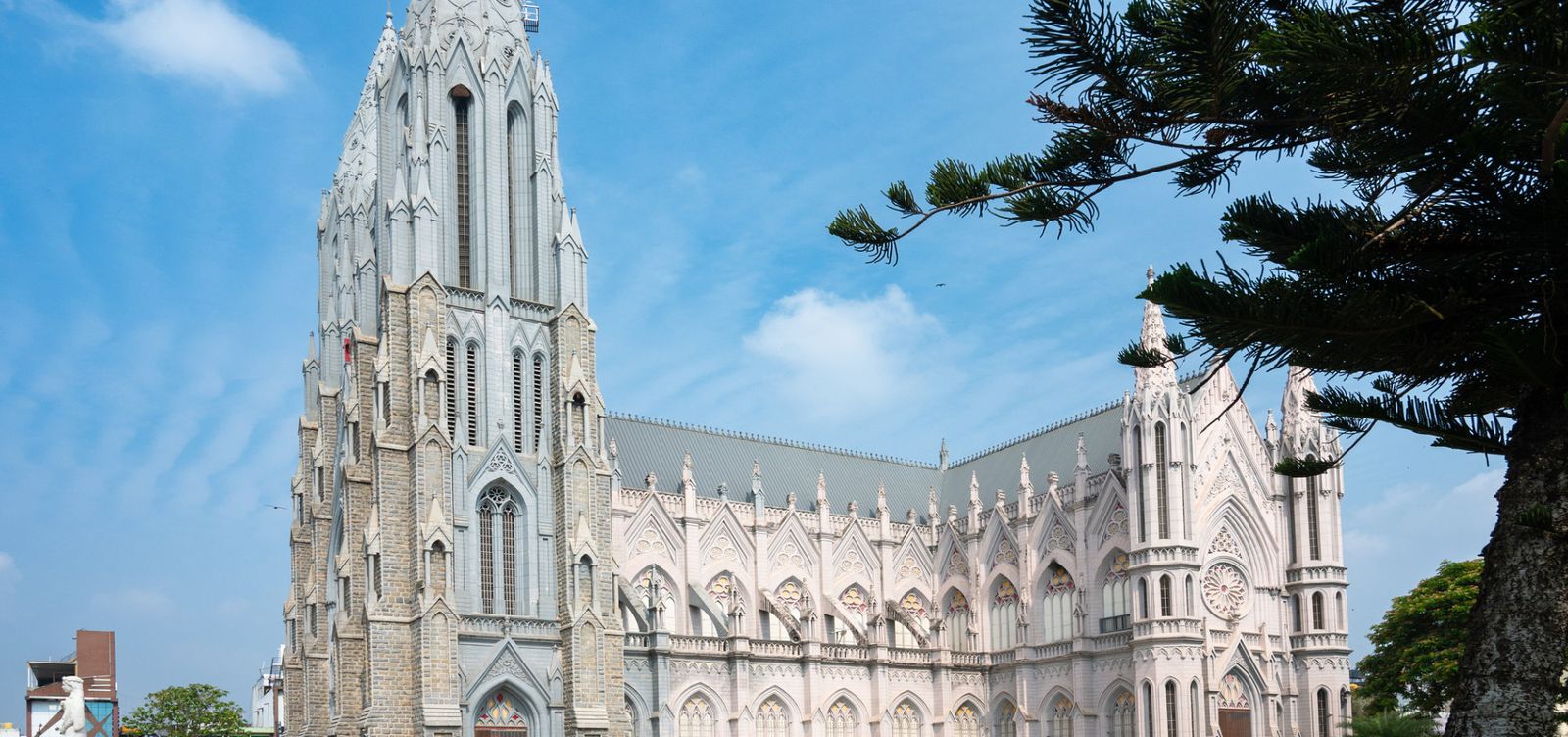
The twin spires of St. Philomena's Cathedral rise 175 feet above Mysore's low-slung skyline, and the first time you see them from a distance, they look misplaced — as if a piece of Cologne had been airlifted into southern India. That dissonance is precisely what makes this cathedral worth your time. Built between 1933 and 1941 under the patronage of Krishnaraja Wadiyar IV, the Maharaja of Mysore, this is a Catholic church that owes its existence to a Hindu king. Let that contradiction settle in. It tells you everything about what Mysore was — and, in some stubborn ways, still is. Standing on Ashoka Road in the Lashkar Mohalla area, this Neo-Gothic structure is one of the tallest churches in Asia, and its story is stranger and more layered than its postcard appearance suggests.
A Hindu King's Gift to Christianity
The original church on this site dated to 1843, a modest structure that served Mysore's small Catholic community. By the early twentieth century, it had outgrown its purpose. Enter Bishop Rene Feuga, a French clergyman who appealed directly to Maharaja Krishnaraja Wadiyar IV for support in building something grander.
The Maharaja didn't just agree — he donated the land and contributed funds. This wasn't an act of conversion or appeasement. Wadiyar IV was a patron of all faiths with the same deliberate generosity, and the cathedral stands as evidence of a pluralism that was institutional, not performative. The architect was a Frenchman named Daly, who modeled the design after the Cologne Cathedral in Germany. Construction took eight years, and the building was consecrated in 1941.
Here's the counterintuitive detail: the cathedral's most ardent protector in its early decades wasn't the church hierarchy but the Mysore royal family, who treated it as a civic landmark rather than a sectarian one. That spirit persists. On any given afternoon, you'll find as many Hindu and Muslim visitors wandering the nave as Catholic worshippers.
Stone, Glass, and Gravity
Step through the main entrance, and the interior scale hits you immediately. The nave stretches roughly 255 feet in length, with a vaulted ceiling supported by granite pillars that draw your eye upward in that deliberate way Gothic architecture demands. The stained glass windows filter southern Indian sunlight into blues and ambers, casting shifting patterns across the stone floor throughout the day. Morning light, particularly between 8 and 10 a.m., transforms the eastern windows into something genuinely luminous.
The cathedral follows a cruciform plan — a Latin cross with a central nave, two side aisles, and a transept. Beneath the main altar, a crypt holds a relic believed to be associated with St. Philomena, the patron saint to whom the church is dedicated. The crypt is accessible, though its low ceiling and dim lighting give it a markedly different atmosphere from the soaring space above. It feels older than it is, which is perhaps the point.
One detail most visitors overlook: the turret clocks mounted on the twin spires still function. They're mechanical, not digital, and their chimes carry across the surrounding streets at the top of each hour — a sound that's become so embedded in the neighborhood's rhythm that residents set their routines by it.
Where Cologne Meets Karnataka
The Neo-Gothic style is the obvious reference point, but the execution carries distinctly Indian characteristics. The construction material is local granite, not European limestone, which gives the exterior a darker, more grounded appearance than its German inspiration. Carved floral motifs on certain columns echo Hoysala temple ornamentation rather than Western ecclesiastical tradition. Whether this was intentional or simply the natural instinct of local craftsmen remains debated, but the result is a building that refuses to be entirely foreign.
The flying buttresses along the exterior deserve a slow walk. They're structurally functional, not decorative — supporting the lateral thrust of the vaulted ceiling — and they give the cathedral its most photogenic angles from the southeast corner of the grounds. If you're carrying a camera, that's your spot.
Inside the Quiet Hours
Mass is held daily, with services in English, Kannada, and Tamil on Sundays. The cathedral opens at 5 a.m. and closes by 6 p.m. on most days. Early morning is the best time to visit, not because of crowds — this isn't Mysore Palace — but because the light is superior and the silence inside the nave is near-total. You can hear your own footsteps on the stone, which is the kind of sensory experience no photograph replicates.
There is no formal entry fee, though donation boxes are placed near the entrance and within the crypt. Photography is generally permitted in the main hall, but it's worth checking with the attendant near the door, as policies shift during religious services and special occasions. Remove your shoes at the entrance. Dress modestly — shoulders and knees covered — out of respect for the worshippers who treat this as a living church, not a museum.
Getting There Without the Hassle
The cathedral sits about three kilometers north of Mysore Palace, making it an easy addition to any day exploring the city center. Auto rickshaws from the palace area cost roughly 50 to 80 rupees, and every driver in Mysore knows the landmark by name. If you're staying near the railway station, it's a manageable walk of about fifteen minutes through relatively flat terrain.
Mysore itself connects to Bangalore by rail and road. The Shatabdi Express covers the distance in about two hours, depositing you at Mysore Junction. From there, the cathedral is a short ride away. City buses also pass nearby, with the Lashkar Mohalla stop being the closest.
Combine your visit with a walk through the surrounding neighborhood, where small tea shops and bakeries sell Mysore pak — a dense, ghee-rich sweet that's far better purchased from a street vendor than from a packaged box at the airport. A cup of filter coffee and a square of fresh Mysore pak on a bench within sight of those twin spires is about as good as a morning gets in this city.
More Than Architecture
During the annual Feast of St. Philomena in August, the cathedral grounds fill with processions, music, and a palpable energy that transforms the normally contemplative space. Thousands gather, and the celebrations spill out onto the surrounding streets. If your travel dates align, it's worth adjusting your schedule to witness the feast — it reveals the building's emotional hold on its community in ways that an ordinary Tuesday visit simply cannot.
The Dasara season in September or October also brings increased visitor traffic to the cathedral, as tourists already in Mysore for the famous festival often add a stop here. The two events share no religious connection, yet they coexist in the city's calendar with the same ease that a Hindu king once coexisted with a French bishop.
A Spire Worth Craning For
St. Philomena's Cathedral doesn't compete with Mysore Palace for attention, and that's precisely its advantage. It receives a fraction of the foot traffic, offers a cooler and quieter interior, and tells a more complicated story about who built what for whom and why. The twin spires are dramatic, the crypt is atmospheric, and the light through those stained glass windows earns every minute of your morning. In a city defined by royal excess, this cathedral stands as proof that the most interesting architecture often comes from the most unlikely collaborations.