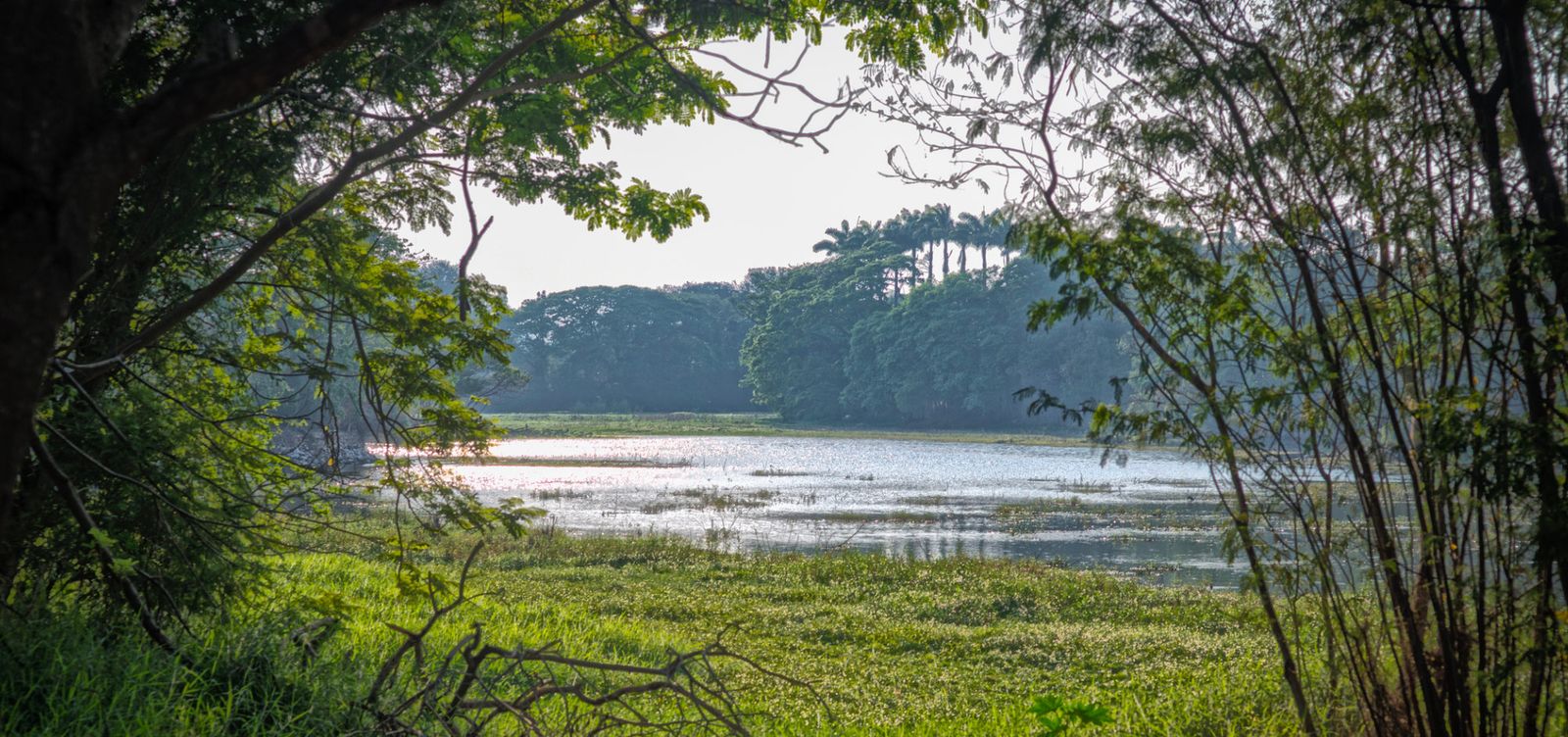
A walk-through butterfly park attached to a lake in the middle of a city sounds like something conjured for children. But Karanji Lake in Mysore pulls it off with surprising grace, and without a trace of theme-park gaudiness. Spread across roughly 90 acres on the southeastern edge of the city, the lake sits in the shadow of the Chamundi Hills, its still waters reflecting the temple-crowned peak on calm mornings. What draws most people is the birdlife — pelicans, painted storks, cormorants, and egrets congregating in numbers that feel almost theatrical. What keeps them longer than expected is the unlikely pairing of a functioning nature reserve with a city that presses right up against its edges. Karanji Lake doesn't ask for your awe. It earns a quieter kind of attention.
A Lake That Refused to Disappear
Karanji Lake predates modern Mysore, originally serving as one of several tanks built to supply water to the city and its surrounding agricultural lands. For decades, it functioned as a utilitarian water body — necessary, unromantic, gradually ignored. Encroachment and sewage inflow degraded its shores through much of the twentieth century.
Then, in the early 2000s, the Mysore Zoo authority stepped in. The lake was cleaned, its boundaries reinforced, and a nature park established along its western shore. Today, the zoo manages the entire property, and the transformation is striking — where weeds once choked the banks, a landscaped walking path now traces the waterline. The restoration didn't erase the lake's scrappy history. It simply gave it a reason to be visited on purpose.
The Butterfly Enclosure That Actually Delivers
India has no shortage of butterfly parks that amount to a netted tent with three tired specimens clinging to a leaf. Karanji's is different. The walk-through enclosure, one of the largest in the country, houses dozens of species within a humid, densely planted dome. You'll spot common Jezebels, blue Mormons, and crimson roses drifting between lantana and pentas flowers, their wings catching light that filters through the mesh overhead.
It works because it doesn't try to be a museum. No glass cases. No laminated fact sheets every three feet. Instead, you walk a winding path through live vegetation while butterflies land on your shoulder or hover just ahead of you. Children lose their minds here, obviously. But it's the adults who tend to linger, phones forgotten in pockets, watching a plain tiger butterfly open and close its wings on a hibiscus bloom. The park charges a modest additional fee beyond the lake's entrance ticket, and it's worth every rupee.
Where the Pelicans Come to Land Like Cargo Planes
Over 140 avian species have been recorded at Karanji Lake — a figure that competes with dedicated birding reserves far outside any city. Spot-billed pelicans dominate the scene, their heavy bodies skimming the water's surface before settling with all the aerodynamic elegance of freight aircraft. Painted storks wade through the shallows in the early hours, pink-tinged feathers catching the first light.
Bring binoculars. From the lakeshore or the elevated walkway, you can pick out kingfishers, purple herons, and the occasional white-bellied sea eagle circling above. Between November and February, migration season swells the population dramatically. The lake's island — inaccessible to you and me — becomes a nesting ground so dense with birds that the trees appear to move. It's the kind of spectacle you'd expect to drive two hours for, not encounter ten minutes from Mysore Palace.
Forty-Five Minutes Around the Edge of Something Calm
A paved path runs along the western and southern edges of the lake, shaded intermittently by rain trees and banyans. The full loop takes about forty-five minutes at a leisurely pace, though most people stop frequently — to photograph a cormorant drying its outstretched wings, to sit on one of the stone benches, or simply to stare at the Chamundi Hills rising above the tree line.
The path never feels isolated. Joggers pass in the early mornings, families stroll through in the late afternoons, and elderly couples occupy the same benches with the regularity of fixtures. A regional aquarium sits near the entrance, modest in scale but stocked with freshwater species native to Karnataka's rivers. Pedal boats operate on the lake too, letting you drift closer to the bird islands without disturbing the residents. The boats move slowly. That's the point.
The Hours That Matter
Timing matters here more than at most places. Arrive before 8 a.m. and you'll have the walking path nearly to yourself — the lake's surface glassy and undisturbed, pelicans already fishing in loose formations. The butterfly park opens around 9:30 a.m., so early risers should start with the lake and loop back. By midday, the heat flattens everything. Birds retreat, butterflies slow, and the reflective surface of the water gives way to a flat glare.
Late afternoons recover some of the morning's magic. Light softens around 4 p.m., and bird activity picks up again as species return to roost. Between October and March, the weather cooperates generously — dry skies, temperatures hovering around 25 degrees Celsius, and that particular crispness in the air that makes South Indian winters so pleasantly deceptive. Mysore's summers push past 35 degrees, and the monsoon months from June through September can waterlog the paths entirely.
The Practical Details
Karanji Lake sits adjacent to the Mysore Zoo on its eastern side, roughly three kilometers from the city center. Auto rickshaws from the Mysore Palace area reach the entrance gate in under fifteen minutes. If you're already at the zoo, walk out the rear exit and you're practically at Karanji's front gate — a pairing that makes for a full day without any transit headaches.
The entrance fee is nominal — around 20 rupees for Indian nationals and slightly more for international visitors, with a separate charge for the butterfly park. The lake is open daily from morning until early evening, though specific hours can shift seasonally. There's a small canteen near the entrance selling tea and snacks, but nothing elaborate. Carry water. The walking path offers no shade for certain stretches, and the Karnataka sun doesn't negotiate.
The Antidote You Didn't Know You Needed
Mysore's identity revolves around its palace, its silk, and its Dasara festival. Karanji Lake doesn't compete with any of that. It operates at a different frequency — slower, greener, populated by wings rather than tour groups. After a morning navigating the palace's gilded corridors and dodging selfie sticks, the lake offers a correction. Sit on a bench. Watch a kingfisher dive. Let a butterfly land on your wrist. Here's the counterintuitive thing about Karanji: it's the most natural-feeling place in Mysore, and it only exists because someone decided to intervene. Left alone, the lake would have vanished under concrete and sewage decades ago. Instead, pelicans still fish within earshot of traffic — and that unlikely persistence is what makes it worth your afternoon.