Most gardens ask you to admire flowers. Brindavan Gardens asks you to admire engineering. Built below the Krishnaraja Sagar Dam in 1932, this terraced expanse stretches across 150 acres on the outskirts of Mysore, and its primary spectacle isn't botanical — it's hydraulic. Every evening, as the sky over the Cauvery River basin dims, a musical fountain erupts in synchronized jets of colored water, and several thousand people fall silent at once. That hush — lasting just a second or two before the crowd catches its breath — is the truest review the garden has ever received.
Sir Mirza Ismail, the Diwan of Mysore, conceived the place as a public pleasure ground to complement the dam's utilitarian purpose. His instinct was sharp. Nearly a century later, Brindavan Gardens remains one of South India's most visited landscapes — not because of rare orchids or ancient banyan trees, but because of what happens when water, light, and concrete work together with unusual grace.
A Dam's Beautiful Afterthought
The Krishnaraja Sagar Dam was dead serious infrastructure. Completed in 1932 under the supervision of the legendary engineer Sir M. Visvesvaraya, it was designed to irrigate the Mandya district and supply water to several cities, including Mysore and parts of Bangalore. Built across the confluence of three rivers — the Cauvery, Hemavathi, and Lakshmana Tirtha — it represented early 20th-century hydraulic ambition at its most muscular.
Brindavan Gardens arrived as its aesthetic counterpart. The Diwan modeled parts of the layout on the Shalimar Gardens in Lahore, borrowing the Mughal principle of symmetry and flowing water channels. But where Mughal gardens served emperors behind high walls, Brindavan was public from day one. That democratic impulse still defines the place. Families from Mysore, busloads of school children from Bangalore, honeymooners from Kerala — they all share the same benches, the same walkways, the same spray from the same fountains.
The Geometry of Green
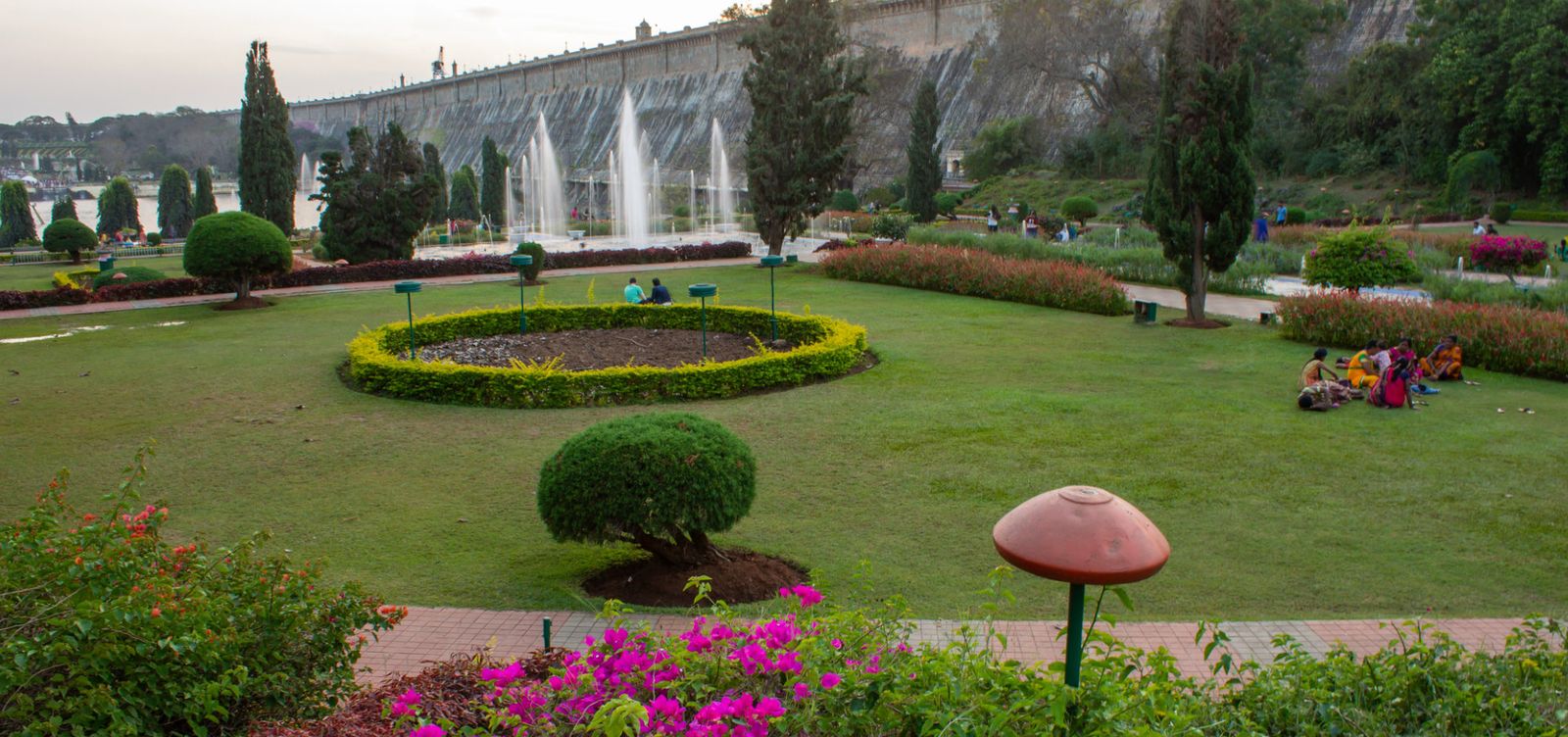
Walking through Brindavan Gardens in daylight, the first thing you register isn't color — it's structure. The terraces descend in three tiers below the dam, each level connected by staircases flanked by ornamental balustrades. Hedges are trimmed into sharp geometric forms — arcs, circles, chevrons — with a precision that suggests someone with a protractor and a vendetta against asymmetry visits weekly.
The plant selection leans toward durability over delicacy. Bougainvillea in magenta and orange dominates the borders, with rows of cypress trees providing vertical punctuation. You won't find rare species here, and a botanist might find the palette repetitive. But the garden's power lies in its macro composition, not its individual specimens. Stand at the top terrace and look down: the entire layout resolves into a carpet of green symmetry stretching toward the reservoir's silver surface. It's a garden designed to be read from above, which makes the dam walkway the best vantage point most people ignore entirely.
Between the hedgerows, long water channels lined with small fountains throw a cooling mist into the air. On hot afternoons — and Mysore's pre-monsoon months push well past 35 degrees Celsius — that mist becomes the garden's most generous offering.
When the Lights Take Over
Brindavan Gardens has two identities: daytime and nighttime. The daytime version is pleasant. The nighttime version is the reason people come.
Around 7 p.m., the musical fountain show begins. Jets of water shoot upward in choreographed sequences, illuminated by colored lights cycling through greens, reds, and golds. The fountain dances to a mix of Kannada film songs, Hindi classics, and the occasional Western tune. It's unapologetically populist entertainment — no avant-garde light installations, no minimalist ambient scores. The crowd loves it precisely because it doesn't try to be subtle.
What catches you off guard is the scale. The main fountain pool spans a considerable stretch of the central terrace, and the tallest jets reach heights that catch the evening breeze, spraying fine droplets over the front rows of spectators. Children squeal. Couples lean closer. The whole spectacle lasts about 30 minutes, and the timing is deliberate — just short enough to leave you wanting one more sequence. The show runs from 6:30 p.m. to 8:30 p.m. on weekdays, extending to 9:30 p.m. on weekends and holidays, though schedules shift seasonally.
The Boat Ride Nobody Rushes
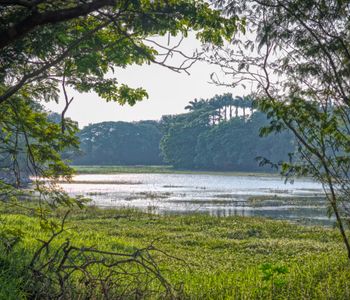
On the garden's northern side, a boating area extends into the reservoir created by the dam. Speed boats and rowing boats are both available, and the experience offers something the garden walkways can't — a view of the dam's full breadth from the water. The Krishnaraja Sagar stretches wide, and from mid-reservoir, Brindavan Gardens appears as a narrow band of green clinging to the dam's edge, dwarfed by the surrounding dry plateau.
That perspective shift matters. From inside the garden, everything feels lush, abundant, almost inevitable. From the water, you understand how improbable this green oasis truly is — an act of irrigation turned into an act of imagination. The boat rides operate during daylight hours and cost a modest fee. Choose the rowing boat if you prefer quiet. The speed boats are loud and popular with groups, which means they'll find you whether you want them to or not.
Arriving and Paying Your Way In
Brindavan Gardens sits about 21 kilometers northwest of Mysore city. The most common approach is by road — taxis, auto rickshaws, and KSRTC buses all make the run regularly. If you're driving from Bangalore, the garden is roughly 145 kilometers along the Mysore-Bangalore Highway, making it a feasible day trip, though a rushed one.
Gates open at 6:30 a.m. and close after the last fountain show. Entry fees are nominal — around 15 rupees for Indian visitors and 200 rupees for foreign nationals, though these figures update periodically. The musical fountain carries a separate ticket of about 50 rupees per person. Parking sits near the main entrance, and the walk from the lot to the garden gate takes roughly ten minutes, past the usual gauntlet of souvenir stalls and snack vendors selling mysore pak, cotton candy, and fresh coconut water.
Weekends draw enormous crowds, particularly Sunday evenings. If you want to photograph the terraces without a thousand other visitors in every frame, arrive at dawn on a Tuesday or Wednesday. The garden in early morning light — quiet, dewy, largely empty — is a fundamentally different creature from its evening incarnation.
A Garden That Knows Exactly What It Is
Brindavan Gardens doesn't pretend to be Kew or Versailles. It doesn't house rare species or whisper contemplative serenity. What it does, with startling confidence, is deliver public pleasure on a grand scale — color, water, music, symmetry, all offered without a trace of pretension. Sir Mirza Ismail built a garden for ordinary people beside a dam that served ordinary needs, and that clarity of purpose still holds. Here's the counterintuitive thing: in a country saturated with sacred groves and palace compounds layered in centuries of meaning, this straightforward, populist, frankly un-spiritual garden may be among the most honest landscapes in South India. It simply wants you to have a good evening. And it does.