The first thing you notice isn't the gleaming engines or the polished brass fittings. It's the quiet. The Mysuru Rail Museum occupies a two-acre plot near Mysuru Junction railway station, and despite the city pressing in from every direction, the grounds hold a stillness that feels deliberate — almost reverential. These machines once hauled passengers and freight across hundreds of kilometres of Indian track, through monsoons and scorching summers, over bridges that swayed above rivers in flood. Now they stand motionless on short lengths of rail, their working lives finished, their stories preserved in rust and rivets and hand-painted number plates.
Opened in 1979, this is one of the oldest rail museums in India, and it remains one of the most intimate. It doesn't attempt to rival the sprawling National Rail Museum in Delhi. What it does is more honest — it tells the story of rail travel in the Mysore region with the kind of granular, local knowledge that large institutions always flatten out. If the relationship between machines and landscape interests you at all, this is an afternoon well spent.
Iron Giants in an Open Garden
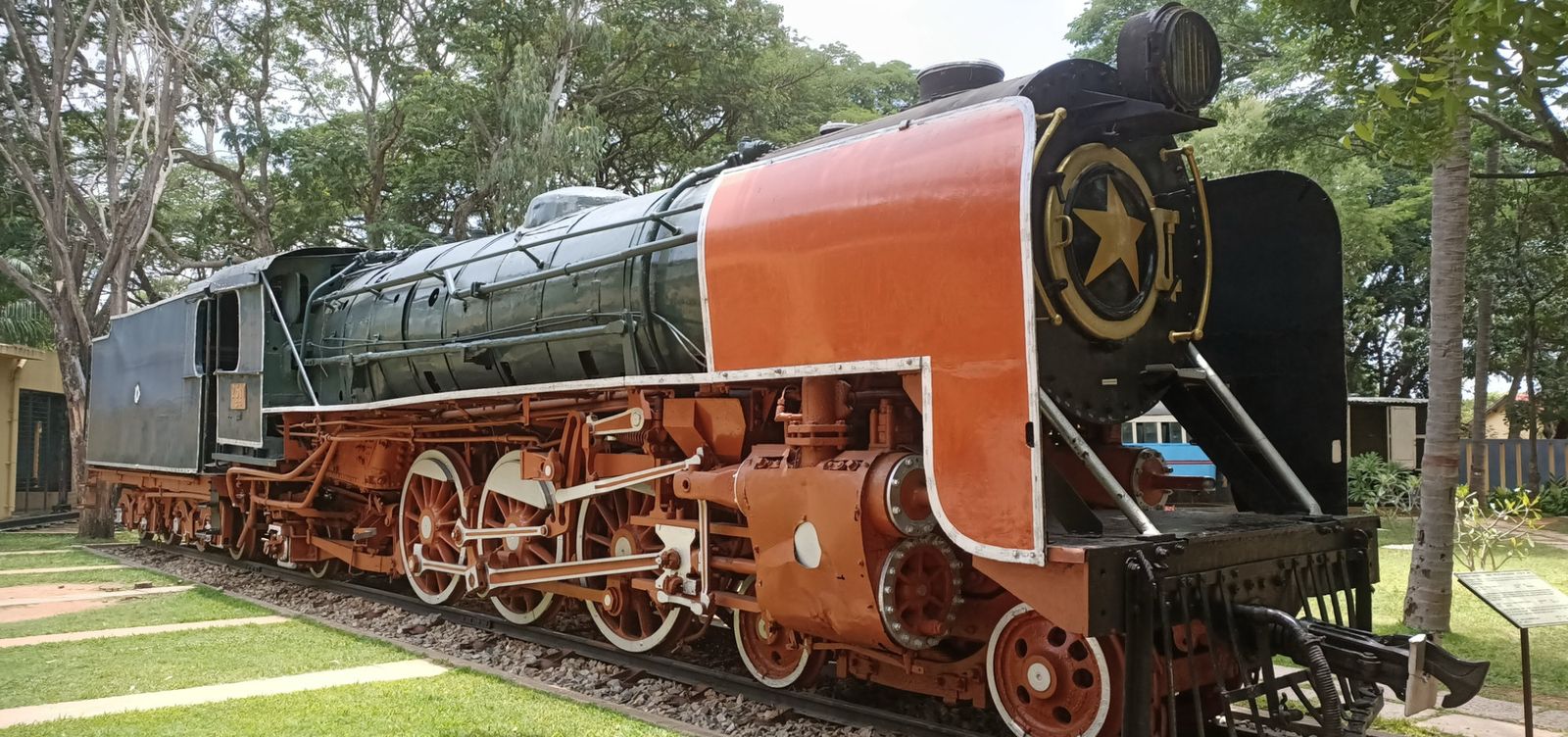
The outdoor gallery is the museum's soul. A narrow-gauge steam locomotive from 1899 occupies one end of the yard, its boiler weathered to a matte charcoal, the maker's plate from Dübs and Company of Glasgow still legible if you lean in close enough. Nearby, a mahogany-panelled rail saloon car once ferried the Maharaja of Mysore between his palaces. The wood has darkened over decades but retains a grain so fine it looks almost liquid in afternoon light.
You move between these machines on gravel paths lined with old signal posts and track switches. No velvet rope holds you at arm's length. You can press your palm flat against the flank of a locomotive and feel where heat and weather have pitted the steel over a century. That tactile honesty is rare in Indian museums, and it changes everything about how you engage with what's here.
A steam crane used for heavy lifting at rail yards stands near the western wall, its boom still extended as though caught mid-swing. The placard gives a manufacture date of 1920 and little else — a frustrating economy, because the machine has more personality than several of the exhibits inside the main building.
Small Objects, Large Truths
Step into the enclosed hall and the temperature drops a few degrees. Glass cases hold rail tickets from the early twentieth century, their cardboard stock faded to pale amber. Old photographs show Mysuru Junction under construction — workers balanced on scaffolding without a safety harness in sight. One image from 1930 captures a platform crowd so dense that the train itself nearly vanishes behind a sea of turbans and parasols.
No single exhibit makes this gallery worth your time. It's the accumulation. A brass telegraph key. A stationmaster's pocket watch. A leather-bound signal register with handwritten entries logging every train that passed through a junction in 1947, the year of independence. Nothing dramatic here. Just the residue of daily labour — and these objects tell you more about what rail travel actually felt like than any locomotive ever could.
One case holds dining car crockery stamped with the Southern Railway insignia. The plates are heavy, institutional, engineered to survive the rattle of a moving train. You can almost hear the clatter of cutlery against porcelain, catch a ghost-scent of the daal and rice served to second-class passengers on overnight journeys south.
A Ride That Earns Its Charm
A miniature train loops the perimeter of the grounds. It's designed for children, obviously. But adults climb aboard too, and nobody looks sheepish about it. The gauge is narrow, the speed barely above walking pace, the whole circuit about ten minutes. What makes it worthwhile is a shift in perspective — from the low vantage point of the miniature carriage, the full-sized locomotives loom overhead with a scale and presence that standing beside them simply doesn't convey.
The ride costs around twenty rupees. It runs on a schedule that depends largely on the operator's mood and the number of passengers gathered, so bring patience. On weekday mornings, you might have the train to yourself entirely.
The Railway That Built a Kingdom
Here's what most people miss: the Mysore railway system wasn't built by the British alone. The Kingdom of Mysore, under Krishnaraja Wadiyar IV, invested heavily in rail infrastructure during the early 1900s — and it was a calculated move. Connecting the kingdom's sandalwood forests and coffee plantations to the port at Madras meant economic leverage, not just transportation. The metre-gauge lines that fanned across the region carried more than passengers. They carried revenue, ambition, and a quiet assertion of sovereignty.
Several exhibits reference this history, though they don't always draw the connections as sharply as they should. A map near the entrance shows the network as it existed in 1935, with Mysuru at the centre of a web of lines reaching toward Bangalore, Hassan, and Chamarajanagar. Spend a moment with it. You'll understand why this city — not some larger metropolis — became the rail hub of the southern Deccan.
Before You Go
The museum sits on Krishnaraja Boulevard, roughly a kilometre from Mysuru Junction. An auto rickshaw from the station runs around forty to fifty rupees. Walking from the Devaraja Market area takes about twenty minutes along shaded roads — pleasant enough if the heat hasn't yet turned punishing.
Opening hours are 10 a.m. to 5:30 p.m., closed Mondays. Entry fees stay modest — typically around twenty rupees for Indian nationals, slightly higher for international visitors, though it's worth confirming current pricing at the gate. Photography is permitted throughout. The outdoor exhibits photograph best in late afternoon, when the sandstone-coloured buildings behind the locomotives catch warm, low-angled light.
Give yourself at least ninety minutes. The grounds aren't large, but the outdoor exhibits reward slow looking, and the indoor gallery reveals its sharpest details only to those willing to read every placard and peer into every case. Carry water — Mysore's midday heat turns hostile between March and June.
A Quiet Monument to Movement
The Mysuru Rail Museum doesn't overwhelm. It doesn't try to. What it offers is a careful, slightly worn collection of machines and objects that document how steel rails reshaped a region. You leave with grease-darkened fingertips if you've been touching the locomotives, and with a clearer sense of how the rhythms of Indian life once moved — literally — on iron wheels. In a city defined by its palace, this modest museum makes a persuasive counter-argument: the railway station mattered just as much.