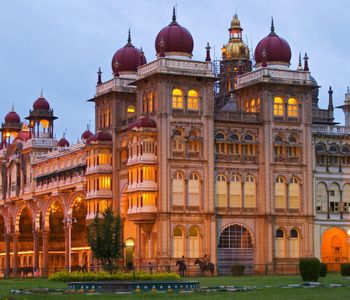
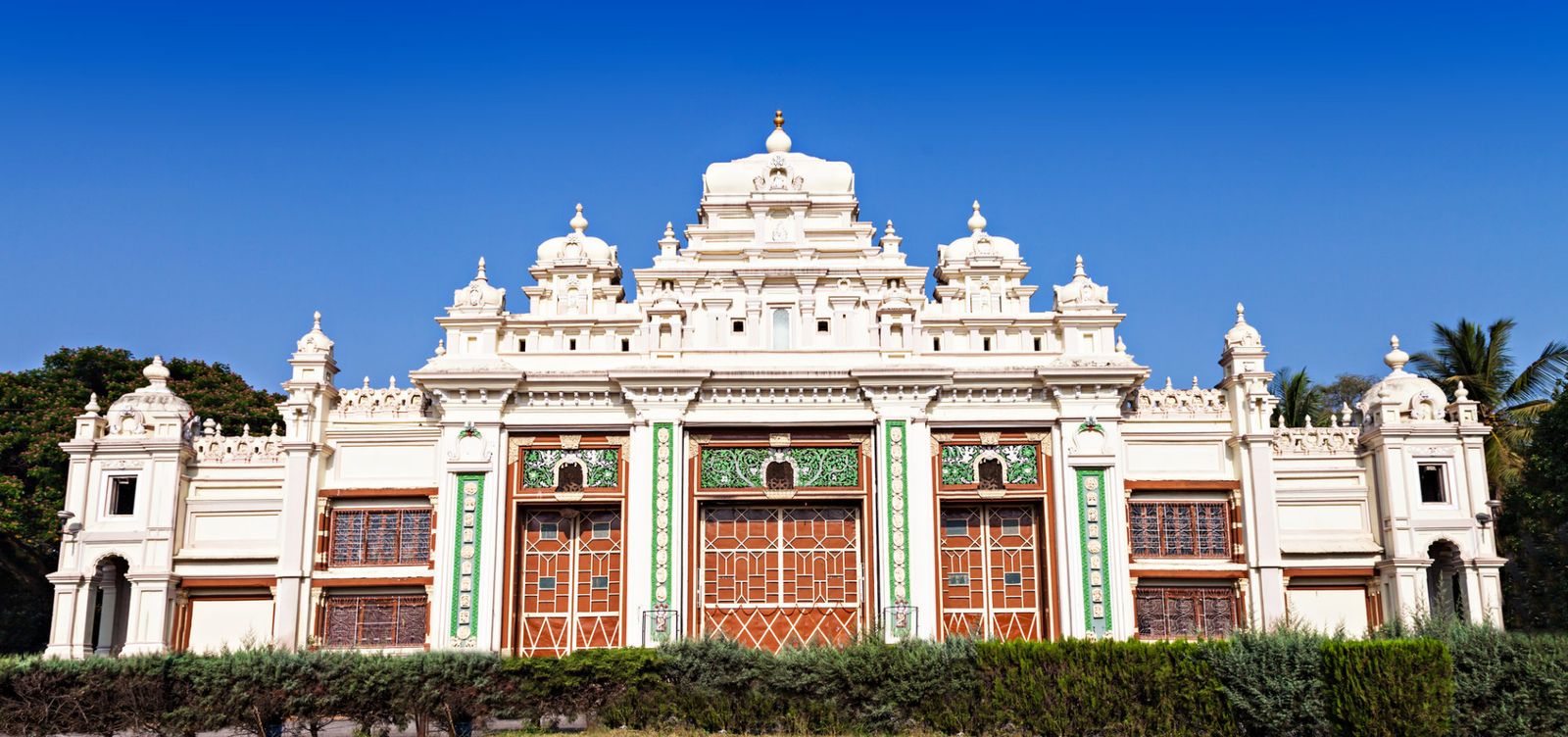
The first thing that strikes you about Jagan Mohan Palace isn't the art inside — it's the building's stubborn refusal to be overshadowed by its more famous neighbor. Sitting just a few hundred meters from the colossal Mysore Palace, this squat, three-story structure in warm ochre holds its ground with quiet authority. Built in 1861 under Krishnaraja Wodeyar III, it served as the royal residence before the main palace was completed, and later as the venue for Krishnaraja Wodeyar IV's coronation in 1902. Today, it functions as an art gallery, which sounds modest until you step inside and realize the Wodeyar dynasty took their collecting as seriously as their governing.
The palace doesn't announce itself with grandeur. It earns your attention room by room, painting by painting, artifact by oddly specific artifact. This is a place where you go expecting a gallery and leave understanding a family.
A Dynasty's Private Obsessions, Made Public
Most royal art collections tell you what a king wanted the world to see. Jagan Mohan Palace tells you what the Wodeyars actually liked. The collection spans centuries, and its range is wonderfully eccentric — works by Raja Ravi Varma, India's most celebrated painter of mythological scenes, hung alongside delicate Mysore-style paintings on wood panels where gold leaf still catches the light after a hundred years. French porcelain shares halls with traditional Rajput miniatures. Nobody curated this for coherence. They curated it for love.
One display stops most visitors cold: a collection of musical instruments that belonged to the royal family. These aren't ceremonial pieces made to look impressive in a portrait. They show signs of actual use — worn frets, smoothed fingerboards. Krishnaraja Wodeyar III was a genuine musician and composer, and the instruments reflect a man who played rather than merely patronized.
Then there are the curiosities. A set of playing cards painted on ivory. A carved rosewood model of the Dasara procession so detailed you can count individual figures in the crowd. These objects resist the sterile label of "artifact." They feel personal, almost intimate, as though someone just set them down and stepped out of the room.
The Building That Became a Throne Room
Jagan Mohan Palace was originally designed as the royal auditorium, a space for durbars and public ceremonies. Its architecture reflects that civic ambition — the central hall rises to a generous height, supported by thick columns that frame the space like a theater stage. Hindu architectural motifs run along the cornices, though the overall form borrows liberally from colonial symmetry: wide verandahs, arched windows, a flat roof that gives the facade a European weight.
What makes the building unusual is how plainly it wears its transitions. You can read its history in the walls themselves. The original structure was meant to impress visiting dignitaries, but the conversion to an art gallery in the early twentieth century softened it. Display cases now occupy spaces where courtiers once stood. The throne Krishnaraja Wodeyar IV used during his coronation still sits in the main hall — a jewel-encrusted seat elevated on a platform, surrounded not by subjects but by oil paintings. Power preserved as decoration. A strange fate for a throne.
The lighting inside is dim, partly by design and partly because the palace was built before electricity reached Mysore. This works entirely in the gallery's favor. The Mysore paintings, with their fine gold-leaf detailing on dark backgrounds, look richer in low light. Ravi Varma's mythological scenes glow rather than glare. You find yourself leaning in closer, which is exactly how these works were meant to be seen — privately, attentively, not from across a cavernous museum hall.
Ravi Varma and the Mysore School, Side by Side
The gallery holds several notable Raja Ravi Varma originals, including depictions from the Ramayana and Mahabharata rendered in the European academic style he famously adopted. His figures carry the dramatic poses and saturated palette of Victorian salon painting, but the faces and settings are unmistakably South Indian. Standing before them, you understand why Ravi Varma became a household name — he made mythology feel contemporary, urgent, almost journalistic in its immediacy.
Counterpoint comes from the Mysore school paintings displayed nearby. Where Ravi Varma worked in oils on canvas, these artists used vegetable dyes and gold leaf on wooden panels, producing images that shimmer rather than project. The themes overlap — the same gods, the same epics — but the Mysore paintings feel devotional where Ravi Varma's feel theatrical. Seeing them in the same building, collected by the same family, reveals a dynasty comfortable with contradiction.
Here's the thing nobody tells you: the lesser-known Mysore paintings are often the ones that hold you longest. Ravi Varma's technique is undeniable, but the smaller panels have a meditative quality that rewards patience. The gold leaf, applied in thin strips over a base of gesso, catches different tones as you shift your position. One painting can look warm and amber from one angle, cool and silver from another. You stop thinking about art history. You just look.
Getting There and Getting In
Jagan Mohan Palace sits on Jagan Mohan Palace Road in the heart of Mysore, a short walk west of the main Mysore Palace. Auto rickshaws from anywhere in the city will bring you to the front entrance for a modest fare — just agree on the price before climbing in, as you should with every rickshaw ride in Karnataka. From the Mysore Junction railway station, roughly three kilometers away, a taxi or rickshaw gets you there in minutes.
The gallery is open daily from 8:30 a.m. to 5:30 p.m. Entry fees are low — around 50 rupees for Indian nationals and a few hundred rupees for international visitors, though it's worth confirming current rates before arriving. Photography inside is generally restricted, which honestly improves the experience. Without a screen between you and the paintings, you're more likely to actually see them.
A weekday morning gives you the quietest visit. The gallery draws far fewer crowds than Mysore Palace, which means you can stand in front of a Ravi Varma for as long as you like without someone's selfie stick drifting into your peripheral vision. Plan for about ninety minutes to see everything properly. Longer if you're the type to read every placard — and here, the placards are worth reading.
A Collection That Outlived Its Collectors
Jagan Mohan Palace doesn't compete with the spectacle of Mysore Palace next door, and it doesn't try to. What it offers is rarer — a window into the private taste of a ruling family that governed for five centuries. The Wodeyars built temples, commissioned dams, and patronized artists across multiple traditions. This gallery is where those instincts converged into something tangible.
Walk through its dim corridors, pause before the gold-leaf panels, and you'll leave with a portrait of Mysore that no palace tour can provide. It's quieter here. That's the point.