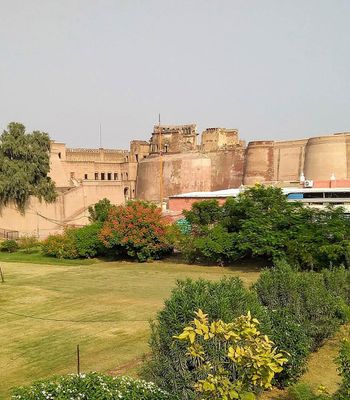
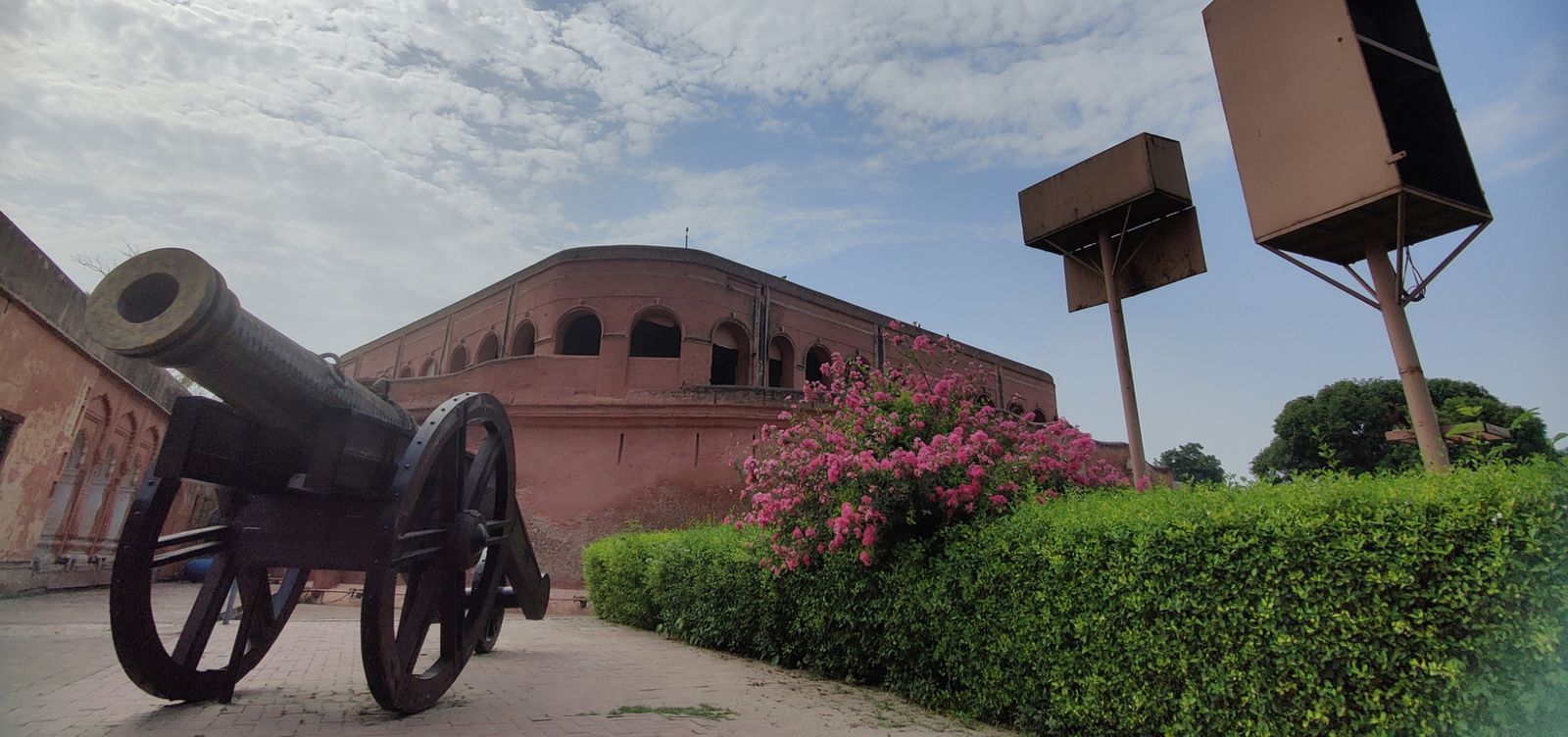
Before it sat in the British Crown Jewels, the Koh-i-Noor diamond was stored here — inside a squat, muscular fortress in the heart of Amritsar that most visitors to the city walk right past on their way to the Golden Temple. Gobindgarh Fort doesn't compete with that spiritual landmark for attention, and it doesn't try. What it offers instead is something rarer: a military structure that has been fought over by Afghans, Sikhs, and the British, yet still stands with its bastions intact, now converted into a living museum that takes its own history seriously without embalming it.
Built in the late eighteenth century and strengthened under Maharaja Ranjit Singh, Gobindgarh Fort spent nearly two centuries sealed off as an active military installation. It only opened to civilians in 2017. That means the walls you touch haven't been smoothed by generations of tourist hands. The brick still feels unmediated.
Forged Under the Lion of Punjab
The fort's story begins with the Bhangi Misl, one of the twelve Sikh confederacies that carved up Punjab in the eighteenth century. They raised a modest mud structure around 1760. But the real metamorphosis arrived when Maharaja Ranjit Singh seized Amritsar in 1805 and funneled resources into turning this rough garrison into the military nerve center of the Sikh Empire.
Under his command, mud walls became fired brick reinforced with lime mortar. The ramparts widened to bear heavy artillery. Ranjit Singh didn't build Gobindgarh to be admired — he built it to hold territory. Its low, thick profile makes that plain. Where Mughal architecture soars upward in ornamental ambition, Gobindgarh hunkers down. Walls ten feet thick in places, engineered to swallow cannonball impact rather than impress visiting dignitaries.
This is where Ranjit Singh kept the treasury of the Sikh Empire, including the Koh-i-Noor diamond, before it passed to British hands after the Second Anglo-Sikh War in 1849. The British then garrisoned Gobindgarh for over a century. After independence, the Indian Army maintained its presence until the fort was finally handed over to civil authorities.
Walking Through Walls That Remember
You enter through the Nalwa Gate, named after Hari Singh Nalwa, the legendary Sikh commander whose campaigns pushed the empire's frontier to the Khyber Pass. The gate is narrow by design — wide enough for a single elephant, tight enough to funnel invaders into a killing corridor. Step through it, and the noise of Amritsar's commercial district falls away with startling abruptness.
Inside, the fort unfolds as a series of courtyards linked by covered passages. The central area houses several museum galleries, each pinned to a different era of occupation. One room recreates the darbar of Ranjit Singh with life-sized figures and period weaponry — tulwars and flintlocks arranged in cases that catch the low light. Another walks you through the Anglo-Sikh wars with maps, replica armaments, and narrative panels that don't flinch from the brutality of those conflicts.
What surprised me most was the 7D theater experience — an oddly modern addition that uses motion seats and projected effects to dramatize the fort's timeline. It's somewhat kitschy, and the production values wobble in places, but it works as a primer for anyone unfamiliar with Sikh military history. Children, predictably, love it.
After Dark, the Fort Shifts
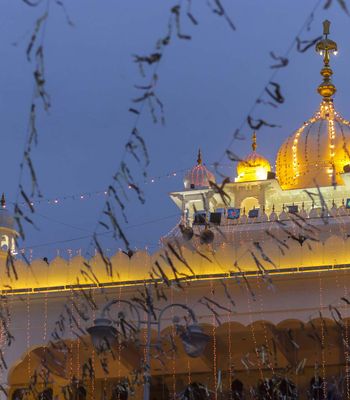
The evening sound-and-light show is the single best reason to time your visit for late afternoon. As the sun drops below the ramparts, colored lights sweep across the brick facades while a narrated performance — projected onto the walls themselves — retells the story of Ranjit Singh's conquest. The Punjabi voice acting carries genuine dramatic heft, and the fort's acoustics amplify every cannon blast in the soundtrack until you feel it in your sternum.
Shows typically run after sunset and last around forty-five minutes. The Hindi and Punjabi versions draw larger local crowds; the English screening is quieter, more contemplative. Seating is open-air on the central parade ground, so bring a light layer during winter months when Amritsar's evening temperatures dip into the low single digits Celsius.
The Practical Details
Gobindgarh Fort sits on Lohgarh Road, barely a kilometer from the Golden Temple. You can walk it in fifteen minutes or take a cycle rickshaw for a nominal fare. Auto rickshaws know it well, though older drivers still refer to the area by its military cantonment name.
Entry tickets are tiered. Basic admission covers the courtyards and museums. A premium ticket bundles in the 7D theater, the sound-and-light show, and a few additional attractions, including a coin-minting demonstration where you stamp your own replica Sikh-era coin in copper. Expect to pay around 500 rupees for the full package as a domestic visitor; foreign nationals pay a slightly higher rate. Verify current pricing at the ticket counter, as rates have shifted since the fort's reopening.
Gates open at 10 a.m. and the last entry for the evening show is typically around 7 p.m. Plan at least three hours if you want to see everything without rushing. The museum sections alone can absorb ninety minutes if you actually read the panels.
A small food court inside the fort serves Punjabi staples — paranthas, chole, lassi. The lassi is thick and arrives in clay cups, and it's better than what you'll find at most restaurants nearby. One vendor fries jalebi to order — syrup-dark, crackling hot. Worth the five-minute wait.
What Most People Walk Right Past
Walk the rampart circuit. Most people cluster around the museums and the central courtyard, but the upper walls offer a complete perimeter loop with views across Amritsar's rooftops toward the gilded dome of the Harmandir Sahib in the distance. The bastions at each corner still have their cannon embrasures intact, and standing behind one gives you a visceral sense of the fort's defensive geometry — how every angle of approach was covered, how every blind spot was eliminated.
There's a counterintuitive quiet up there, even when the courtyards below are busy. The thick walls absorb sound the way they once absorbed ordnance.
A Fort That Earned Its Place
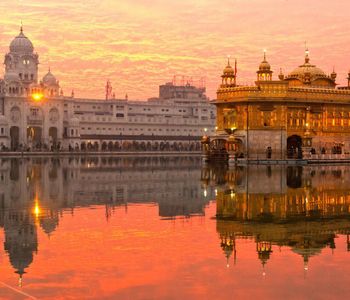
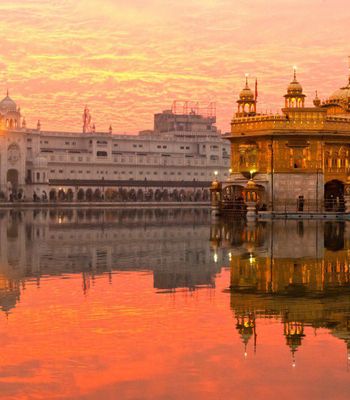
Amritsar's spiritual gravity pulls nearly every visitor toward the Golden Temple, and rightly so. But Gobindgarh Fort tells the other half of the city's story — the political, military, and imperial chapter that shaped modern Punjab. It doesn't ask for reverence. It asks for attention. Two centuries of continuous military use gave these walls a weight that no restoration can fabricate. Walk the ramparts, watch the light show, stamp your coin, and leave knowing that Amritsar holds more than one kind of gold.