In a city that trades almost exclusively in grandeur — palaces cantilevered over lake water, marble courtyards the size of cricket pitches — it's a walled garden in the northern quarter that delivers the most honest pleasure. Saheliyon Ki Bari, the Garden of the Maidens, sits barely two kilometers from The City Palace, and the contrast is the point. Maharana Sangram Singh II built it in the eighteenth century for forty-eight women who accompanied his queen as part of her dowry. Not a monument. Not a flex of Mewar ambition. A gift of companionship. That origin explains everything you'll find inside: fountains engineered to run without electric pumps, lotus pools so still they seem to hold their breath, and a scale that feels personal rather than imperial. This garden wasn't built to overwhelm. It was built to console.
A Gift Measured in Fountains
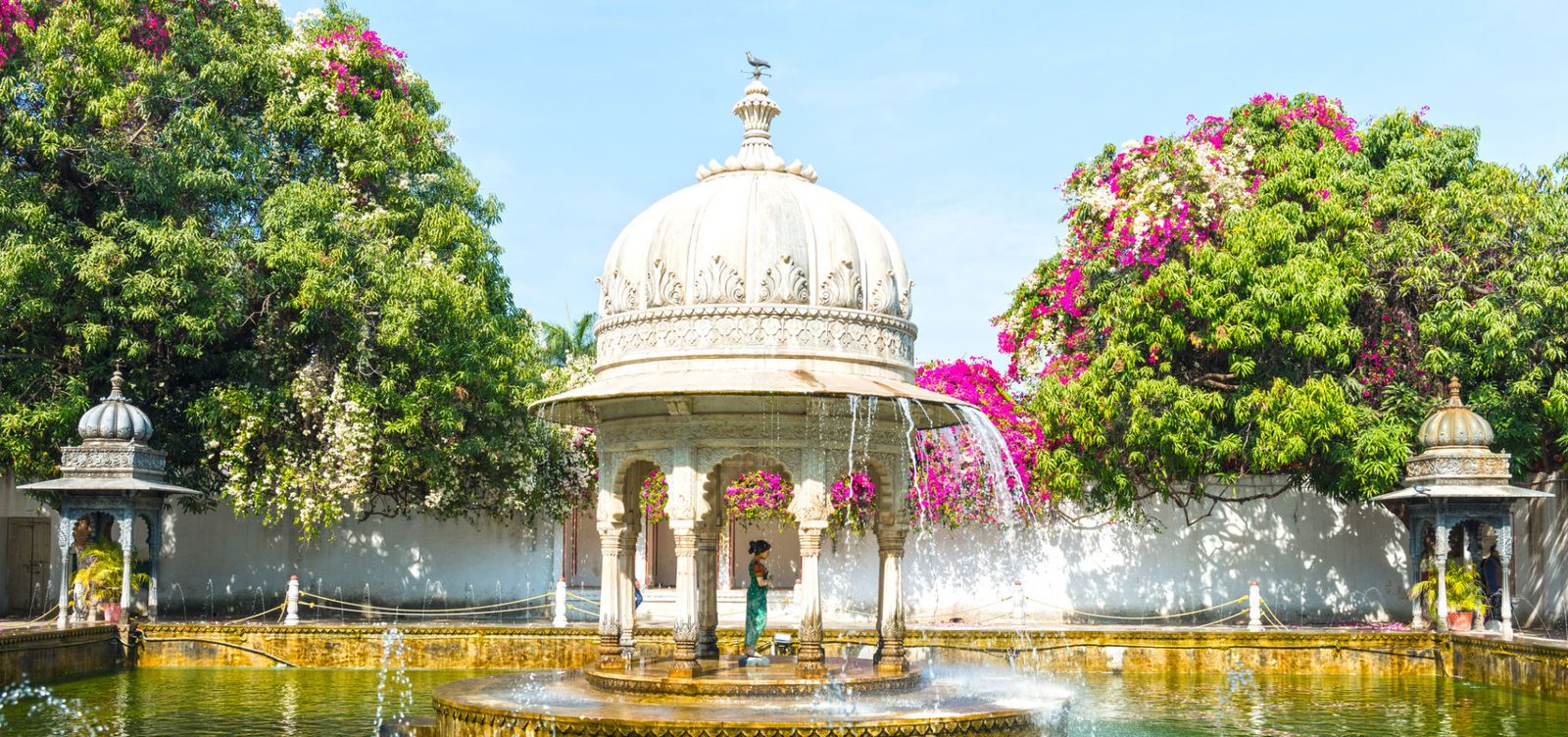
The engineering at Saheliyon Ki Bari hides in plain sight. Four principal marble fountains anchor the central courtyard, surrounded by a constellation of smaller carved jets — all of them operating on gravitational water pressure fed directly from Fateh Sagar Lake. No motors. No modern plumbing retrofits. Water runs downhill through underground channels and pushes upward through narrow stone apertures, and the system still works on the same principle it did nearly three centuries ago.
Stand near those fountains on a warm afternoon. The mist creates its own microclimate — the air temperature drops several degrees within a few steps. This was the entire idea. Sangram Singh didn't commission the garden as decoration. He commissioned it as relief. Udaipur's summers push past 40 degrees Celsius with a dry, punishing regularity. These fountains were never ornamental. They were air conditioning.
Rain transforms the place completely. During the monsoon months, the kiosk-like marble chattris surrounding the fountains begin channeling rainwater into a secondary cascade. The sound shifts from gentle spray to something closer to applause. Most guidebooks skip this entirely, but a visit during a July downpour turns the garden from pleasant stop to genuine theater. It's the difference between seeing a stage set and seeing the show.
The Women It Was Built For
Forty-eight handmaidens traveled to Udaipur with the queen, and the garden became their private retreat. This fact shaped the architecture in ways a royal pleasure garden would never have demanded. Walkways run narrow enough for two people side by side — not wide enough for a procession. The pools are shallow, wading depth, not swimming depth. Pavilions were scaled for conversation, not ceremony.
There's a directness to this design philosophy that feels almost contemporary. No grand axis drawing your eye to a vanishing point. No symmetrical beds performing geometric obedience. The layout curves and bends instead, encouraging wandering rather than marching. The women who spent their afternoons here weren't meant to be impressed. They were meant to feel at ease.
One detail that rarely gets mentioned: the garden's perimeter walls stand high enough to block sightlines from surrounding streets, but low enough to let in the late afternoon breeze off Fateh Sagar. Someone thought hard about that calibration between privacy and ventilation. The result is a space that feels enclosed without feeling trapped — a distinction most walled gardens botch entirely.
Stone Elephants and Quiet Pools
Past the fountain courtyard, a row of marble elephants lines the edge of a long rectangular pool. Each one holds water in its trunk and releases it in a thin arc that drops into the surface below. The craftsmanship is solid rather than spectacular — these aren't the hallucinatory carvings of Ranakpur or the Jain temples at Mount Abu. Their charm is proportional. They're just large enough to anchor the scene without competing with the water itself.
The lotus pool, adjacent to this section, is where the garden turns contemplative. Green lily pads crowd the surface, and during bloom season — typically August through October — pink and white lotus flowers open in the early morning hours. Arrive before nine, and you'll catch them fully unfurled. By noon, most have begun to close. The surrounding stone benches carry centuries of wear from people who understood this timing. So should you.
A small museum occupies a building at the garden's rear. The collection is modest — some royal paintings, a handful of Mewar-era handicrafts, an assortment of stone inscriptions. It won't hold you for more than fifteen minutes. But the building itself, with its carved jharokha windows and cool stone interior, offers a genuine pause on a hot day. Go for the architecture, not the exhibits.
Getting There Without the Headache
Saheliyon Ki Bari sits along Moti Magri Road, roughly a ten-minute auto rickshaw ride from the City Palace area. You'll need to negotiate the fare — thirty to fifty rupees is reasonable from the old city, though drivers near the major sights will open at double. If you're staying near Fateh Sagar Lake, it's an easy walk, under fifteen minutes along a straightforward road.
The garden opens at 9 a.m. and closes at 7 p.m. daily. Entry runs around fifty rupees for Indian nationals and slightly more for international visitors, though exact prices shift periodically. A camera fee may apply; enforcement varies. The grounds aren't large. Forty-five minutes covers everything comfortably. An hour if you linger at the lotus pool or duck into the museum.
Weekday mornings draw the thinnest crowds. Weekends and holidays bring school groups and families, and the noise undercuts the garden's essential character. If silence matters to you — and in this particular place, it genuinely should — plan accordingly.
Weaving It Into a Morning
Because the garden sits near Fateh Sagar Lake, combining the two into a single morning makes clean logistical sense. Start at Saheliyon Ki Bari when it opens, then walk south to the lake for a boat ride or a stop at Nehru Garden on the island. The Vintage Car Museum is also within easy reach — a peculiar collection of royal automobiles that operates on an entirely different register of Mewar extravagance.
For food, the stretch between the garden and the lake hosts several small restaurants serving Rajasthani thali meals. The seating is basic, the menus handwritten, and the dal bati churma at any of them will be better than what arrives on a hotel buffet tray. Here's the only test you need: count the locals versus the tourists at the tables. Eat where the ratio favors the former.
A Garden That Remembers What It's For
Udaipur's palaces demand your awe. Its lakes command your camera. Saheliyon Ki Bari asks for something quieter — your attention. In a city that can feel like it's performing for an audience, this garden does the opposite. It was built for women who already lived inside a palace and needed somewhere that didn't feel like one. Three centuries on, that impulse still translates. The fountains still run on gravity. The lotus still opens at dawn. The walls still hold the afternoon breeze exactly as someone intended. Some designs simply don't need improving.