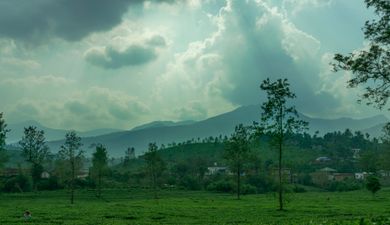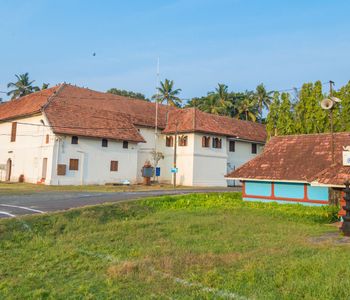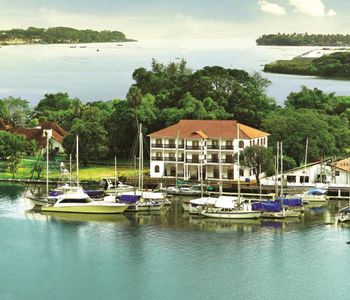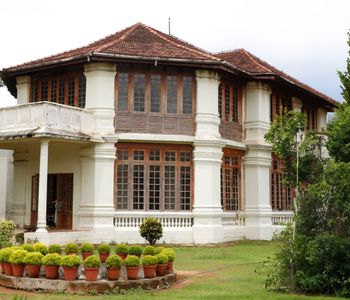
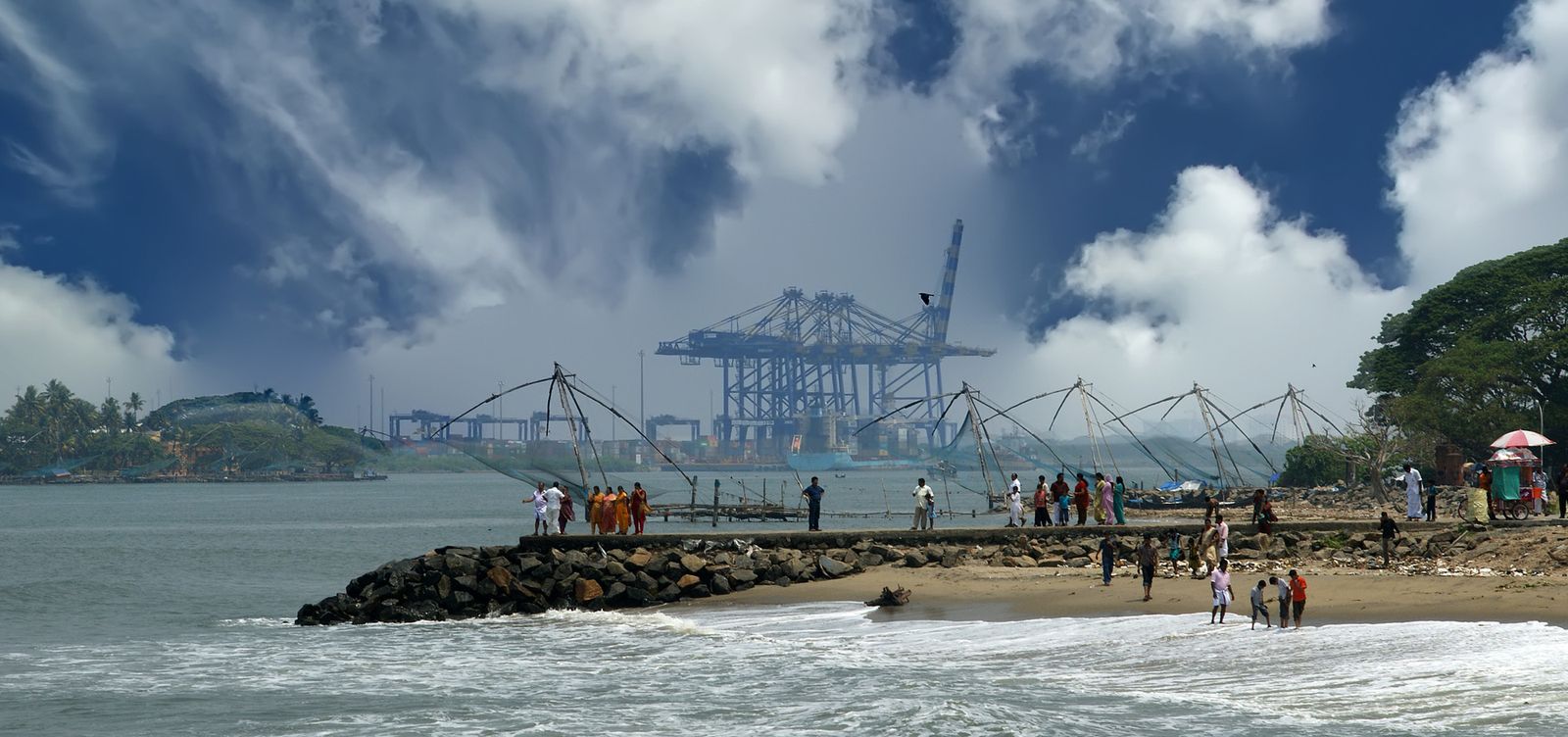
The first thing that strikes you isn't the architecture or the history — it's the light. Late afternoon in Fort Kochi casts everything in a warm, honeyed glow: the peeling facades of colonial mansions, the tangled fishing nets rising from the sea, the weathered walls splashed with street art. This small peninsula on Kerala's southwestern coast holds five centuries of layered history in its narrow lanes, and it wears every era like a well-loved garment.
Portuguese churches stand shoulder to shoulder with Dutch gabled warehouses. British colonial verandas overlook streets where the aroma of fish curry drifts from open doorways. And along the waterfront, enormous Chinese fishing nets — believed to be older than any European presence here — still dip into the Arabian Sea at dawn, just as they have for over six hundred years.
Originally established as a Portuguese trading post in 1503, Fort Kochi passed through Dutch and then British hands before India's independence in 1947. What makes it extraordinary is how little has been erased. Unlike so many Indian towns reshaped by rapid modernization, this waterfront neighborhood has held on to its heritage with fierce, almost stubborn, authenticity. For anyone exploring Kerala, there's no better place to begin.
Five Hundred Years, Written in Stone and Spice
The story starts in 1500, when Portuguese explorer Pedro Álvares Cabral struck a trading relationship with the local ruler of Cochin. Three years later, Fort Emmanuel rose on this very peninsula — Europe's first colonial foothold in India. Pepper, cardamom, and cloves flowed out through the port, and Kochi's position along the Malabar Coast made it one of the most fiercely contested harbors in the Indian Ocean.
Then came the Dutch. In 1663, the Dutch East India Company seized control after a prolonged siege, tearing down Portuguese fortifications and stamping their own architectural identity onto the town. Nearly 130 years later, the British arrived in 1795 and stayed until 1947. Each colonial power reshaped the streets, built new landmarks, and left behind cultural fingerprints that remain strikingly legible today.
Walk slowly here. Every crumbling wall, every carved doorframe, every faded inscription tells a chapter of a story that spans half a millennium of international trade, ambition, and cross-cultural collision.
Landmarks That Breathe History
St. Francis Church — India's Oldest European Church
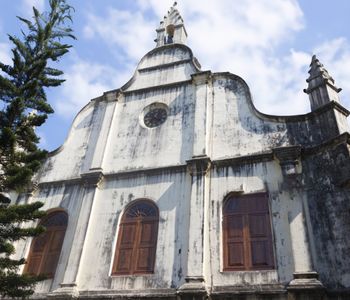
Step through the heavy wooden doors of St. Francis Church and the noise of the street falls away. Built by Portuguese Franciscan friars in 1503, this is the oldest European church in India, and its cool, whitewashed interior still carries a profound sense of stillness. Vasco da Gama himself was buried here in 1524 — his original gravestone remains inside, worn smooth by time, though his remains were eventually shipped back to Lisbon.
Over the centuries, the building shifted from Catholic to Dutch Reformed to Anglican, and each transition left subtle marks: a modified arch here, a different plaster texture there. You're not just looking at a church. You're reading the autobiography of a town.
Santa Cruz Cathedral Basilica — Pastel Grandeur and Painted Ceilings
Originally raised by the Portuguese in 1505 and elevated to cathedral status by Pope Paul IV in 1558, Santa Cruz was demolished by the Dutch and then rebuilt under British permission in 1887. The current structure, completed in 1902, is a visual feast — Gothic arches, soft pastel walls, and ceiling murals so vibrant they seem to glow in the filtered light.
Linger near the ornate altar and tilt your head upward. The painted panels overhead deserve the kind of unhurried attention usually reserved for European cathedrals, and yet this one stands on a quiet Indian street where roosters crow outside and coconut palms sway over the compound wall.
The Dutch Cemetery — Whispered Names and Weathered Stone
A short walk from St. Francis Church, the Dutch Cemetery sits behind a low gate, shaded by old trees and hushed even at midday. Dating back to 1724, it's one of the oldest European burial grounds in India. Tombstones bear Dutch and British inscriptions — names, dates, fragments of lives lived far from home and never completed.
It's a small space, easily visited in fifteen minutes. But something about the moss-covered headstones and the dappled silence invites you to slow down and stay a little longer.
Giants of the Waterfront: The Chinese Fishing Nets
There's a moment, just before sunset, when the massive cantilevered nets along Fort Kochi's shore rise against a sky streaked in amber and violet — and every camera on the waterfront clicks at once. These iconic structures, known locally as cheena vala, are believed to have arrived with Chinese traders during the court of Kublai Khan in the 14th century. They predate every colonial building in town.
Each net operates on an elegantly simple counterweight system. A team of fishermen heaves in unison to lower the net into the Arabian Sea, waits, then hauls it skyward, dripping and (hopefully) full. Early mornings and late afternoons are the best times to watch the ritual — rhythmic, communal, unchanged for centuries despite every technological revolution happening around it.
Here's the best part: fishermen sell their catch right on the spot. Buy a glistening mackerel or a handful of prawns, carry them to one of the nearby vendors, and within minutes you'll be eating the freshest meal of your trip — grilled over coals, seasoned with salt and lime, the taste of the sea still on your lips.
Where Street Art and Biennale Collide
Fort Kochi's creative pulse might surprise you. Every two years, the Kochi-Muziris Biennale — the largest art biennale in South Asia, established in 2012 — transforms warehouses, heritage buildings, and open-air spaces across the peninsula into a sprawling contemporary art exhibition that draws artists and visitors from around the globe.
But you don't need a biennale ticket to feel the town's artistic energy. Independent galleries hide behind unassuming doorways. Murals explode across residential walls — a giant octopus here, a surrealist portrait there — catching you mid-stride as you wander a lane you hadn't planned to explore. Art cafés double as exhibition spaces, serving strong filter coffee alongside installations that riff on colonialism, identity, and the ocean.
Spend a few unhurried hours drifting through these creative spaces and you'll sense something rare: a place where centuries of layered history haven't become a museum piece, but a living source of inspiration.
A Feast Shaped by the Spice Trade
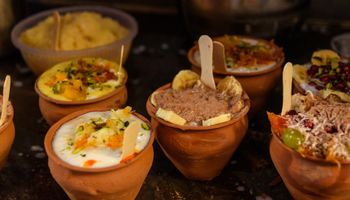
Kerala's food is bold, aromatic, and unapologetically coconut-rich — and Fort Kochi serves it at its coastal best. Menus here revolve around the sea: karimeen (pearl spot fish) pan-fried in a masala crust, fat prawns simmered in tangy coconut curry, crab cracked open and eaten with your hands while the ceiling fan whirs overhead.
Centuries of Portuguese influence linger in the kitchen, too. You'll find dishes that blend European techniques with Kerala's signature curry leaves, black pepper, and kokum — a culinary conversation that started 500 years ago and never stopped.
Mornings call for appam — delicate, lace-edged rice pancakes — scooped through a fragrant vegetable stew. Or try puttu with kadala curry: cylinders of steamed rice and coconut served alongside spiced chickpeas. Both are best eaten at no-frills local eateries where the food is extraordinary and the bill is almost comically small.
Along Princess Street and Burger Street, the options widen — traditional thali meals alongside fusion cafés that play with Kerala flavors in unexpected ways. And don't walk past the tiny tea stalls without stopping. A cup of milky, cardamom-laced chai costs just a few rupees, and the vendor might just become the best conversation of your day.
Navigating the Peninsula
Fort Kochi rewards slowness. Its compact layout is made for walking — every turn reveals a new doorway, a new mural, a new cat asleep on a colonial windowsill. Rent a bicycle from one of the many guesthouses or shops (available by the hour or day) and you'll cover even more ground at exactly the right pace.
Auto rickshaws zip you easily between Fort Kochi and neighboring Mattancherry, where the famous Jew Town and Mattancherry Palace await. From Ernakulam, the commercial heart of greater Kochi, public ferries make regular crossings — the short harbor ride delivers gorgeous views of the shoreline and is honestly one of the most enjoyable ways to arrive anywhere in India.
Cochin International Airport sits roughly 30 kilometers away. Taxis and pre-booked rides will have you in Fort Kochi within an hour, depending on traffic.
When to Go and What to Know
October through March is the sweet spot. The monsoon has packed up, the air is warm but not punishing (expect 23–32°C), and the light is gorgeous for wandering and photography. Planning around a biennale year? Exhibitions typically run December through March — book early, because the town fills up fast.
Most landmarks charge little or nothing for entry, keeping Fort Kochi firmly in budget-friendly territory. Heritage homestays and cozy guesthouses line the quieter streets, offering far more character than a hotel chain ever could — though snagging your first choice during peak season means reserving ahead.
Two to three days gives you room to explore every major site, eat spectacularly well, and still have those unstructured hours where the best travel memories tend to form — an unexpected conversation, a hidden courtyard, the sound of church bells mixing with the evening call to prayer across the water.
Fort Kochi doesn't rush. It doesn't shout. It simply exists, quietly astonishing, on a small peninsula where five centuries of history, a thriving art scene, and the everyday rhythms of Kerala life have woven themselves into something you won't find anywhere else in India. Come here, walk slowly, and let it unfold.