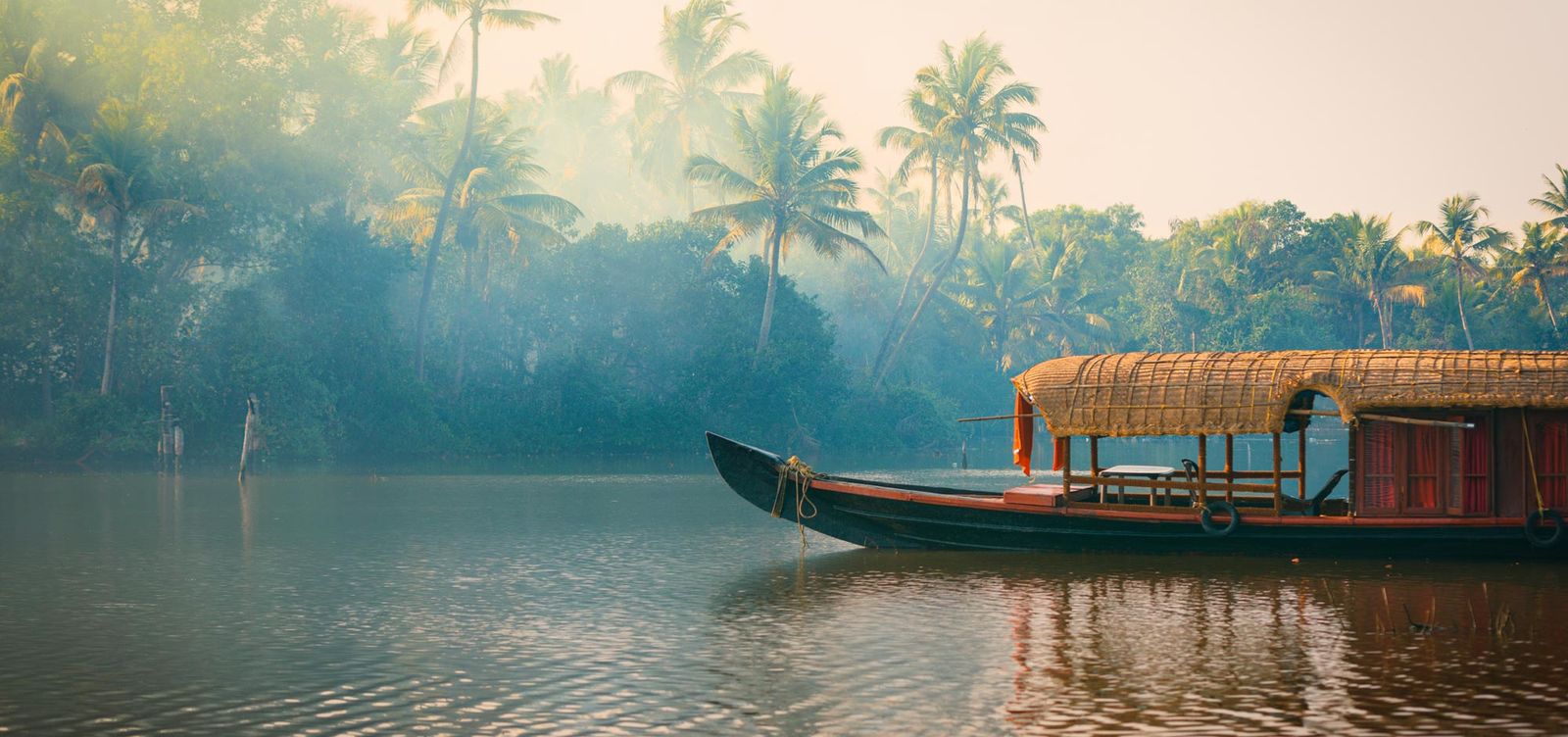


The engine cuts out somewhere past Kumarakom, and suddenly the only sound is water lapping against the hull — a soft, irregular rhythm that rewires your nervous system within minutes. The boatman poles you through a corridor of coconut palms so dense they form a green cathedral overhead, and you realize you've lost all sense of urgency. You couldn't find it again if you tried.
Kerala's backwaters are not a lake or a river but a labyrinth — over 900 kilometers of interconnected canals, lagoons, and waterways that snake through the southern tip of India like veins through a leaf. A houseboat night here isn't a cruise. It's a slow dissolution of everything you thought you needed.
But the experience varies wildly depending on what you book, where you board, and how much you spend. Some houseboats are floating five-star rooms; others are glorified barges with a mattress. This guide covers every practical decision — boat types, routes, costs, the extraordinary food — so the only surprise left is how completely the silence gets under your skin.
Nine Hundred Kilometres of Water That Refuse to Reach the Sea
The backwaters aren't a lake, a river, or a lagoon. They're all three at once — a sprawling, interconnected labyrinth of brackish canals, tidal estuaries, and freshwater lakes that stretches along nearly half of Kerala's coastline. The whole system runs parallel to the Arabian Sea, separated from it by a slender ribbon of land so narrow that in places you could throw a stone from the surf into the still water on the other side.
What strikes you first isn't the beauty. It's the silence. Five minutes off the main channel, the outboard motors fade and the world contracts to the sound of water lapping against palm-fringed banks, the occasional slap of a Chinese fishing net being lowered, and the surprisingly loud croak of a kingfisher you'll hear long before you spot it.
Life here hasn't been preserved for anyone's benefit — it simply never left. Women wash clothes at stone steps that have been worn smooth by decades of use. Toddy tappers shimmy up coconut palms at dawn with a casualness that borders on contempt for gravity. Children paddle to school in dugout canoes barely wider than their shoulders. The backwaters function as road, marketplace, and front yard simultaneously.
The most counterintuitive thing about this network is that it's not wilderness. It's densely populated. Villages line the banks continuously, and the water serves as the connective tissue of an entire civilization. That's precisely what makes it extraordinary — you're not floating through a nature reserve, you're floating through someone's neighbourhood, and they barely glance up. The landscape absorbs you rather than performing for you, which is rarer than any scenic view.
From Floating Palace to Modest Canoe: Choosing Your Vessel
Not all kettuvallams are created equal. The word itself — meaning "tied boat," from the way coconut fibers once lashed planks together — covers everything from a bare-bones single-bedroom barge to a three-story floating hotel with a jacuzzi on the upper deck. The range is absurd, and your choice shapes the entire experience.
The standard option is a one-bedroom houseboat, which is really all most couples need. You get a furnished bedroom with attached bathroom, a small covered sitting area at the bow, and a kitchen where a cook works miracles with a two-burner stove. These boats move slowly, close to the water, and that proximity matters — you'll hear the lap of the canal against the hull as you fall asleep.
Premium and luxury boats add air conditioning, larger sundeck areas, and sometimes two or three bedrooms for families or groups. Some come with fishing rods, kayaks, even flat-screen televisions — though turning on a TV while drifting through palm-fringed waterways feels like a minor crime against beauty. The real upgrade with premium boats isn't the amenities; it's the build quality. Sturdier hulls mean less engine vibration, which means better sleep.
Then there's the shikara — a smaller, uncovered canoe-style boat that threads through narrow canals the kettuvallams can't reach. No overnight stay, but if you want to actually see village life up close — women washing clothes at the water's edge, toddy tappers shimmying up coconut palms — the shikara gets you there. The houseboat gives you atmosphere. The shikara gives you intimacy.
One honest note: the cheapest houseboats often share routes and anchor spots, meaning you'll spend the night parked alongside six other identical vessels. Privacy, in Kerala's backwaters, has a price.
Where You Begin Changes Everything You'll See
Alleppey gets all the attention, and honestly, it earns most of it. The network of canals radiating from this town is the densest in the backwaters, and the majority of houseboat operators launch from the Punnamada jetty or Finishing Point area. But that popularity comes with a cost — during peak season, you'll find yourself in a slow-moving procession of kettuvallams, diesel fumes mixing with the coconut-scented air, the illusion of solitude thoroughly punctured.
Kumarakom, on the eastern shore of Vembanad Lake, offers a quieter alternative without sacrificing much. The routes here drift through narrower waterways lined with paddy fields, and the birdlife around Kumarakom Bird Sanctuary adds a soundtrack — egrets, cormorants, the occasional kingfisher dropping like a blue stone into the water. It's slightly more expensive than Alleppey, but the trade-off in peace is real.
Then there's Kollam, which most travelers overlook entirely. The Kollam-to-Alleppey route is the longest navigable stretch in the backwaters, running roughly eight hours through Ashtamudi Lake and into progressively narrower channels. If you want the full arc of the landscape — open lake giving way to village canals where children wave from cement bridges — this is the route that delivers it. Few houseboats operate from here, which is precisely the point.
Kottayam works as a starting point if you're arriving from the Periyar region and want to minimize road time. The routes tend to be shorter, the boats fewer, the experience more stripped back. Not every traveler needs the grand tour. Sometimes a single quiet canal at dusk is worth more than eight hours of scenery you're too exhausted to absorb.
Below Deck: Your Floating Room, Honestly Assessed
The first thing you notice stepping aboard a kettuvallam isn't the room — it's the creak. These boats are built from anjili wood and coir rope, and they speak to you in a low, rhythmic groan as the hull settles into the water. It's the sound your accommodation makes when it's alive.
Rooms vary wildly depending on what you've booked. A standard single-bedroom houseboat gives you a surprisingly large bed — usually a double with clean white sheets — an attached bathroom with a working shower, and an air-conditioning unit that earns its keep after sundown. Don't expect five-star fixtures. The plumbing is functional, the towels are thin, and the mirror might be slightly too small. None of that matters once you slide open the window and the backwaters are six inches from your pillow.
Premium and luxury boats add sitting areas, upper sun decks with cane loungers, and bathrooms with actual hot water pressure. Some carry two or three bedrooms, making them workable for families or small groups. The best ones feel like someone converted a modest lake house onto a barge — comfortable without pretending to be a resort.
What surprises most people is the crew. Even budget houseboats typically come with three: a captain who steers from the rear, a guide, and a cook working out of a galley roughly the size of a phone booth. The cook, invariably, produces meals that have no business coming from a kitchen that small.
One honest note: the generator hum at night can be intrusive on cheaper boats. If you're a light sleeper, ask specifically about generator placement before booking. The difference between a good night and a restless one often comes down to that single detail.
Where the Water Takes You — And Why It Matters
Not all backwater routes are equal, and picking the wrong one can mean spending your evening motoring past concrete embankments instead of palm-fringed canals. The Alleppey to Kumarakom route is the most popular for good reason — it crosses Vembanad Lake, the largest in Kerala, where the horizon dissolves into a silver haze of water and sky. But popularity has a cost. During peak season, you'll share the lake with dozens of other kettuvallams, their generators humming in unison like an orchestra nobody asked for.
The smarter move is to request the narrower canal networks south of Alleppey, toward Kainakary and Champakulam. Here the waterways tighten to the width of a village road, and your houseboat drifts close enough to the banks that you can smell the jasmine in someone's garden. Cormorants dry their wings on wooden stakes. A woman washes rice at the water's edge, unbothered by your slow passage. This is where the backwaters feel genuinely inhabited rather than staged.
The Kollam to Alleppey route stretches roughly eight hours and covers the longest navigable distance — an ambitious choice if you want variety, passing temples, coir-making villages, and the Mata Amritanandamayi ashram along the way. It demands an early start and a tolerance for long stretches of open water that lack the intimacy of the canals.
What most operators won't tell you: the real magic happens after the engine cuts out. Around five in the evening, houseboats are required to anchor for the night. That stillness — the water going glassy, the only sound a kingfisher hitting the surface — is the route nobody can map for you. It finds you wherever you stop.
The Kitchen That Floats: Eating Your Way Through the Backwaters
The cook works in a space no bigger than a closet, squatting over a single burner at the stern, and somehow produces meals that would embarrass restaurants ten times the size. This is the paradox of houseboat dining — the tighter the kitchen, the better the food.
Lunch arrives on a banana leaf, and it arrives seriously. A mound of red rice anchors the spread, surrounded by a slow procession of dishes: fish curry darkened with kudampuli (a smoky, sour tamarind native to Kerala), a dry thoran of cabbage and coconut, sambar with drumstick, aviyal thick with yogurt and coconut, and a rasam so peppery it clears your sinuses before the second sip. The fish changes depending on what the cook bought that morning at the waterside market — karimeen, the pearl spot, is the backwater standard, pan-fried in a masala paste and served whole.
Dinner follows a similar architecture but shifts key ingredients. Prawns appear, often cooked in a coconut milk curry that's gentler than lunch's sharper flavors. Appam — lacy, fermented rice pancakes with crisp edges and a soft, spongy center — replace the rice. The sweetness of the appam against the heat of the curry is one of those combinations that seems obvious once you taste it, and impossible to replicate at home.
Breakfast tends toward simplicity: puttu (steamed rice cylinders layered with coconut) and kadala curry, or dosa with an arsenal of chutneys. Tea comes strong and milky, served in small steel tumblers while the morning mist still sits on the water. You won't go hungry. The real risk is torpor — eating this well in heat this gentle, on water this calm, makes staying awake after lunch a genuine act of will.
The Price of Floating: What Your Wallet Should Brace For
Kerala's houseboat market runs on a tiered system that's remarkably transparent once you understand the logic. A standard one-bedroom houseboat — decent condition, functional AC, three meals included — starts around 6,000 to 8,000 rupees per night for two people during the off-season. That's roughly 70 to 95 US dollars, and it covers more than you'd expect: a crew of three, all meals, and a route through the canals of your choosing.
Jump to the premium category and you're looking at 12,000 to 20,000 rupees. The difference shows up in details: thicker mattresses, upper-deck lounging areas with cushioned seating, fresher paint, and a cook who actually cares whether the fish curry sings or merely functions. Some premium boats offer two or three bedrooms, which drops the per-person cost considerably if you're traveling as a group.
Luxury houseboats — the ones with glass-paneled rooms, jacuzzis, and wine service — can run 25,000 rupees and well beyond. Whether that's worth it depends on how much the boat itself matters to you versus the waterscape outside it. The canals don't change at any price point. A kingfisher diving for breakfast looks exactly the same from a budget deck.
Peak season, roughly November through February, inflates everything by 30 to 50 percent. Weekends and holidays push rates higher still. The sharpest move is booking a midweek trip in September or early October — the monsoon is fading, the water levels are generous, the greenery is almost absurdly lush, and operators negotiate freely. One thing worth knowing: the cheapest boats often skip AC after 10 PM to save on generator fuel. Ask directly before you book, or you'll discover this at the worst possible hour.
The Honest Verdict: What That Night on the Water Actually Gives You
Here's what nobody tells you before you book: the houseboat itself isn't the point. The kettuvallam is just a floating platform that puts you in the right place at the right time — drifting through a landscape that operates on a clock most of the world forgot decades ago. The value isn't in the vessel. It's in the slowness it forces on you.
There are legitimate reasons to skip it. If you're prone to restlessness, twenty hours on a boat with no Wi-Fi and limited mobility will feel like a sentence, not a vacation. Couples expecting luxury resort standards from a converted rice barge will be disappointed. And if you book the cheapest option in Alappuzha during peak season, you'll spend the night parked hull-to-hull with forty other boats in a diesel-scented traffic jam, which is about as romantic as a marina parking lot.
But do it right — choose a quieter departure point, pay for a decent boat with an attentive crew, and let the afternoon unspool without an agenda — and something shifts. The canals narrow. Kingfishers flash past at eye level. Your cook pulls a whole karimeen from a banana leaf and the smell alone justifies the fare. Night falls fast, and the silence that settles over the water is so complete you can hear coconuts dropping on the far bank.
That silence is the thing you'll remember. Not the boat, not the food, not the selfies at golden hour. The silence, and the strange realization that you haven't checked your phone in six hours and didn't notice.
Worth it? If you approach it as an experience in subtraction rather than addition — fewer distractions, fewer choices, fewer sounds — then yes. Completely.
The backwaters don't ask much of you. Just that you slow down, watch the coconut palms bend toward their own reflections, and let the hours blur into something unstructured and whole. A single night aboard a kettuvallam won't change your life — that's the wrong expectation. But it will remind you what stillness actually feels like, which in this frantic age might be worth more.
Book the boat. Pick a weekday if you can, when the waterways thin out and the silence between villages grows longer. Bring a book you never finish. Let the crew cook you karimeen in banana leaf while the sky turns the color of ripe jackfruit. And when the engine cuts at dusk and the only sound is water lapping against wood — stay there. Just stay.