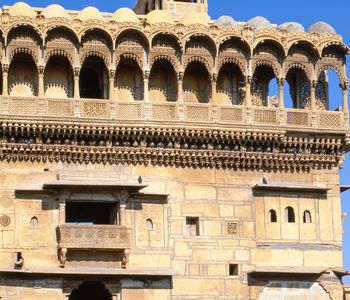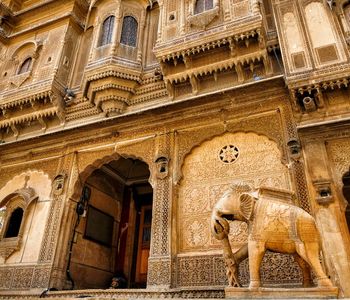
Five mansions, five sons, and sixty years of relentless artistry carved into golden sandstone — that's the story of Patwon Ki Haveli, the crown jewel of Jaisalmer's old city. The moment you step into the narrow lane that leads to its towering facade, the sheer ambition of the place stops you mid-stride. Hundreds of ornamental balconies rise above you, each one chiseled with such impossible detail that the stone seems to breathe. This isn't just a haveli — it's a love letter written in sandstone by one of 19th-century India's wealthiest merchant families, and every corridor, every painted ceiling, every sun-warmed rooftop terrace still whispers their story.
A Fortune Built on Brocade and Jewels
Guman Chand Patwa made his money in brocade cloth and jewelry — and he spent it lavishly. Between 1800 and 1860, he commissioned not one but five interconnected mansions, one for each of his sons, creating the grand complex that greets visitors today.
The Patwa family belonged to the Oswals, a powerful merchant class whose trading networks stretched across India and deep into Central Asia. Their home wasn't just a residence — it was a statement, a declaration of status broadcast in stone to every trader and traveler passing through Jaisalmer's Silk Road corridors.
Though the family eventually moved on, the havelis endured. Today, portions fall under the care of the Archaeological Survey of India while other sections remain privately owned — a layered arrangement that gives the complex a fascinating, lived-in texture you won't find in a standard museum.
Stone That Glows Like Honey at Sunset
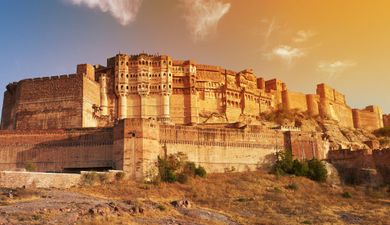
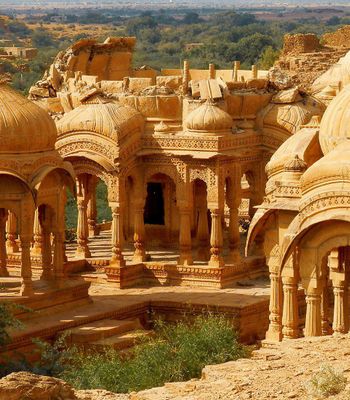
Every surface here demands your attention. Constructed entirely from Jaisalmer's signature golden-yellow sandstone, Patwon Ki Haveli melts into the cityscape at midday and then, as the afternoon light deepens, seems to catch fire — warm, amber, almost edible.
A Facade That Takes Your Breath Away
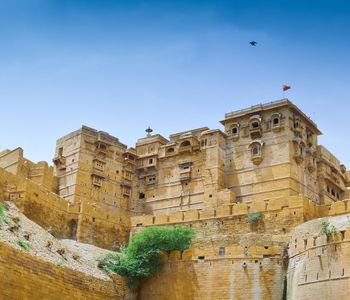
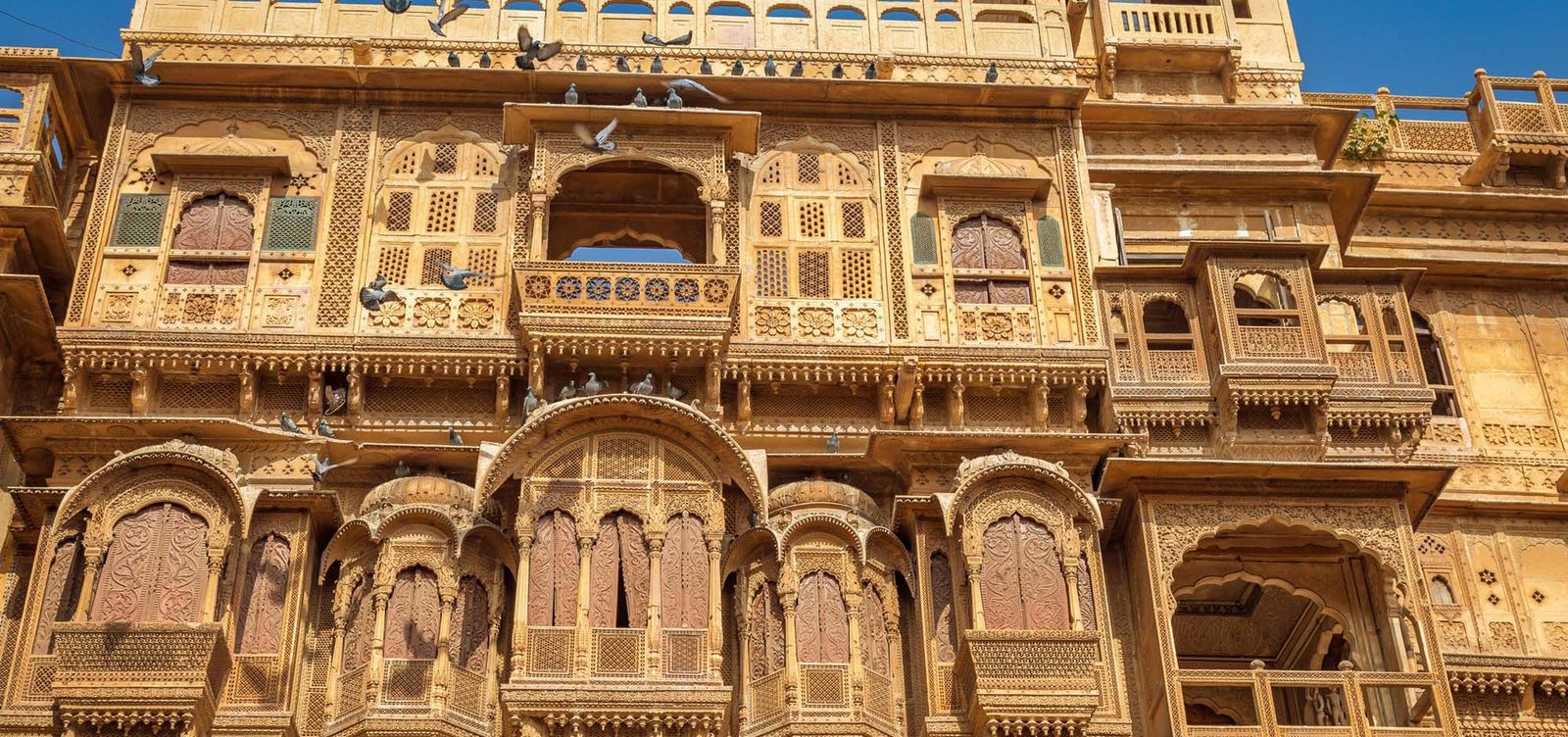
The first haveli in the row is the showstopper. Its five-story facade looms over the narrow lane, rows upon rows of jharokhas — ornamental balconies — cascading down its front like frozen lace. Try counting them. You'll lose track somewhere past a hundred.
Master craftsmen spent years — entire careers — chiseling floral motifs, geometric patterns, and figurative scenes into this stone. Run your fingertips along the edges and feel the precision. The detailed archways at street level frame the entrance with a regal confidence that still commands respect two centuries later.
Inside: Murals, Mirrors, and a Maze of Stories
Cross the threshold and the artistry doesn't pause for a single breath. Painted murals sprawl across walls and ceilings — hunting scenes, glimpses of daily life, mythological narratives rendered in pigments that have outlasted empires. In the inner chambers, mirrored mosaics catch stray beams of sunlight and scatter them across the room in dazzling fragments.
Because the five havelis were built over six decades, each one carries subtle differences in style and technique. You're essentially walking through a timeline of evolving Rajputana craftsmanship. Climb the narrow staircases to the rooftop terraces and your reward is a sweeping panorama — the amber sprawl of the old city below, Jaisalmer Fort rising in the distance, and the Thar Desert shimmering beyond.
Step Into the Past at the Haveli Museum
One of the five mansions has been converted into a government-run museum, and it's the best place to start if you want context before wandering freely. Glass cases hold antiques, ornate costumes, old currency, and everyday artifacts from the Patwa family's era. Informational displays trace the history of Jaisalmer's merchant community and the trade routes that once made this remote desert city a hub of commerce.
A separately operated private section showcases additional paintings, textiles, and antiques. Entry fees differ between the two — budget a small amount for each. Photography is generally allowed inside, but check with staff at the entrance before you start shooting, as policies can shift.
Why This Place Still Matters
Jaisalmer once sat at a crossroads of the Silk Road, and Patwon Ki Haveli is the most eloquent surviving proof of what that prosperity looked like when poured into architecture. Walking these corridors, you aren't just admiring old stone — you're tracing the ambitions of families who built empires from fabric and gemstones, who hired the finest artisans money could buy, and who left behind a monument so detailed it still humbles modern visitors.
For anyone curious about Rajasthani culture or traditional Indian architecture, this complex isn't optional. It's essential.
Finding Your Way Through the Golden Lanes
Patwon Ki Haveli sits deep inside Jaisalmer's old city, just a short walk from the famous fort. The lane is too narrow for large vehicles, so park at a nearby lot and let the bustling market streets guide you in — past stalls selling embroidered textiles, silver jewelry, and cups of thick, cardamom-laced chai.
From Jaisalmer's bus stand or railway station, an auto rickshaw whisks you to the old city in minutes. Local drivers know the haveli well and will drop you at the nearest accessible point. Staying within the old city walls? You're likely already just a few minutes on foot from the entrance.
Jaisalmer is well connected by train from Jodhpur, Jaipur, and Delhi, and flights operate into Jaisalmer Airport from major Indian cities. Once you're in town, Patwon Ki Haveli is one of the most centrally located landmarks — easy to fold into any day of sightseeing.
Linger a Little Longer
Don't rush off after your visit. The surrounding old city rewards slow exploration. Nearby Salim Singh Ki Haveli, with its distinctive peacock-bracket roof, and Nathmal Ki Haveli, carved by two brothers working simultaneously on opposite halves, complete an architectural trail that reveals Jaisalmer's merchant heritage in extraordinary depth. Walk all three in a single morning and you'll carry their golden glow with you for years.
Whether you spend a quiet hour tracing carved motifs with your eyes or lose an entire morning climbing staircases and lingering on rooftops, Patwon Ki Haveli leaves an imprint that outlasts any photograph. It is, quite simply, one of Rajasthan's finest moments frozen in stone — and the desert light pouring through those hundreds of jharokhas makes sure you never forget it.