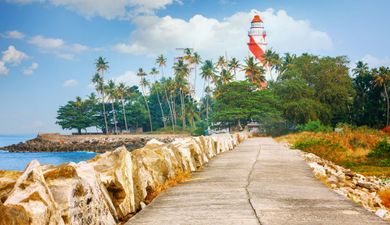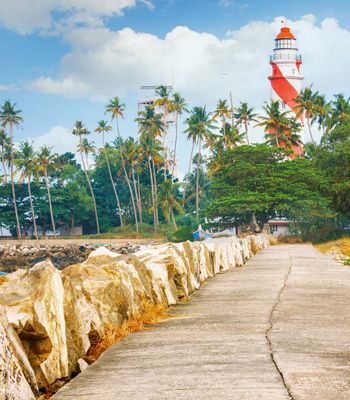
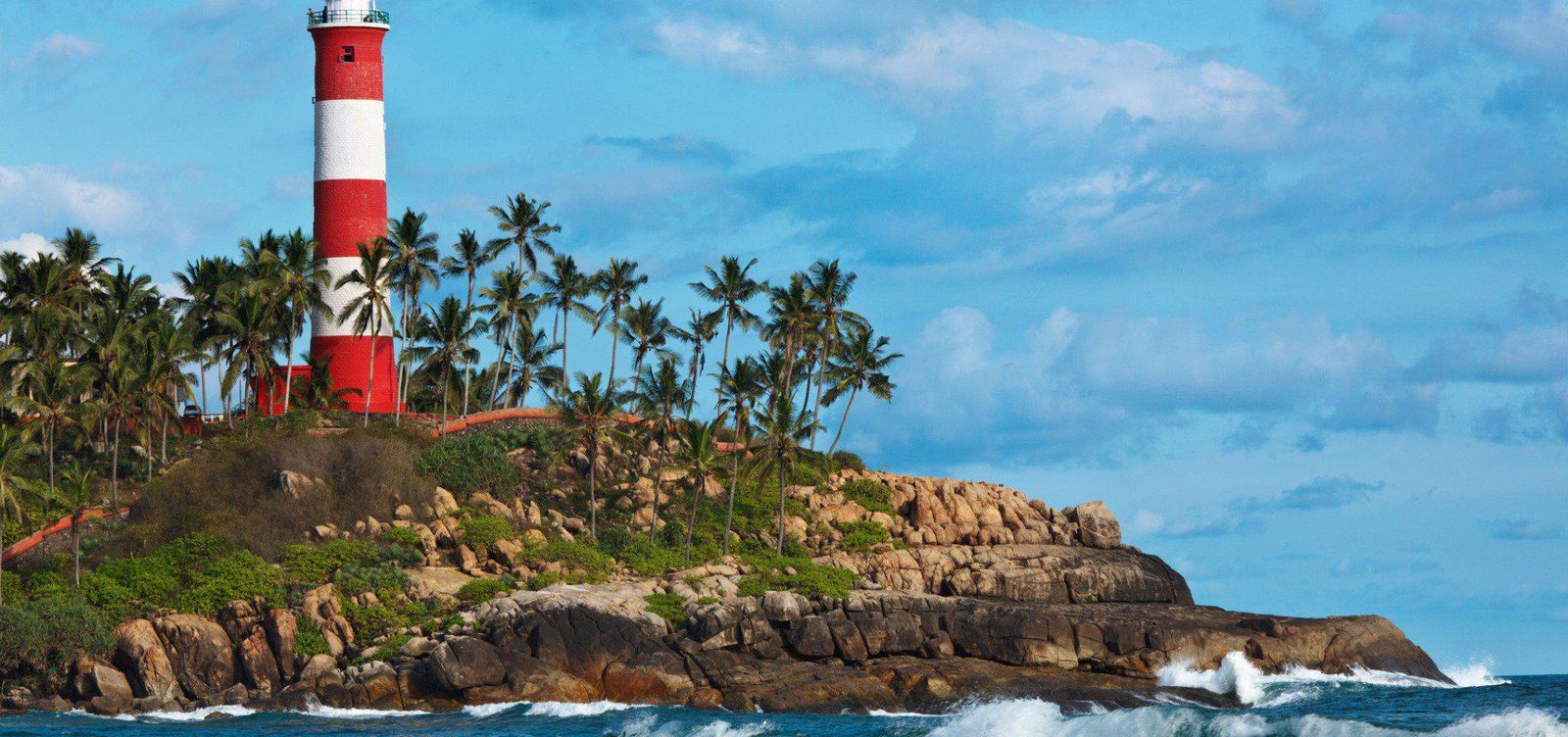
Most lighthouses promise panoramic views. Vizhinjam Lighthouse actually delivers one worth the climb. Rising from a rocky headland above the fishing village of Vizhinjam, roughly 18 kilometers south of Thiruvananthapuram's city center, this working lighthouse commands a stretch of Arabian Sea coastline that feels wilder and more unruly than anything you'd expect this close to Kerala's capital. The tower itself is modest — white-and-red striped, about 36 meters tall — but its position, where laterite cliffs give way to coconut groves and the land simply drops into the sea, lends it a gravity that taller structures on flatter ground can never achieve. Below, fishing boats knock against each other in the harbor. Above, the lamp still turns. Between those two facts lies one of Thiruvananthapuram's quieter, more honest pleasures.
Where the Land Drops Away
The climb involves 142 steps up a spiral staircase inside the cylindrical tower. It's narrow enough that you'll flatten yourself against the wall when someone descends. The metal railing warms under your palm from the heat trapped inside, and by the time you reach the gallery platform, the sea breeze feels genuinely earned.
What strikes you first isn't the horizon — it's how close the fishing village sits below. Vizhinjam's harbor spreads out in miniature: wooden boats painted in blues and greens, nets drying on sand, the jagged outline of the breakwater under construction for the upcoming international seaport. The contrast is almost uncomfortable. A centuries-old fishing community and a billion-dollar port project share the same frame. No other vantage point in Kerala compresses past and future so tightly into a single glance.
Turn seaward, and the Arabian Sea stretches flat and silver to the edge of the Earth. On clear days, the Kovalam coastline curves northward, and you can trace the shoreline all the way to the red-roofed hotels dotting the bluffs above the beach. It's a useful corrective — a reminder of how close you are to Kerala's most commercialized stretch of sand, and how far Vizhinjam still feels from all of it.
A Port That Predates the Nation
Vizhinjam's history runs deeper than most travelers suspect. This was a significant port under the Ay dynasty, one of the earliest ruling families of southern Kerala, centuries before any European ship appeared on the horizon. Rock-cut cave temples from the 8th century still stand near the harbor, their carvings worn smooth by salt air and monsoon rains. The lighthouse, by comparison, is a newcomer — raised in 1972 by the Indian government to guide vessels along this treacherous coast.
The village remains a working fishing community, predominantly Latin Catholic, with small churches lining its narrow lanes. On most mornings, the beach below the lighthouse comes alive with fishermen hauling in the day's catch. The smell of drying fish carries uphill on the wind. It's not romantic. It's real. And it gives the lighthouse visit a weight that purely scenic spots often lack — you're standing above a place where people make their living from the sea, not a curated overlook designed for selfies.
Inside the Lamp Room
Vizhinjam Lighthouse remains an active navigational aid, operated by the Directorate General of Lighthouses and Lightships. The lamp rotates with a white flash visible up to 22 nautical miles out to sea — a fact the keeper on duty will tell you with quiet pride if you think to ask. The optic system sits behind thick glass at the tower's crown, and on the rare occasions when staff permit a closer look, the precision of the rotating mechanism — still partly mechanical — is surprisingly elegant for a building most people treat as a viewpoint and nothing more.
A small museum occupies the ground floor, displaying navigation instruments, signal flags, and photographs of other Indian lighthouses. You'll walk through in fifteen minutes. But the collection of vintage lamp assemblies deserves a longer pause. These were the machines that kept ships off the rocks for decades, and seeing them stripped down to their gears and lenses changes the way you think about the tower above — it becomes functional, urgent, not merely decorative.
Getting There Without the Hassle
From Thiruvananthapuram's central railway station, Vizhinjam sits about 16 kilometers south along the coastal road. An auto rickshaw covers the distance in roughly 40 minutes, depending on how badly traffic clogs the Kovalam stretch. Buses operated by KSRTC run regularly from the East Fort terminal, though the ride is slower and involves a short walk from the Vizhinjam junction stop to the lighthouse entrance.
If you're staying in Kovalam, the lighthouse is barely three kilometers away — close enough for a morning walk along the coast road if the heat hasn't set in. Taxis from Kovalam tend to overcharge for this absurdly short trip, so negotiate firmly or simply flag a passing auto.
The Narrow Window
The lighthouse opens to visitors between 3 p.m. and 5 p.m. daily, except on Mondays and national holidays. This tight window catches many travelers off guard. Arrive early in the afternoon slot — last entry is typically 4:30 p.m., and the spiral staircase creates a bottleneck that slows everyone down.
Entry fees are nominal: around 20 rupees for Indian citizens, 50 rupees for foreign nationals, though rates can shift. Carry exact change; there's no card machine. A separate fee of roughly 25 rupees applies if you bring a camera, though smartphone photography doesn't seem to attract the surcharge in practice.
The best months to visit fall between October and March, when the monsoon has passed and the skies cooperate for long coastal views. During June through September, heavy rains can erase visibility entirely, and the approach road occasionally floods near the harbor.
What Else the Headland Holds
After descending from the tower, walk south along the cliff path toward the Vizhinjam rock-cut cave temple. Carved into the laterite hillside, this 8th-century shrine features an incomplete relief of Vinandhara Dakshinamurthy — a seated Shiva holding a veena. The carving's unfinished state is part of its strange power, as if the sculptor simply set down his tools one afternoon and never came back. Few people make the short detour, which means you'll likely have the cave entirely to yourself.
The fishing harbor below is worth a wander too, particularly in the early morning before the lighthouse opens. Fishermen unload the night's catch directly onto the sand, and local buyers haggle over baskets of sardines and mackerel. The energy is raw and unperformed. Nobody is doing this for your benefit.
A Small Tower With an Honest Reward
Vizhinjam Lighthouse doesn't compete with India's grand monuments. It doesn't try. What it offers is a 142-step climb to a platform where the Arabian Sea, a working harbor, and a coastline in transition all converge beneath your feet. The wind is strong enough to tug at your clothes. The light behind the glass still turns each night. Here's the counterintuitive thing about this place: in a state that packages its beauty with remarkable efficiency, the most memorable view I found in southern Kerala came from a government-run tower with a 20-rupee entry fee and a two-hour visiting window. That gap between expectation and experience is exactly what makes it worth your afternoon.