In 2011, a team of court-appointed officials descended into a series of underground vaults beneath the Sree Padmanabhaswamy Temple in Thiruvananthapuram. What they brought to the surface — or rather, what they catalogued in situ — staggered the world: gold coins by the thousands, diamond-studded crowns, golden idols, ceremonial chains thick as rope. The estimated haul exceeded $20 billion. One vault, designated Vault B, remains sealed to this day, its iron door reportedly bearing the image of a serpent. No one has opened it in recorded history.
Yet walk past the temple on any given morning, and you'll find barefoot devotees filing through its eastern gate with the quiet discipline of people who've done this for centuries. The treasure didn't alter the rhythm here. Not even slightly. The temple's purpose was never wealth — it was devotion to Lord Vishnu, reclining on the serpent Anantha. That image, carved in stone, defines this place more completely than any vault ever could.
A God Lying Down, a City on Its Knees
The deity inside this temple doesn't sit upright or stand in warrior posture. Lord Padmanabha reclines — stretched across the coils of the five-hooded serpent Anantha, one hand raised slightly, the other at rest. The idol is composed of Katu Sarkara Yogam, a blend of thousands of medicinal herbs, coated with a layer of gold. To see the full form of the reclining deity, you must look through three separate doorways inside the sanctum. Each door reveals a different section — the face, the torso, the feet.
This is not an accident of architecture. It's a deliberate act of instruction. The idol measures approximately 18 feet long, too large for any single line of sight to capture. You're forced to piece the image together, door by door, as though the temple itself is teaching you about patience, about the limits of perception. It's an oddly moving experience, even if you carry no devotional stake in it.
Granite Ambition, Dravidian Restraint
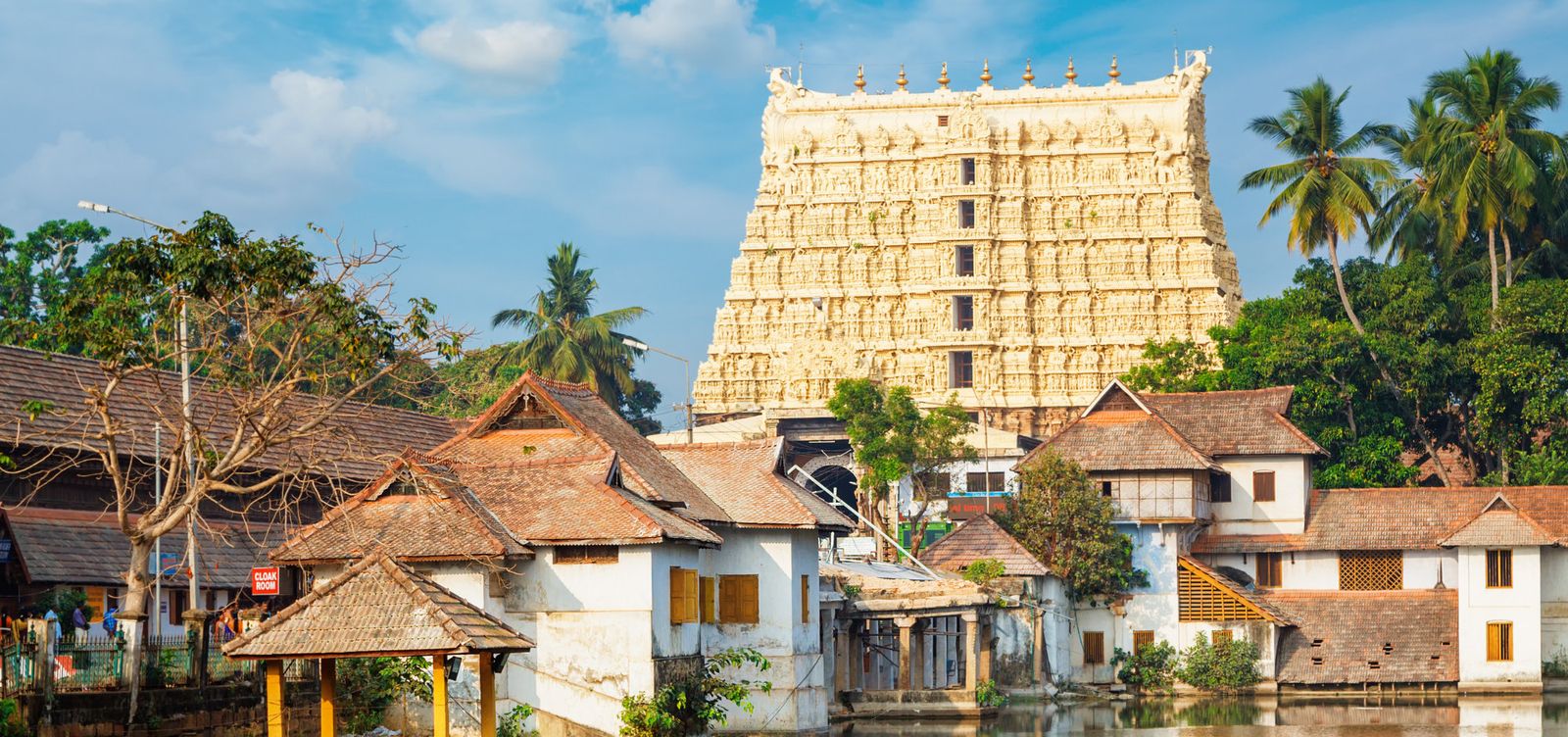
From the outside, the temple announces itself with a seven-story gopuram — that towering gateway architecture endemic to South India. Its granite surface is dense with figures from Hindu mythology, each tier slightly narrower than the one below, drawing the eye upward toward a ridgeline that seems to graze the Kerala sky.
Inside the compound, corridors lined with intricately carved granite pillars stretch ahead of you. Each pillar tells a different story if you slow down long enough to read it — though most people move through too quickly. The main hall features 365 and a quarter sculptured granite pillars — one for each day of the year, with the quarter pillar reportedly representing the leap year correction. Whether that's deliberate mathematics or devotional folklore, it speaks to the obsessive ambition pressed into every surface of this structure.
The Kulasekhara Mandapam, an outer hall, offers some of the finest examples of traditional Dravidian stone carving in Kerala. But unlike the ornate temples of Tamil Nadu, there's a restraint here that strikes you. The decoration is dense but controlled, as if the artisans understood that excess would only distract from the god lying just beyond the walls.
Kings Who Called Themselves Servants
In 1750, Maharaja Marthanda Varma did something extraordinary: he dedicated his entire kingdom to Lord Padmanabha and declared himself merely a servant of the deity. Every ruler of Travancore since has technically governed on behalf of the god. This wasn't symbolic theater. Revenue, land, governance — all of it was formally conducted in the deity's name.
Even after Indian independence dissolved the princely states, the family retained custodianship. A 2020 Supreme Court ruling affirmed that the Travancore royal family should continue managing the temple's affairs. This unbroken chain of stewardship — from monarchy through colonial rule to modern democracy — is rare anywhere on earth. It's also why the temple feels less like a preserved artifact and more like a living institution, still answering to the same authority it recognized three centuries ago.
The Door That Won't Open for You
Here's the counterintuitive part: a temple sitting on billions of dollars in treasure has remarkably strict entry rules that turn away most international travelers. Only Hindus are permitted inside. This is enforced at the gate, and there's no room for negotiation. If you're not Hindu, your experience is limited to the exterior — the gopuram, the Padma Theertham tank, and the surrounding grounds.
For those who do enter, the dress code is absolute. Men must wear a mundu or dhoti — no trousers, no shirts. Women wear saris or long skirts with a blouse. The temple provides no exceptions and no rental facilities, so come prepared. Shoes come off well before the entrance, and the stone floors shift between cool shade and blistering sun depending on the hour. You'll feel the difference in the soles of your feet before you notice it anywhere else.
Photography is prohibited inside the complex entirely. Your phone stays in your pocket, or better yet, in your vehicle. Storage facilities outside the temple hold belongings for a small fee.
When to Show Up, and How to Get There
The temple opens at 3:30 a.m. for the first darshan and closes by 7:30 p.m., with several breaks throughout the day. The most accessible window is between 6:30 a.m. and 11 a.m. Afternoons reopen around 5 p.m. Arriving during the first morning session means smaller crowds and a stillness that the later hours don't offer — though the pre-dawn walk through Thiruvananthapuram's East Fort area carries its own reward. Autorickshaw drivers half-awake at their wheels. The smell of jasmine garlands being strung for the day ahead. A city not yet performing itself.
Entry is free. No admission charge, though donation boxes stand at multiple points inside the complex. From Thiruvananthapuram Central railway station, the ride takes about ten minutes by autorickshaw. Trivandrum International Airport sits roughly six kilometers away. If you're coming by bus, the East Fort terminal is practically at the temple's doorstep.
October through March offers the most comfortable weather, with temperatures hovering in the mid-twenties Celsius. Kerala's monsoon season, June through September, brings rain heavy enough to turn the stone corridors slippery and stretch wait times as devotees crowd under whatever shelter the architecture provides.
One Hundred Thousand Flames
During the Laksha Deepam festival, held once every six years, the temple and its surroundings are illuminated by one hundred thousand oil lamps. The last celebration turned the entire East Fort neighborhood into a flickering amber landscape — not a metaphor, a literal description. The biannual Navaratri festival fills the temple's outer halls with Carnatic vocalists performing under granite ceilings designed centuries before amplification existed. The acoustics, improbably, work. The stone catches the voice and returns it fuller than it left.
A Temple That Doesn't Need You
Most major religious sites around the world court attention. They install information boards, build gift shops, translate everything into six languages. Sree Padmanabhaswamy Temple does none of this. It operates on the assumption that you already know why you're here — or that you'll figure it out by watching the devotees who do.
The treasure in its vaults made international headlines. The temple hasn't adjusted its posture by a single degree. Lord Padmanabha is still reclining. The doors still open at 3:30 a.m. The barefoot faithful still come, as they have for centuries. Whether you enter or simply stand outside watching the gopuram catch the first morning light, this place leaves an impression that has nothing whatsoever to do with gold.