The oldest thing about Thiruvananthapuram Zoo isn't the animals — it's the trees. Massive rain trees with canopies wide enough to shade a cricket pitch arch over the pathways, their roots cracking through colonial-era stone. Established in 1859 by the Maharaja of Travancore, this is one of the oldest zoos in India, and it feels like it. Not in a neglected way, but in the manner of a place that has had over 160 years to let its landscaping mature into something genuinely extraordinary. Spread across 55 acres in the heart of Kerala's capital, the zoo sits adjacent to the Napier Museum and the Sree Chitra Art Gallery, forming a cultural triangle that can swallow an entire day. Come for the animals, certainly. But pay attention to the ground beneath your feet — you're walking through a botanical garden that happens to house wildlife.
A Maharaja's Obsession, Made Public
Swathi Thirunal Rama Varma, the Maharaja of Travancore, collected obsessions the way other rulers collected territories — Carnatic music, Western classical composition, and apparently, exotic animals. His private menagerie became the seed for what eventually opened to the public under the supervision of the British Resident. The zoo's original purpose wasn't entertainment alone; it was conceived as a living museum, a place where the subjects of Travancore could encounter creatures they'd otherwise never see.
That educational impulse still hums through the grounds. Signage provides genuinely useful information about species behavior and conservation status, not just the Latin name and native range that most zoos slap on a placard and call it done. The Kerala State government now manages the facility, with recognition from the Central Zoo Authority of India pushing several rounds of modernization over the decades.
The Residents Worth Slowing Down For
The collection spans roughly 80 species, and not all enclosures are created equal. The reptile house is the star. Kerala's saturated climate makes it an ideal environment for cold-blooded species, and the king cobras here are particularly arresting — thick-bodied specimens coiled behind glass, some stretching beyond twelve feet, their hoods flattened in that patient, calculating stillness. Nearby, the Nilgiri langurs occupy a shaded enclosure near the center of the grounds, jet-black fur against amber eyes. They're endemic to the Western Ghats and harder to find in the wild than their numbers might suggest.
Lions, tigers, and Indian elephants fill the large-mammal section, though the enclosures for these bigger animals show their age more than others. The hippo pond, however, feels almost generous by Indian zoo standards. Time it right, and you can watch the resident hippos surface and submerge in a slow, prehistoric rhythm that holds you longer than you'd expect. An aviary section houses peafowl, hornbills, and several parrot species, their calls slicing through the canopy noise like bright scissors.
Here's what nobody tells you: the zoo's most compelling attraction isn't behind any fence. A free-roaming population of Indian flying foxes — enormous fruit bats with wingspans approaching four feet — hangs from the upper branches of the rain trees throughout the grounds. Hundreds of them. They rustle and shift and occasionally launch in broad daylight, casting shadows that startle children below. No enclosure, no glass. Just wild animals that chose a zoo as their home. It makes you wonder who's watching whom.
When the Gardens Upstage the Animals
The botanical collection predates the zoo itself. Massive ficus trees, jackfruit groves, and flowering tropical species turn the walkways into a canopy tunnel that drops the temperature several degrees compared to the city streets just outside the gates. During monsoon season, the green intensifies to a shade that feels aggressive — almost artificial, like someone has adjusted the saturation on the world.
A lake occupies the lower section of the grounds, its surface broken by turtle heads and the occasional splash of a waterbird diving for fish. Benches line the paths at regular intervals, and locals use them without ceremony — couples, elderly men reading newspapers, mothers keeping half an eye on small children. The zoo functions as a city park as much as it does a wildlife facility, and that blurred boundary gives the place a lived-in quality that sanitized modern zoos deliberately erase. There's something to be said for a place that hasn't been curated to within an inch of its life.
Arriving Without the Headache
The zoo sits in the museum complex near the center of Thiruvananthapuram, about six kilometers from the international airport and roughly two kilometers from the central railway station. Auto rickshaws are your simplest bet from the station — drivers know the zoo well, and the fare shouldn't exceed a hundred rupees if you negotiate before climbing in. City buses from the East Fort terminal stop near the main entrance.
If you're arriving by train from elsewhere in Kerala, Thiruvananthapuram Central connects to most major cities in the south. From Kochi, the journey runs roughly four hours. The zoo's main entrance opens onto a road shared with the Napier Museum, so the turn is easy to spot. Parking exists but fills quickly on weekends and school holidays — plan accordingly.
When to Go, What to Pay, How to Survive
Gates open at 9 a.m. and close at 5:15 p.m., Tuesday through Sunday. Mondays are off. Entry fees are modest — around 20 rupees for Indian adults and 50 rupees for foreign nationals, though these rates adjust periodically. Camera fees apply separately if you bring anything beyond a phone.
Visit on a weekday morning if you value your sanity. Weekends draw enormous crowds — particularly families — and the paths near popular enclosures become congested enough to make actual animal-watching a lost cause. Heat peaks between noon and three, and shade, while abundant, doesn't eliminate Kerala's humidity. It merely bargains with it. Carry water. Wear shoes that can handle uneven stone paths and the occasional muddy stretch during monsoon months.
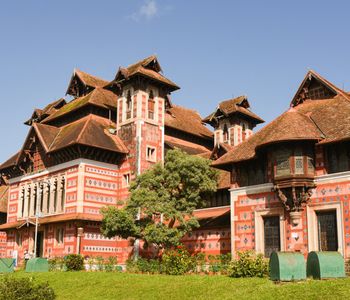
Plan roughly two to three hours for a thorough visit. Afterward, walk directly to the Napier Museum next door — its Indo-Saracenic architecture alone justifies the detour, all candy-striped gables and terracotta flourishes, and the natural history collection inside complements what you've just seen alive.
A Place That Has Earned Its Age
Thiruvananthapuram Zoo won't compete with Singapore or San Diego on enclosure design or species count. It isn't trying to. What it offers instead is something those places can't manufacture — a century and a half of roots, literally and figuratively, grown into the soil of a city that still treats the place as its own backyard. The bats overhead, the langurs behind the fence, the old man asleep on a bench beneath a rain tree that was planted before India's independence — they all belong here equally. That's the rare thing. Not spectacle, but belonging.