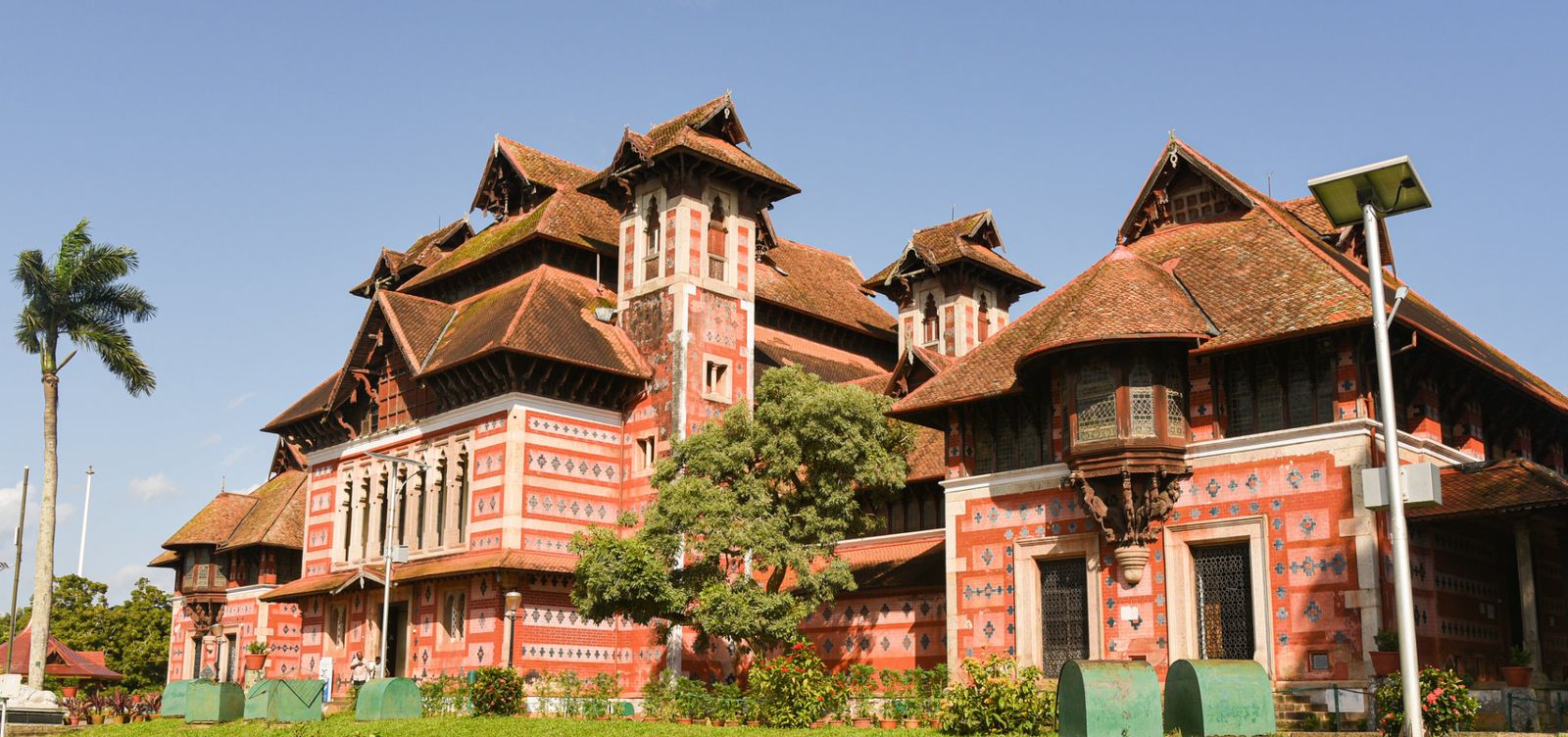
The first thing that hits you isn't the collection inside. It's the building itself — a riot of red, black, and ochre brickwork topped by ornamental gables that look like they were transplanted from a Gothic cathedral and left to marinate in the Kerala humidity. The Napier Museum sits in the middle of a botanical garden in Thiruvananthapuram, and its exterior alone could justify the visit. Designed by Robert Chisholm in the Indo-Saracenic style during the late 19th century, the structure manages to be simultaneously Victorian and unmistakably South Indian, its natural ventilation system so effective that it predates air conditioning by a century and still keeps the interior cool. What waits inside is an eclectic, occasionally bewildering survey of Kerala's artistic and natural history — the kind of museum that feels more like rummaging through a civilization's attic than walking a curated gallery.
Where Gothic Arches Meet Kerala Tiles
Robert Chisholm completed the museum in 1880, naming it after Lord Napier, the then-Governor of Madras. Chisholm was an architect possessed by hybridization, and the Napier Museum became one of his finest experiments. The exterior walls feature polychromatic brickwork — alternating bands of color that give the facade a textile quality, as though the building were woven rather than constructed.
Step inside and the ceiling seizes your attention. Wooden trusses curve overhead in a pattern that borrows from cathedral ribbing but feels lighter, almost skeletal. The open design channels air through the exhibition halls without mechanical assistance — a deliberate engineering choice for Thiruvananthapuram's equatorial climate. On the hottest afternoons, the interior stays several degrees cooler than the garden outside. Chisholm understood his environment, even if he'd arrived from Edinburgh.
The tiled roof incorporates Chinese-style ornamentation at its ridgeline, minaret-like turrets at the corners, and arched windows that wouldn't look out of place in a Venetian palazzo. It shouldn't work. Somehow it does — the building's sheer confidence holds all these contradictions together, daring you to find a seam.
Bronze Gods and Ivory Elephants
The collection sprawls across art, archaeology, and natural history with the kind of ambition only a 19th-century institution would attempt. Bronze idols dominate the early galleries. Chola-period figures stand in glass cases with the fluid posture that defined South Indian metalwork at its peak — Nataraja in mid-dance, limbs frozen in perfect counterbalance, the ring of fire surrounding him worn smooth by centuries of handling before the glass went up.
Move deeper and the museum changes personality on you. A Japanese shadow-puppet display, carved ivory pieces from Travancore's royal workshops, and a temple chariot elaborate enough to make you wonder how anyone maneuvered it through narrow temple streets. The ivory carvings stop you cold — miniature elephants and deity figures rendered with a precision that borders on obsessive, each tusk and ornament individually articulated at a scale no larger than your thumb.
The natural history section feels like a different institution entirely. Taxidermied animals line the walls, their glass eyes tracking you with unsettling patience. A fin whale skeleton occupies a disproportionate amount of floor space, its ribcage arching overhead like the hull of an inverted ship. The display methodology hasn't changed much since the Victorian era, which gives this wing a time-capsule quality — you're seeing the collection more or less as visitors in the 1890s would have encountered it. That's either a complaint or a compliment, depending on your appetite for the unreconstructed past.
The Garden That Refuses to Be a Footnote
Most people treat the surrounding botanical garden as a pleasant walkway to the museum entrance. Don't. Established in 1859, the grounds predate the museum itself and cover roughly 55 acres of landscaped terrain anchored by enormous rain trees whose canopies stretch wide enough to shade entire pathways.
Tropical species crowd the beds with a density that feels less planned and more insurgent — bougainvillea in violent magenta, jackfruit trees heavy with their armored fruit, lotus ponds where the flowers open in the early morning and close by noon. A canal runs through the property, its banks thick with ferns. The Sri Chitra Art Gallery and the Thiruvananthapuram Zoo share this same compound, which means you could spend an entire day here without retracing your steps.
Families flood the garden on weekends, particularly Sunday afternoons when the shade becomes a matter of survival. Weekday mornings offer something rarer — near solitude among the trees, with only the sound of mynas bickering in the canopy above.
What Most People Miss
Here's the counterintuitive truth about the Napier Museum: its most memorable quality isn't any single artifact. It's the refusal to specialize. Modern museums obsess over coherence — themed wings, narrative arcs, audio guides that tell you what to feel at every turn. The Napier Museum predates all of that. A Chola bronze sits a room away from a stuffed crocodile. A Kathakali mask hangs near geological specimens. The effect is disorienting at first, then oddly liberating. You stop looking for a through-line and start simply looking.
This approach reveals something about the Travancore rulers who originally commissioned the collection. They weren't building a museum in the contemporary sense. They were assembling a cabinet of wonders — proof that their kingdom contained multitudes. That ambition still radiates from the glass cases, even when the labels have yellowed and the taxidermy has gone a bit hollow around the eyes.
Arriving and Getting Through the Door
The museum sits in the heart of Thiruvananthapuram, about four kilometers from the central railway station. Auto rickshaws cut fastest through the city's dense traffic — most drivers know the botanical garden by name, even if "Napier Museum" draws a blank. Trivandrum International Airport lies roughly six kilometers away, making this an easy first stop if you land in the morning.
Entry fees are modest. Indian citizens pay around 20 rupees; international visitors pay approximately 200 rupees. Camera fees apply separately. Doors open at 10 a.m. and close by 4:45 p.m. on most days, though the museum shuts entirely on Mondays and Wednesday mornings. Kerala's heat peaks between noon and three, so arriving right at opening lets you explore the cooler galleries before retreating to the garden shade.
The October-to-February window offers the most bearable weather, though Thiruvananthapuram never truly cools down. Carry water. Wear light clothing. And budget at least two hours — one for the museum, one for the garden. Rushing defeats the purpose entirely.
A Relic Worth Revisiting
The Napier Museum doesn't compete with slick, interactive institutions elsewhere. It doesn't try. What it offers instead is a direct encounter with a 19th-century idea of knowledge — wide-ranging, unapologetic, and housed in a building that remains more interesting than half the objects it contains. Walk through Chisholm's polychromatic arches, stand beneath the wooden trusses, and let the collection's beautiful disorder rearrange your expectations. In a country where ancient temples and Mughal tombs dominate tourist itineraries, a Victorian museum in Kerala's capital makes a quietly persuasive case for the pleasures of the unexpected.