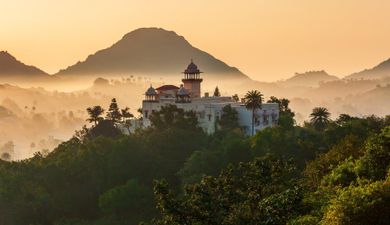
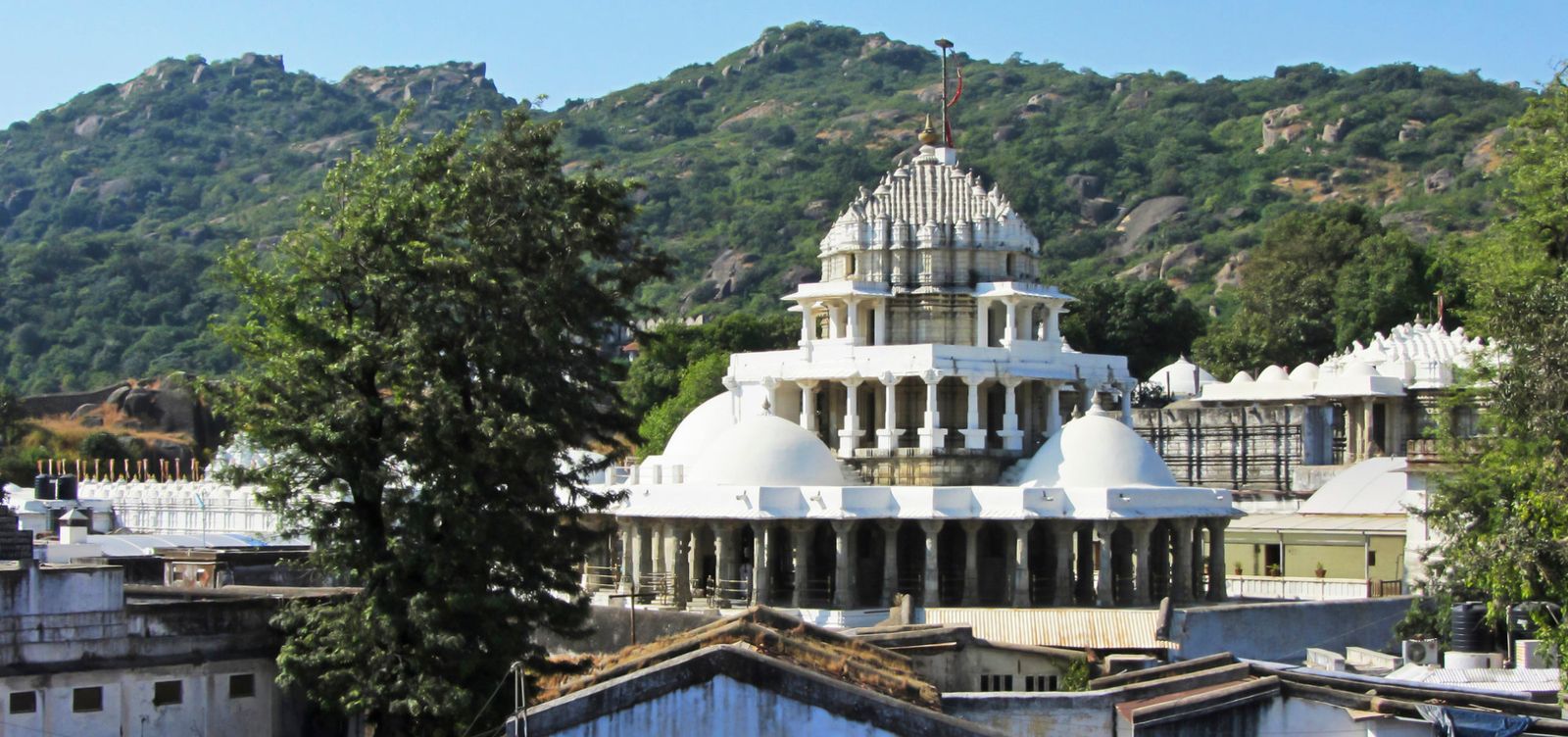
From a distance, the Dilwara Jain Temples look like nothing special. Five modest structures of plain exterior stone sit on a forested hillside in Mount Abu, Rajasthan's only hill station. You could walk past them and think they were storehouses. Step inside, however, and the deception breaks apart entirely. Every ceiling, column, and doorway erupts into marble carvings so intricate, so impossibly detailed, that your first instinct is to touch the stone just to confirm it's real. Craftsmen reportedly worked on individual ceiling panels for up to fourteen years. The result is a complex where architecture doesn't merely shelter worship — it becomes worship itself. These five temples, built between the 11th and 13th centuries, represent the apex of Jain devotional art, and nothing else in India quite prepares you for them.
The Philosophy Written in Plain Stone
That dull exterior isn't neglect. It's argument. Jainism prizes inner spiritual richness over outward display, and the Dilwara temples literalize this belief with absolute conviction. Outside, unadorned walls of grey-white. Inside, marble worked to the thinness of paper, carved into lotuses, dancers, elephants, and geometric patterns that seem to pulse with their own quiet respiration.
The contrast is so stark it almost feels like a rebuke — a declaration that what matters is never the surface. The temples don't compete with their landscape. They don't announce themselves with towering gopurams or gilded domes. Their power is entirely internal, and the walk through each doorway carries the physical sensation of crossing from one world into another.
Two Temples That Command the Rest
Of the five, two dominate most visitors' attention — and earn every second of it. The Vimal Vasahi Temple, dedicated to Adinath, the first Jain tirthankara, dates to 1031 CE. Vimal Shah, a Solanki dynasty minister, commissioned it, and the resources he poured into the project still show in every surface. Forty-eight carved pillars ring the central hall, no two identical. The ceilings bloom with concentric rings of carved figures — deities, musicians, celestial beings — all radiating outward from a central pendant that hangs like a frozen chandelier.
Then there's the Luna Vasahi Temple, which arrived about two centuries later in 1230 CE, built by the brothers Vastupal and Tejpal in honor of the 22nd tirthankara, Neminath. Here, the carving reaches an almost absurd level of refinement. The famous Rang Mandapa — the hall of color — features a domed ceiling with layered marble so delicately worked that portions appear translucent. Run your eye along a single bracket, and you'll count dozens of figures, each no larger than a thumbnail, each with distinct facial expressions. It's the kind of detail that makes you suspect the artisans weren't entirely sane.
What the Stone Doesn't Tell You
The commonly repeated claim is that artisans were paid by weight of marble dust, not by block. Whether apocryphal or accurate, the story captures something true about this place: the carving here is reductive rather than additive. Every figure, every filigree, every impossibly thin marble lattice was cut away from a single block. Nothing is assembled. Nothing is attached. The lotuses dangling from the ceiling aren't separate pieces — they were freed from the surrounding stone one chisel stroke at a time.
Here's the counterintuitive thing: Jainism's emphasis on non-attachment didn't exempt its artisans from obsession. These temples took generations to complete, and the precision involved suggests a devotion to craft that borders on the fanatical. The spiritual lesson and the artistic ambition exist in productive tension, and standing beneath those ceilings, you feel both forces pulling at you simultaneously.
The Other Three — Quieter, Still Worth Your Time
The Pittalhar Temple, dedicated to Rishabdev, takes its name from the brass — "pital" — used for its central image, which weighs several tonnes and anchors the otherwise modest structure. The Parshvanath Temple, though smaller, holds carvings of remarkable fluidity, particularly in its depiction of kalpa vriksha, the wish-fulfilling tree. And the Mahavir Swami Temple rounds out the five with a hushed atmosphere that makes it a fine place to sit and let everything you've just seen settle.
None of the three match the Vimal Vasahi or Luna Vasahi in scale or ambition, but they contribute to something cumulative. Moving from temple to temple, you begin to notice how the quality of light shifts between buildings — how a corridor catches afternoon sun and illuminates carvings that were invisible ten minutes earlier. This is a complex that rewards patience and repeat visits more than efficiency.
When the Light and the Crowds Cooperate
The temples open daily from noon to 6 p.m. for non-Jain visitors, while Jain worshippers have morning access starting at 6 a.m. This schedule matters more than you'd think. Arriving right at noon gives you a narrow window before tour groups flood the corridors. By 2 p.m. on a high-season weekend, the Luna Vasahi can feel congested, the atmosphere swinging from contemplative to chaotic in the time it takes a bus to unload.
Mount Abu's elevation — roughly 1,220 metres — keeps temperatures tolerable even in May, a mercy given what Rajasthan inflicts at lower altitudes. Still, the ideal months fall between October and March, when cool air and low humidity make walking between temples comfortable rather than endured. Photography is prohibited inside, a policy enforced with varying degrees of enthusiasm. Leave the camera in your bag and look with your eyes. The memory will be sharper than any photograph.
Getting There Without the Hassle
Mount Abu's nearest railhead is Abu Road station, about 28 kilometres downhill. Shared taxis and state buses run the winding ascent regularly, and the ride itself — hairpin turns through scrubby Aravalli hills — takes roughly 45 minutes. From Udaipur, the drive covers around 160 kilometres through dry, sparsely populated terrain before the road begins to climb.
Once in Mount Abu, the temple complex sits about 2.5 kilometres from the town centre. Auto rickshaws handle the trip in minutes. Entry is free, though the temple management asks you to remove leather items — belts, wallets, shoes — before entering. Small lockers near the entrance accommodate your belongings. Dress modestly. Bring socks if you dislike walking on cool marble floors in bare feet.
The Argument for Staying Longer Than You Planned
The Dilwara temples don't photograph well, don't lend themselves to quick walkthroughs, and don't broadcast their significance from the outside. They ask you to slow down, look closely, and accept that the most extraordinary things sometimes wear the most ordinary faces. In a country where monuments routinely announce their grandeur from kilometres away, these temples do the opposite — and that restraint is precisely what makes them unforgettable.
Carve out an unhurried afternoon. Stand beneath the Luna Vasahi ceiling until your neck aches. What those anonymous artisans accomplished in marble, across generations, still hasn't been equalled.