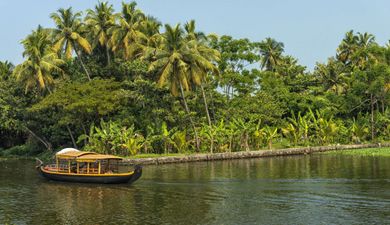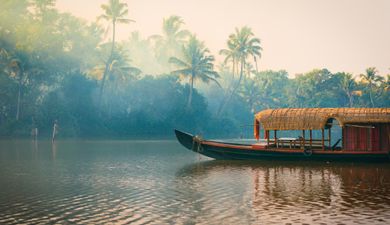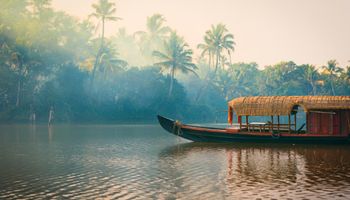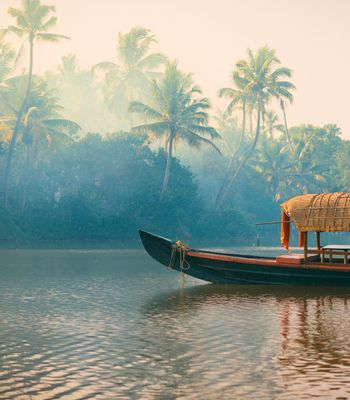
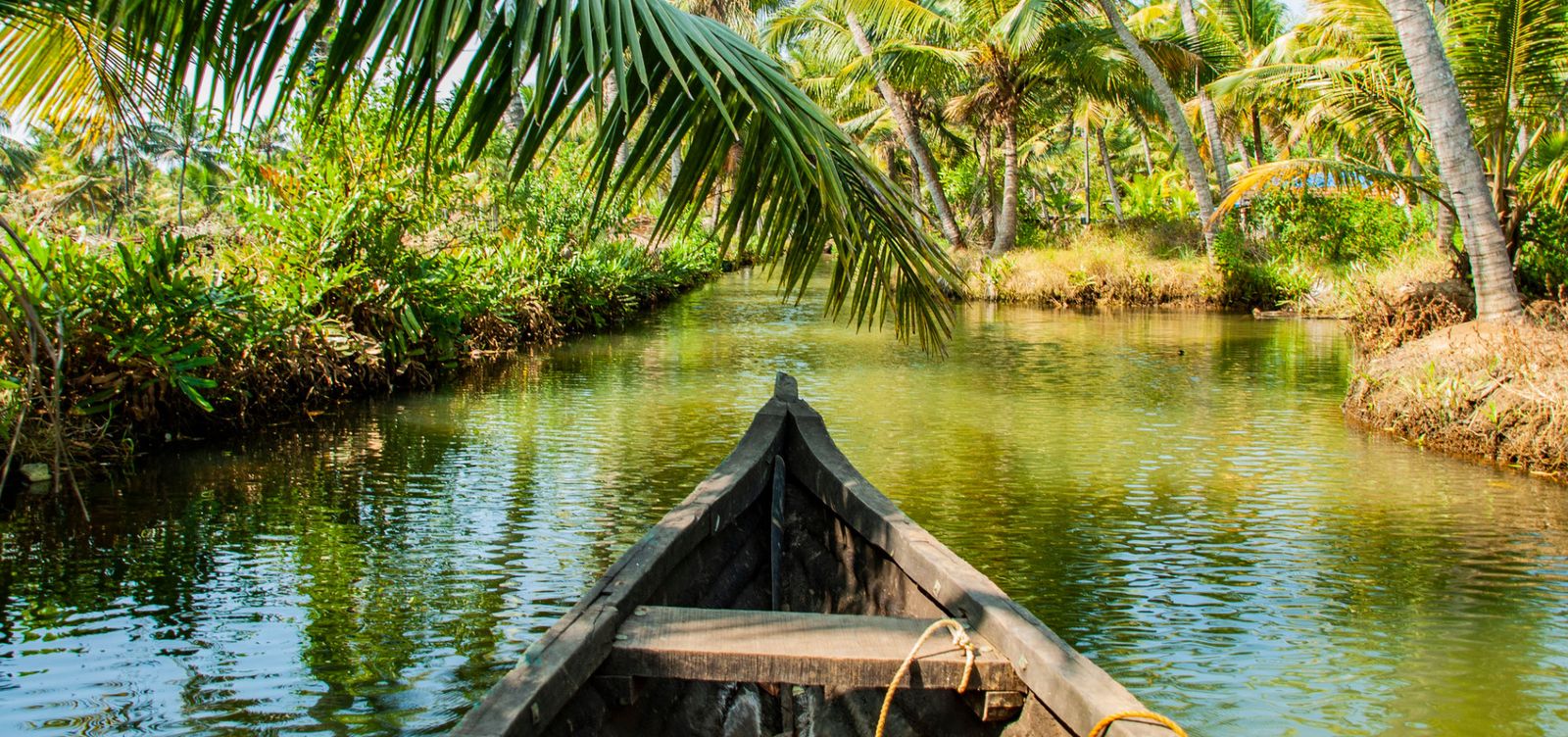
Munroe Island isn't really one island. It's eight of them, a scatter of low-lying landmasses where the Kallada River loses its nerve and dissolves into Ashtamudi Lake. You reach it by a narrow road that seems to run directly on top of the water, or by a canoe that slides through canals so tight the mangrove branches brush your shoulders. This is the Kerala backwaters stripped of their postcard gloss — no houseboats the size of hotels, no buffet lunches, no choreographed sunsets. Just coir-weavers on verandas, women rinsing rice in the canal behind their houses, and the occasional kingfisher detonating out of the reeds. Named after Colonel John Munro, the British Resident who dredged these waters in the early 1800s, the island still runs on its own quiet clock.
A Waterway That Runs Through Living Rooms
The only way to understand Munroe is from a canoe. A proper one — the slim wooden kind that seats two or three passengers and is poled by a man who knows every submerged tree stump by memory. The main channels are wide enough for small ferries, but the real rewards lie down the kayal, the narrow feeder canals that snake between coconut groves and houses built almost into the water itself.
You glide past a woman scrubbing a brass lamp on her back step. A man mending a net strung between two palm trunks. Children waving from a jetty cobbled out of three uneven planks. None of it is a performance. Nobody is dressed for tourists. The island's population is small and aging, and these canals are the arteries of daily life — the route to school, to the temple, to the small shop selling biscuits and kerosene.
Canoe rides last anywhere from two to four hours, and the shorter ones are almost always a mistake. You want the long version, the one where you stop being a spectator and start noticing things: the kingfishers, the water snakes, the way the light shifts when the canopy closes overhead.
The Island That's Slowly Going Under
Here's a detail no brochure will tell you: Munroe Island is sinking. Not dramatically, not all at once, but measurably — ever since the 2004 tsunami shifted the water tables and the Thenmala dam upstream altered the flow of freshwater into the estuary. Salt creeps into fields that once grew paddy. Houses list gently toward the canal. Some families have moved to higher ground on the mainland, leaving behind empty verandas and overgrown yards.
This gives the place an atmosphere you won't find in the busier backwaters near Alleppey. There's a melancholy to Munroe, a sense of watching something that may not be here in fifty years. It's not sad, exactly. The people who remain are matter-of-fact about it. But it sharpens the attention. You look harder. You remember more.
Coir, Clams, and the Rhythm of Work
Coir-making is the closest thing Munroe has to an industry. Coconut husks are soaked for months in the brackish water until the fibres loosen, then beaten, spun, and woven into rope and mats. Along the canal banks, the fibres lie drying in long reddish-brown sheets that look, from a distance, like hair. Stop and watch a woman at her spinning wheel and she'll likely wave you over, hand you a strand, let you try. It takes about four seconds to realise how hard her job is.
In the shallows, men wade with long bamboo poles and rake the lakebed for clams. The shells are sold, and the lime from burning them once fed a small construction trade. It's a living, though a thinner one each year. Pollution, overharvesting, shifting salinity — the Ashtamudi clam fishery was one of the first in India to receive international sustainability certification, but the pressures remain.
Where to Sleep When You Don't Want to Leave
A handful of homestays have opened on the island, mostly small family-run affairs with three or four rooms, mosquito nets, and breakfast served on the veranda. This is the way to do it. A day trip from Kollam gives you the highlights, but staying overnight is when Munroe works its particular magic — the canals going quiet after dusk, frogs taking over the soundtrack, a single fishing lamp drifting past your window at midnight.
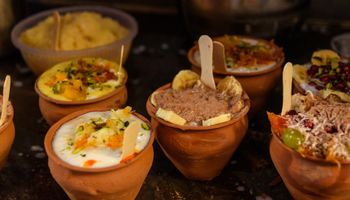
Expect basic comfort, not luxury. The power cuts out occasionally. The Wi-Fi, where it exists, is a polite fiction. The food, on the other hand, is usually excellent: karimeen fried in coconut oil, red rice, thoran made from whatever leafy green was in the garden that morning.
Getting There Without Overthinking It
Kollam is the gateway. A working port city about an hour and a half south of Alleppey by train, it isn't somewhere people come for urban charm — they come to catch a boat or a tuk-tuk to Munroe, which lies about 27 kilometres northeast. The road route takes roughly an hour and threads through a string of villages worth a slower look if you've got the time.
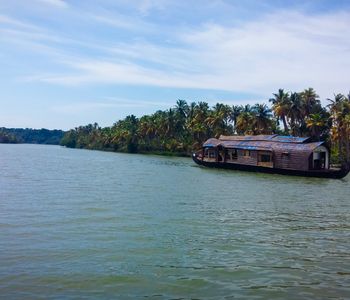
The more romantic option is the public ferry that runs between Kollam and Alleppey, an eight-hour journey that stops at Munroe along the way. It's cheap, slow, and one of the great backwater experiences in India — far more atmospheric than the private houseboats, if you don't mind a hard bench and no air conditioning.
When to Come, and What to Bring
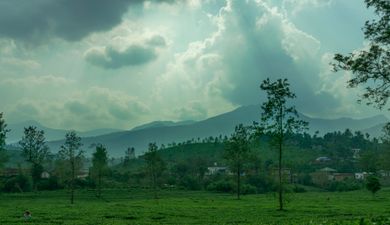
November through February is the window. The weather is dry, humidity manageable, and the light soft enough for photographers to do real work. March to May gets punishingly hot. The southwest monsoon from June to August turns the canals muddy and the skies permanently grey — dramatic, but not what most visitors are after.
Bring mosquito repellent. Bring more than you think you need. Bring a hat, because the sun off the water is relentless even in winter. Cash is essential; ATMs are scarce on the island itself, and most homestays and canoe operators work in rupees and handshakes rather than cards.
A Place That Asks You to Slow Down
Munroe rewards patience. It doesn't have monuments or viewpoints or anything you can check off a list. What it offers is the chance to spend a day — or two, or three — watching a way of life that is both ordinary and quietly disappearing. Go by canoe, stay overnight if you can, and let the place set the pace. You'll leave with fewer photographs than you expected and more of something harder to name. That's the point.