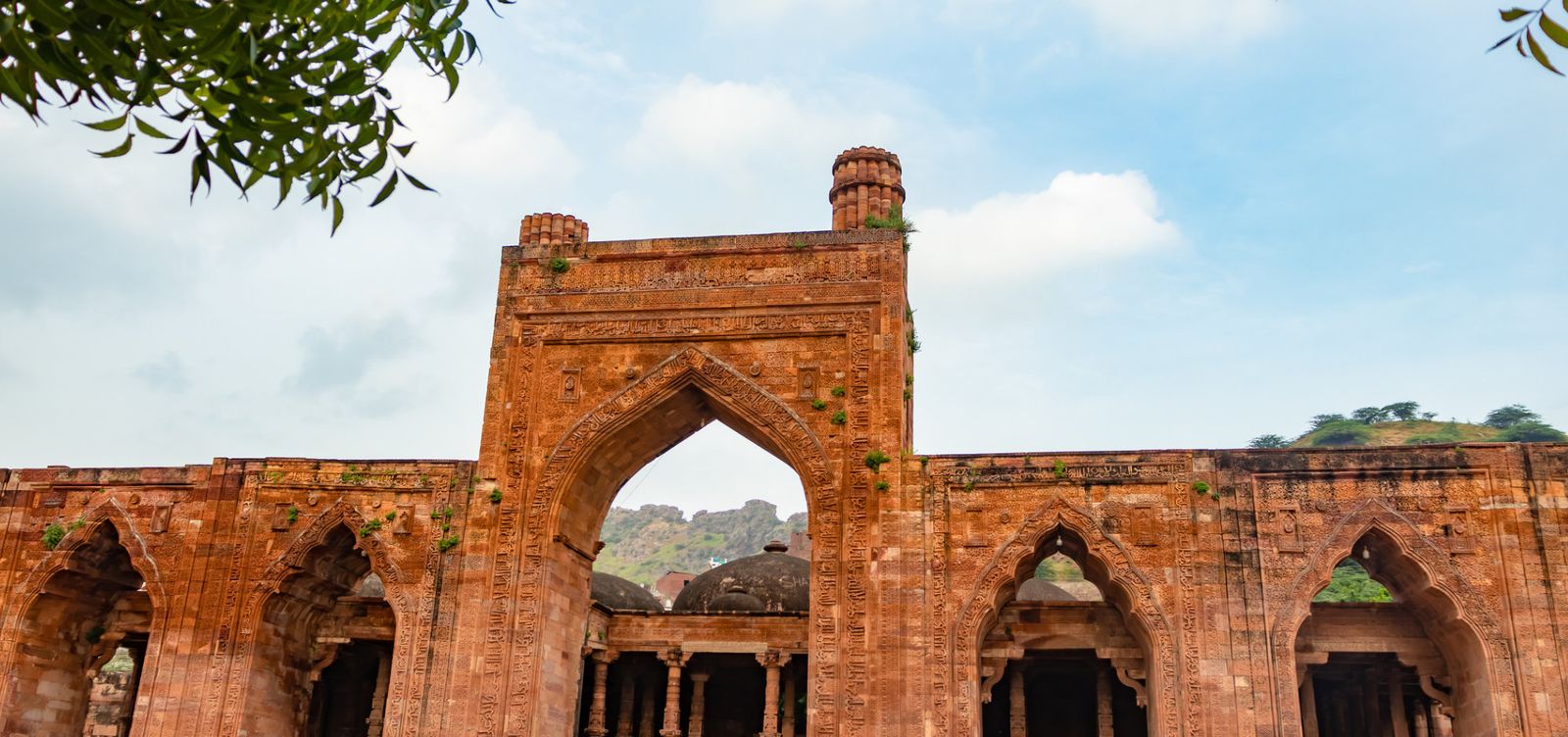
Two and a half days. That's what the name claims — Adhai Din Ka Jhopra, the "shed of two and a half days" — supposedly the time it took to build this twelfth-century mosque on the western edge of Ajmer. The story is almost certainly a myth, or perhaps a nod to a fair once held here. What stands today is something far stranger and more compelling: a Sanskrit college torn apart by conquering armies in 1192, hastily reassembled as a mosque, and left to weather eight centuries of dust, rain, and indifferent restoration. No manicured lawns. No piped audio guides. Just forty pillars, none of them quite matching, holding up a story India still hasn't fully decided how to tell.
A Conquest Written in Stone
Qutb-ud-din Aibak commissioned the mosque shortly after Muhammad of Ghor's victory at the Second Battle of Tarain. The site had previously held a Sanskrit college and several Hindu and Jain temples. Aibak's builders didn't start from scratch — they couldn't afford to. They dismantled what stood and pressed the carved stone back into service.
The result is one of the oldest surviving mosques in India, and arguably the most architecturally schizophrenic. Walk the prayer hall and you'll see pillars carved with bells, garlands, dancing figures, and lotus medallions — Hindu and Jain motifs left fully intact, simply turned to face a new direction. Some pillars are stacked two or three deep, mismatched in height, the builders compensating with extra blocks like a child solving a problem with whatever's at hand.
The Screen That Changed Everything
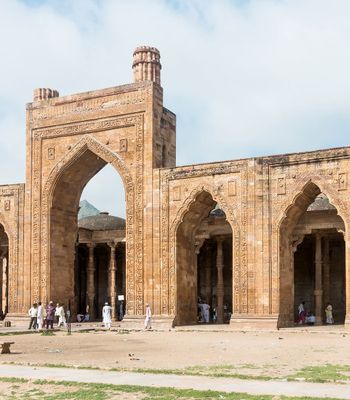
The most arresting element wasn't there at the beginning. Around 1213, Sultan Iltutmish added a monumental arched screen across the front of the prayer hall — seven pointed arches in red and yellow sandstone, the central one rising nearly twenty metres. This was something new in India. The pointed arch, the calligraphic bands of Quranic verse, the geometric interlacing — all imported from Ghurid and Persian tradition, laid over Indian foundations like a second skin.
Look closely at the inscriptions. The Kufic and Naskh scripts curl through the sandstone with extraordinary precision, and in places they bloom into floral patterns — a quiet hybrid where Persian letters borrow the vocabulary of Indian carving. Stand beneath the central arch and you can see exactly where two civilizations met and refused to fully blend.
Forty Pillars and No Two Alike
Behind the screen, the prayer hall opens into a forest of columns. The roof is gone in places, and the sky comes through in patches. This is where the mosque gets under your skin.
Run your hand along one of the pillars and you might feel a defaced face — a yakshi or a tirthankara, the features chiselled away in compliance with Islamic prohibition on figurative imagery. But the chisels were not thorough. Bodies remain. Garments remain. The dancers still dance, headless. There's something in this incomplete erasure that says more about the conquest than any chronicle.
The pillars themselves are extraordinary as building material. Each one is a small museum of twelfth-century stonework — bell-and-chain motifs, kalasha pots, geometric friezes, lotus rosettes. No two arrangements repeat. Spend an hour here and you'll start playing a game: trying to imagine the original temples these stones came from, piecing together a building that no longer exists from the rubble of the one that replaced it.
What the Restoration Left Behind
The Archaeological Survey of India has held the site since the colonial era, and their intervention has been cautious — perhaps too cautious for some, exactly right for others. Roofs have not been replaced. Missing pillars have not been re-carved. The mosque exists in a state of arrested decay, which is precisely what makes it feel honest.
You won't find the polished marble of more famous mosques here. The sandstone is pitted, weathered, sometimes blackened by centuries of monsoon. Pigeons have made the upper arches their own. In the late afternoon, when the light catches the western screen, the stone goes the colour of old fire — and you understand why early travellers wrote about this place as if they'd stumbled on a ruin in the desert, even with a city pressing right against its walls.
Climbing the Hill to Get There
The mosque sits on the lower slope of Taragarh Hill, just past the Dargah of Khwaja Moinuddin Chishti. Most pilgrims come to Ajmer for the Dargah, and many never make the short uphill walk to this site — a quiet injustice, but also a gift, because you'll often have the prayer hall nearly to yourself.
The approach is steep and narrow, threading past tea stalls and shops selling embroidered caps and rose petals meant for the Dargah. Wear shoes you can slip off easily; you'll need to leave them at the entrance. Modest dress is expected — covered shoulders and knees for everyone, and women may want to bring a scarf for the head, though it isn't strictly enforced.
When to Come, What to Bring
The site is open daily from sunrise to roughly sunset, with no entrance fee at the time of most recent reporting. Friday afternoons can bring prayer gatherings, when the mosque returns briefly to its original function — a remarkable thing to witness if you visit respectfully and stay out of the way.
Come early in the morning if you want the light on the screen, or late afternoon if you want it on the pillars. Avoid midday between April and September, when Ajmer turns ferocious and the sandstone radiates heat well into the evening. October through March is the kinder season — cool mornings, sharp light, manageable crowds.
Bring water. Bring a camera with a lens that handles low light, because the prayer hall is darker than you'd expect. And bring time. This isn't a place to tick off in twenty minutes. The longer you stay, the more the pillars start telling you things.
A Building That Refuses to Settle
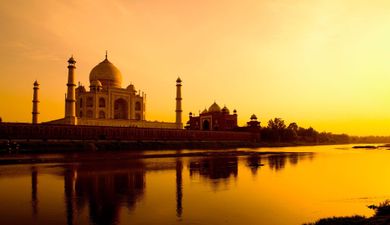
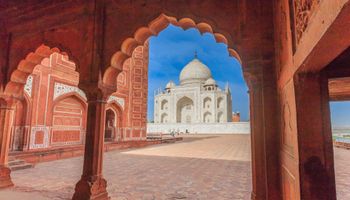
Adhai Din Ka Jhopra is not beautiful in the way the Taj Mahal is beautiful. It's not coherent. It's not whole. It's a mosque built from temples, carved with images it was meant to forbid, named after a fair that may never have happened. It contradicts itself in every direction.
That's exactly why you should go. In a country where history is constantly being rewritten to suit the present, this ruin on a hillside in Ajmer simply refuses to lie. It tells you what happened, in stone, and lets you make of it what you will.