Walk through the southern gate of Banaras Hindu University on a winter morning, and the first thing that strikes you isn't the scale — though the scale is considerable, some 1,300 acres of it — but the quiet. After the relentless press of Varanasi's old city, where motorbikes and pilgrims and cows negotiate every square metre of broken pavement, BHU feels like a different country. Wide avenues lined with neem and gulmohar trees. Cyclists in long shadows. Students hunched over books on stone benches outside red sandstone buildings that look more like minor palaces than lecture halls. This is one of Asia's largest residential universities, and arguably its most atmospheric. You don't need an admission letter to wander in. You just need a morning.
One Man's Improbable Dream
Pandit Madan Mohan Malaviya founded BHU in 1916, and the ambition behind it bordered on the absurd: build a centre of learning that could hold its own against Oxford while remaining unmistakably Indian. He raised the money himself, going door to door among maharajas and merchants like a man collecting for a wedding. The Maharaja of Darbhanga gave land. Annie Besant lent her name. Gandhi spoke at the foundation ceremony.
The university still carries the weight of that founding idealism. Departments here range from Sanskrit and Ayurveda to nuclear physics and aerospace engineering, all on a single campus. You can spend a morning watching students chant Vedic verses in one building and walk five minutes to find PhD candidates debating quantum field theory in the next.
The Colour of an Entire University
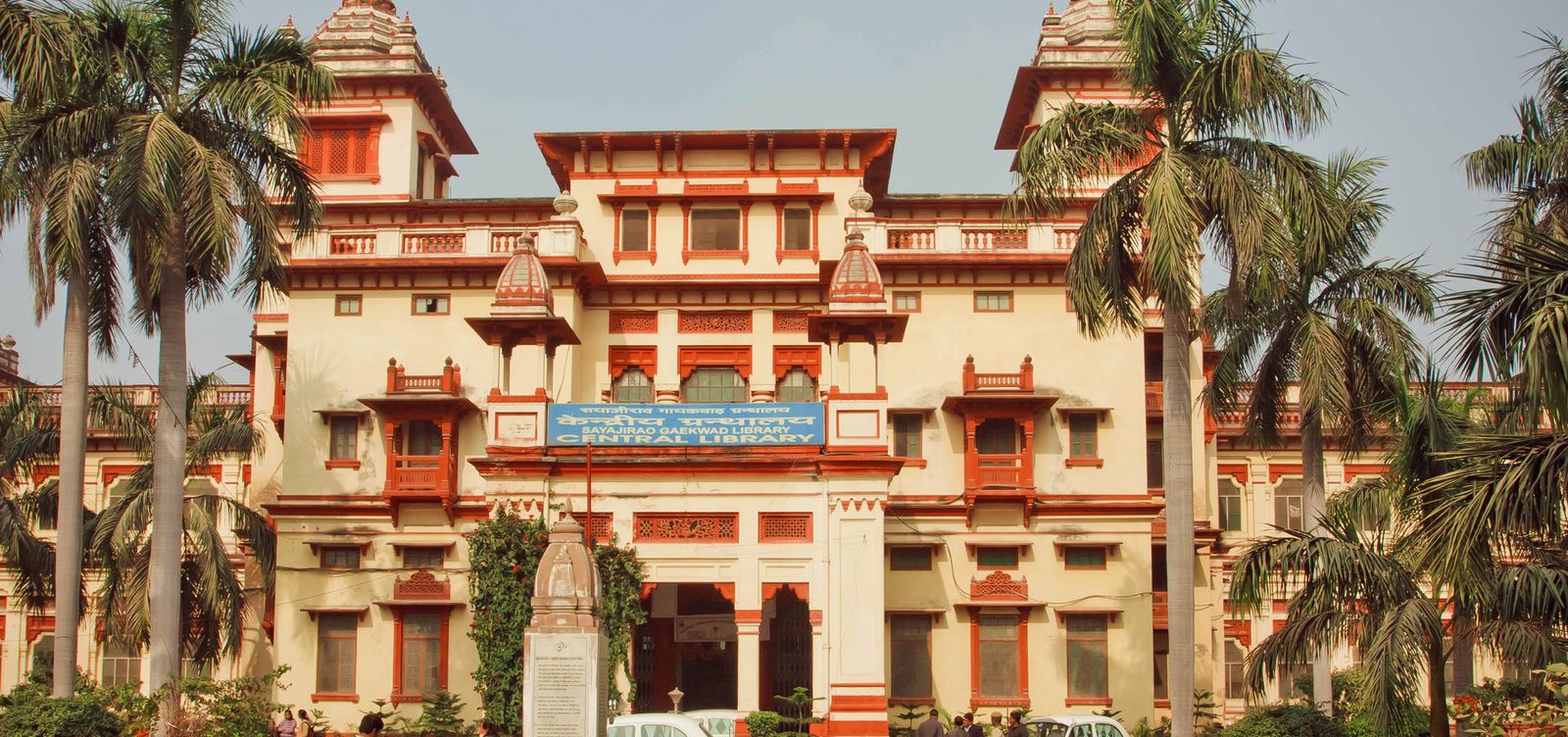
The campus was laid out on a semicircular plan, with the main road sweeping in a long curve from the Singh Dwar — the main gate — toward the temple at the heart of the grounds. The architecture is a particular kind of early twentieth-century hybrid: Mughal arches, Rajput chhatris, classical columns, all rendered in the same deep red sandstone that gives BHU its signature look.
The Central Hall, the Faculty of Arts, the Institute of Medical Sciences — each building wears the same colour but carries a slightly different personality. Some have wide verandas where pigeons gather. Others rise three storeys with carved balconies that nobody seems to use. The trees do half the work. In March, when the gulmohars bloom, the avenues turn the colour of fire.
Walking the full perimeter takes the better part of a day. Most visitors don't. Most come for one specific reason, and they head straight there.
The White Tower Among the Red
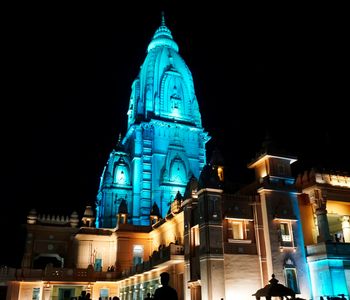
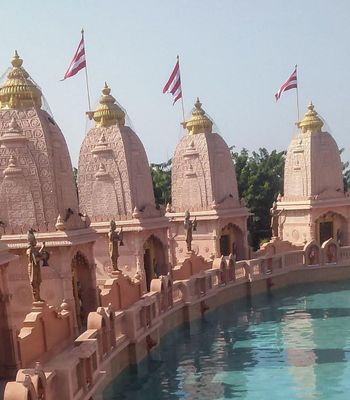
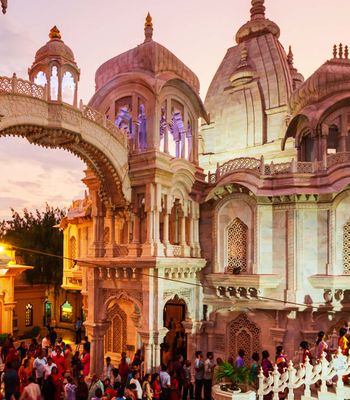
The Vishwanath Temple inside BHU — usually called the New Vishwanath Temple, to distinguish it from the ancient one in the old city — was funded largely by the Birla family and completed in 1966. It is one of the tallest temples in India, rising in a slender white shikhara that you can spot from much of the campus.
Unlike its older namesake, this temple admits people of all faiths and castes. That was the point. Malaviya had insisted on it decades earlier, and the Birlas honoured the principle. You leave your shoes at a stand outside, climb the steps, and walk through halls inscribed with verses from the Bhagavad Gita carved directly into the marble walls. Nine shrines in total. The atmosphere is calm, well-kept, and noticeably less frenetic than the temples in the city proper. If you've already braved the chaos of the original Kashi Vishwanath, this version offers a reflective counterpart.
The Museum Almost Nobody Tells You About
If you only have an hour at BHU, spend it at the Bharat Kala Bhavan. The museum sits inside the campus and is easy to miss if you don't know to look for it, yet it holds one of the finest art collections in northern India. Miniature paintings from the Mughal and Rajput courts. Sculptures pulled from temples a thousand years older than the university itself. Textiles, coins, terracotta figurines, manuscripts.
The lighting is uneven, the labels are sometimes faded, and the building has the slightly worn dignity of a place that takes its scholarship more seriously than its presentation. None of that matters. The collection is genuine and deep. A small Krishna painted on a palm leaf can hold you longer than you expected.
The museum is closed on Sundays and university holidays. Hours can shift. Check before you go.
Thirty Thousand Lives, Lived in Public
Around 30,000 students live and study here, and you feel their presence everywhere without it ever becoming overwhelming. Tea stalls cluster near the engineering faculty. Bookshops near the arts block sell everything from Sanskrit dictionaries to dog-eared copies of Marquez. The hostels — there are dozens, named for rivers and saints and freedom fighters — sit behind their own walls, and you'll catch glimpses of cricket matches on dusty grounds in the late afternoon.
It's worth wandering simply to see what an Indian campus feels like when it works. The mood shifts with the hour. Mornings are slow and golden. Afternoons get busy near the canteens. Evenings, especially around the temple, soften into something contemplative.
The Practicalities
BHU sits in the southern part of Varanasi, around seven kilometres from the main ghats. An auto-rickshaw from Dashashwamedh or Assi Ghat will get you there in twenty to thirty minutes, depending on traffic, which in Varanasi can mean anything. Agree on the fare before you climb in.
The Singh Dwar is the main entrance and the most impressive — a tall red sandstone gate that announces the university with confidence. Entry is free for visitors. Cycle-rickshaws wait inside the gate and will pedal you to the temple or the museum for a small fee, which is genuinely the most pleasant way to cover the distances involved. The campus is too large to see entirely on foot unless you have a full day and serious shoes.
Dress modestly, especially if you plan to enter the temple. Photography is generally permitted on the grounds but not inside the temple or museum.
When the Light Is Right
The best months to visit are November through February, when Varanasi's weather turns mild and the campus feels almost European in the early mornings. Summer here is punishing — temperatures climb past 40 degrees Celsius — and the monsoon, while atmospheric, can turn the avenues into sheets of standing water.
Aim for a weekday if you can. Weekends bring more local visitors, particularly to the temple. Early morning, just after the gates open, is when the campus is at its most photogenic and least crowded.
The Varanasi Most Travellers Miss
Most travellers come to Varanasi for the ghats, the cremation fires, the bone-deep antiquity of one of the world's oldest continuously inhabited cities. BHU offers something different and, in its quiet way, equally telling. It is the modern republic's answer to ancient Kashi — a place that took the city's traditions of learning and gave them a campus, a budget, and a future. Spend a morning here between visits to the river, and you'll leave with a fuller picture of what Varanasi actually is.