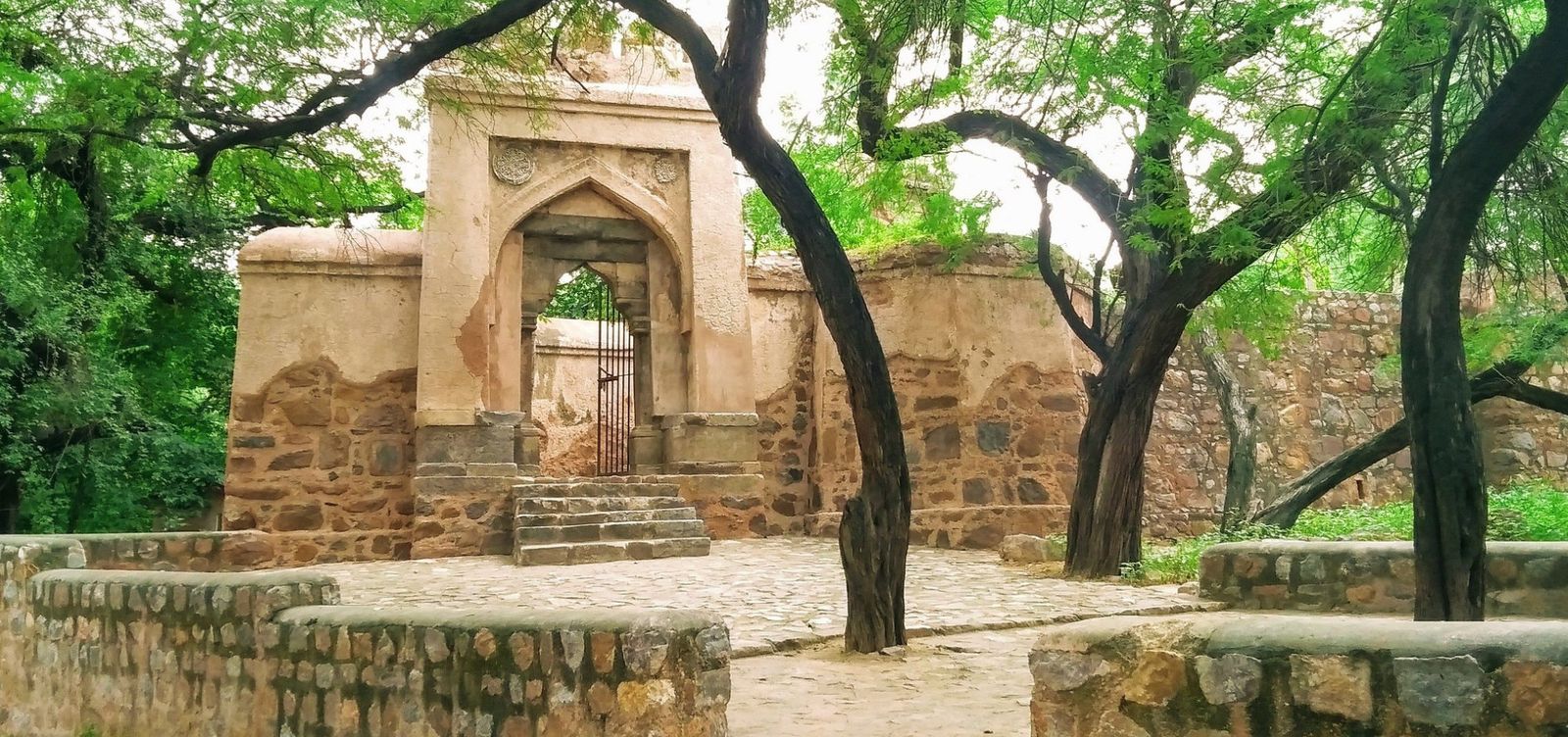
Most of Delhi's monuments come with plaques, ticket counters, and the heavy hand of official history. Bhuli Bhatiyari Ka Mahal has none of it. A crumbling 14th-century hunting lodge in the scrubby Ridge Forest of West Delhi, it charges no admission, posts no guard, offers no explanatory signage at its entrance. The name translates roughly to "the palace of the forgotten innkeeper" — a title so perfectly enigmatic that even historians can't fully agree on where it came from. What's left is a roofless stone shell, its walls threaded with creeping fig roots and shaded by wild kikar trees, a place where Delhi's Tughlaq-era past simply sits in silence, waiting for anyone curious enough to duck through its broken archways. It rewards you precisely because it asks nothing of you.
Three Stories, No Consensus
The etymology of "Bhuli Bhatiyari" has generated at least three competing theories, and none quite holds. In one version, a bhatiyarin — a female innkeeper — ran a sarai near this site until the city's expansion left her and her roadside lodge behind, her identity swallowed by time. Another account binds the name to a woman who lost her way in The Ridge Forest, her story slowly fusing with the ruin's folklore across centuries.
What historians do broadly agree on is the structure's Tughlaq-dynasty origins. The Tughlaqs ruled the Delhi Sultanate through much of the 14th century and built with an almost ideological austerity. You see it in the thick rubblestone walls: no delicate jali screens, no floral carvings. Just masonry stacked to survive. The construction is heavy, nearly brutalist — closer in spirit to a fortress than a palace, regardless of its name.
The ambiguity is, oddly, the point. In a city where every second monument has been catalogued and annotated to exhaustion, Bhuli Bhatiyari Ka Mahal holds onto a genuine sense of the unknown. That's rarer than it sounds.
Rooms Open to the Sky
The structure is compact — you can cover its entire footprint in fifteen minutes if you're rushed. But rushing defeats the purpose. The hunting lodge is a series of interconnected rooms and corridors, most of them roofless now. Whatever covering they once had collapsed long ago, leaving jagged wall tops where ring-necked parakeets perch in the late afternoon light.
Step through the main archway and you'll feel the walls narrow as you move deeper inside. The passageways were clearly designed to funnel movement — perhaps to channel game, perhaps to control access during royal hunts. A few chambers still retain fragments of their original arched ceilings, the stonework blackened with centuries of age and the soot of fires lit by squatters who came and went with no one watching.
The strangest thing is the silence. Delhi's Ridge Forest, despite being surrounded by one of the noisiest cities on earth, manages to muffle the honking and diesel rumble to a distant hum. Inside the ruin, the acoustics shift further. Your footsteps on the packed earth floor sound louder than they should. Bird calls ricochet off bare stone at odd angles. It's a disorienting quiet — the kind that makes you suddenly aware of your own breathing.
The Forest That Holds It
You can't separate Bhuli Bhatiyari Ka Mahal from the Northern Ridge that envelops it. This remnant of the ancient Aravalli range is Delhi's largest green lung, and the forest around the ruin grows dense with native dhak, kair, and prosopis trees. During the monsoon months of July and August, the undergrowth thickens dramatically, and the path to the lodge turns slick with red laterite mud.
The Ridge carries its own layered chronology. British-era markers from the 1857 uprising dot the forest floor, and Flagstaff Tower — where British women and children sheltered during the siege of Delhi — stands a couple of kilometers north. Bhuli Bhatiyari Ka Mahal predates all of this by nearly five centuries. Walking here, you cross timelines without meaning to.
A word on the Rhesus macaques: they're numerous, bold, and entirely unimpressed by you. Don't carry exposed food unless you're prepared to surrender it.
After Dark, Another Story Entirely
It would be dishonest to write about this place without mentioning its reputation as one of Delhi's "haunted" sites. Local media regularly ranks Bhuli Bhatiyari Ka Mahal among the city's most supernatural locations, and the Delhi government has at various times restricted nighttime access. Whether you find this compelling or laughable depends entirely on your temperament.
What's undeniable is the atmosphere. An abandoned ruin in a dense forest, unlit, unguarded, bearing a name that literally invokes forgetting — the place practically writes its own ghost story. During daylight, this reputation is mostly good for a laugh. The ruin feels more melancholy than menacing, more neglected than cursed. But visiting alone as the sun drops behind the Ridge canopy does produce a specific unease — and it owes more to isolation than to anything otherworldly. Here's the counterintuitive thing: the supposed haunting may be the only reason the place hasn't been entirely forgotten. Fear, it turns out, is its own form of preservation.
How to Find It — and What to Bring
The lodge sits near the intersection of Sardar Patel Marg and Ridge Road in west Delhi, not far from the Pusa Institute. Auto rickshaw drivers in the area generally know it, though you may need to clarify you're looking for the ruin, not a restaurant. The nearest Delhi Metro station on the Yellow Line is Vishwavidyalaya — a reasonable starting point, though you'll still need a short rickshaw ride to reach the forest entrance.
There's no ticket counter and no entry fee. The Archaeological Survey of India has placed the structure under protection, but active maintenance is minimal at best. No restrooms, no water vendors, no food stalls nearby. Carry what you need.
Morning visits between October and March offer the most comfortable conditions. Delhi's summer heat — regularly above 40 degrees Celsius — makes the exposed, roofless ruin punishing by midday. The monsoon brings its own beauty but also standing water and mosquitoes. Wear closed shoes regardless of season; the ground inside is uneven rubblestone scattered with loose debris.
The Monument That Forgot Its Own Name
Bhuli Bhatiyari Ka Mahal doesn't compete with the Red Fort or Humayun's Tomb, and it shouldn't try. Its power lies in the total absence of spectacle. No sound-and-light show will ever illuminate these walls. No guided tour will shepherd you through its corridors. What you get instead is a raw encounter with a structure that has outlasted its own story — a building whose very name concedes that memory has failed it. In a city obsessed with its monuments, this is the one that simply lets you stand in the ruins and decide for yourself what it means. Bring water, wear sturdy shoes, and leave your expectations at the broken archway.