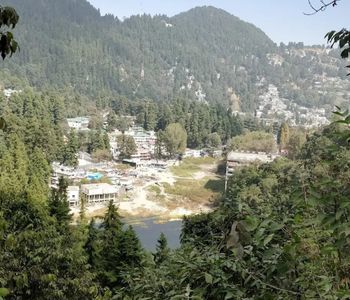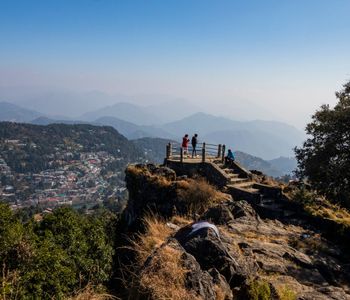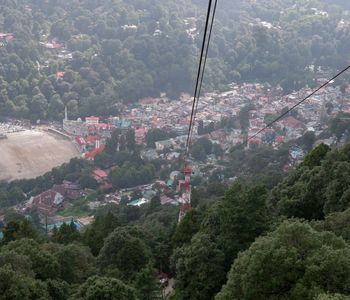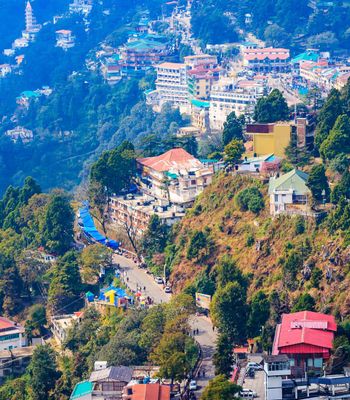
Most Indian hill stations exist because the British wanted to escape the heat. Nainital exists because a man saw a lake and lost his nerve to leave. In 1841, a sugar trader named P. Barron came upon this crescent of water held between seven hills in Uttarakhand's Kumaon region, and within a decade the British had raised an entire town around its shores. The lake didn't just attract a settlement — it became one. Even now, Nainital Lake isn't a feature you visit on the side. It's the town's circulatory system, its economic engine, the reason every road here bends the way it does. Take the lake away and Nainital has no argument for existing.
A Kidney-Shaped Mirror at 6,358 Feet
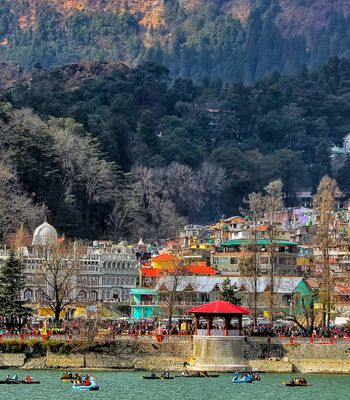
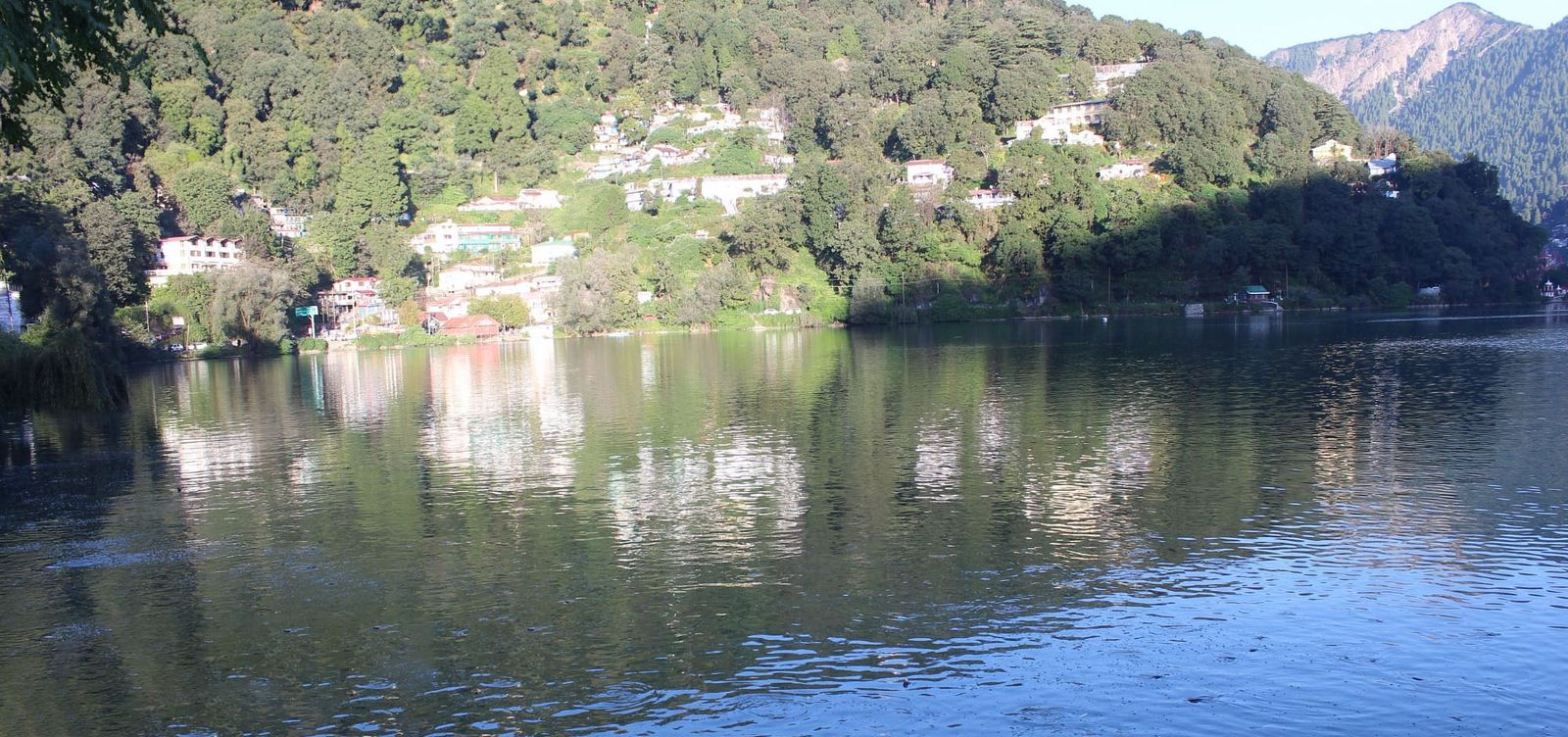
The water sits at roughly 6,358 feet, stretching about 1.5 kilometers long and some 500 meters across at its widest. Its kidney-like curve means you never quite see the whole thing from any single spot. Walk the Mall Road along the eastern shore and the surface bends away from you, retreating toward Tallital at the southern end. Cross to the western bank and the northern tip at Mallital reveals itself, the white dome of the Naina Devi Temple keeping its centuries-long watch.
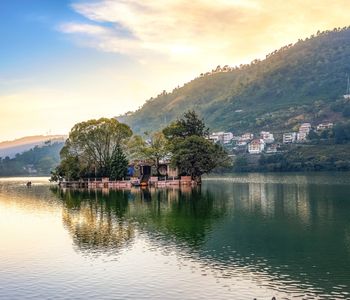
The water changes temperament by the hour. Early mornings produce a flat, steel-grey stillness that reflects the surrounding deodar and oak forests with near-photographic precision. By midday, paddle boats and shikaras churn everything into broken fragments of green and blue. Then dusk arrives. The hills throw long shadows across the basin, and the lake deepens to an emerald that feels older than the town above it.
The Promenade They Call Mall Road
A paved walkway traces the lake's eastern edge, linking Mallital in the north to Tallital in the south — roughly 1.5 kilometers that function as Nainital's living room. Locals stroll here after dinner. Tourists stop every thirty feet to photograph the water. Horse riders clop along the margins, offering rides to families with the practiced nonchalance of people who've made the same pitch ten thousand times.
What makes this promenade unusual is proximity. There's no dramatic elevation change, no railing-lined cliff between you and the surface. You walk nearly at lake level, close enough to hear the wooden hulls of rental boats knocking against each other at the ghats. This changes your relationship with the water entirely. You don't observe it from above like some scenic overlook. You're beside it — the way you sit next to someone on a bench, sharing the same silence.
Halfway along, the Flats — a rectangular open ground reclaimed after a devastating landslide in 1880 — interrupt the rhythm. Cricket matches happen here on weekends. That landslide killed 151 people and permanently reshaped the town's geography, a fact the cheerful ice cream vendors working the Flats don't mention.
On the Water, Not Just Beside It
Boat rentals run from both the Mallital and Tallital ends. You'll find rowboats, paddle boats, and the more elegant shikaras — those Kashmiri-style craft with cushioned seats and a canopy overhead. The rowing clubs here trace their lineage to the British era, and the Nainital Boat House Club still organizes regattas that feel borrowed from another century entirely.
A piece of advice most guides won't offer: skip the paddle boat. The effort-to-reward ratio is dismal, and you'll spend more time pedaling than looking at anything. Hire a rowboat with a boatman instead. For a few hundred rupees, someone who has navigated this lake since childhood will take you to the center, where the surrounding hills form an unbroken amphitheater of green. The silence there — even on a crowded day — is startling. Sound doesn't carry well across the water. The town's noise drops away faster than you'd believe.
Where Gods and Geology Collide
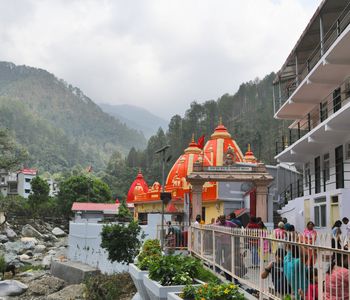
The Naina Devi Temple at the northern shore predates the British by centuries. Hindu tradition identifies it as one of the 51 Shakti Pithas — the spot where the eyes of Goddess Sati fell to earth. The 1880 landslide destroyed the original structure. It was rebuilt. The site's spiritual gravity, though, has survived every catastrophe thrown at it, geological or otherwise.
Beneath the mythology, the lake occupies a tectonic basin — a depression carved by fault activity in the Kumaon hills. Natural springs and rainwater feed it, though seasonal fluctuations can reduce its depth considerably by late spring. During the monsoon, the lake swells and its color shifts to a murky, rain-fed brown. This isn't the postcard version, but it's the truthful one. The lake is a living hydrological system, not a decorative pond. It behaves accordingly.
When to Show Up, and When to Think Twice
High season runs from March through June, when plains dwellers flee upward in search of cooler air. During May and June especially, Nainital's population balloons and the lakeside promenade becomes a slow-moving wall of people. Hotel rates spike. Boat queues stretch.
September through November is the smarter window. The monsoon retreats, the air sharpens, and the surrounding forests carry that post-rain freshness that makes every shade of green look like it was just invented that morning. Winter brings fog and temperatures dropping near freezing; occasionally the hills above the lake receive snow. The lake itself doesn't freeze — it sits too low for that — but the cold keeps the crowds thin, and the town returns to something closer to itself.
You reach Nainital by road from Delhi, roughly a six-hour drive via Haldwani. The nearest railway station is Kathgodam, about 35 kilometers south, with daily trains from the capital. From Kathgodam, shared taxis and buses handle the winding ascent. No flights land here. You arrive slowly, by road, watching the elevation climb — and that deliberate approach is part of the point.
What the Lake Asks of You
Nainital Lake has a pollution problem the local government has struggled to address for decades. Sewage runoff, tourist waste, and encroaching construction along its banks have degraded water quality in measurable ways. The High Court of Uttarakhand has intervened more than once to restrict building activity near the lake's catchment area. Here's the counterintuitive thing: the lake's most visible threat isn't industry or agriculture. It's affection. Too many people loving a place too carelessly. As a visitor, the simplest contribution is the most obvious — don't throw anything in the water, and choose boatmen who respect the same principle.
A Lake Worth Sitting Beside
Nainital Lake doesn't require you to hike to it, decode it, or cross an entry gate to reach it. It's right there, at the center of everything, reflecting seven hills and more than a century of human ambition back at anyone willing to stand still. The best thing to do here costs nothing. Find a bench on Mall Road in the early evening. Watch the shikaras drift across darkening water. Understand why a sugar trader in 1841 decided this was the place. Some landscapes demand you conquer them. This one just asks you to sit down.