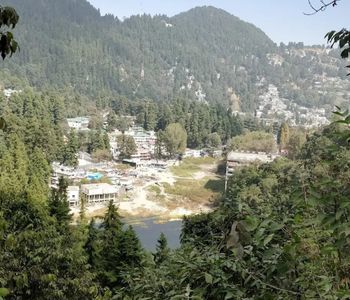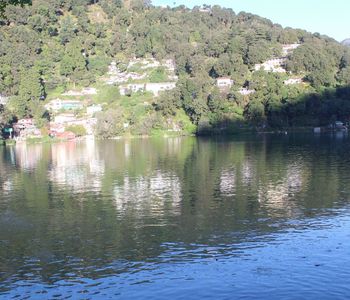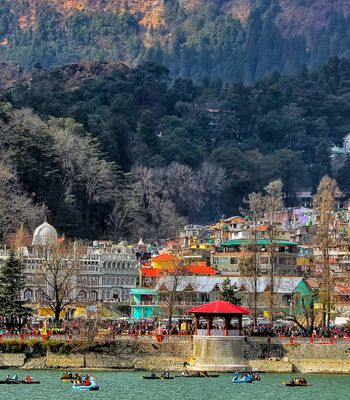
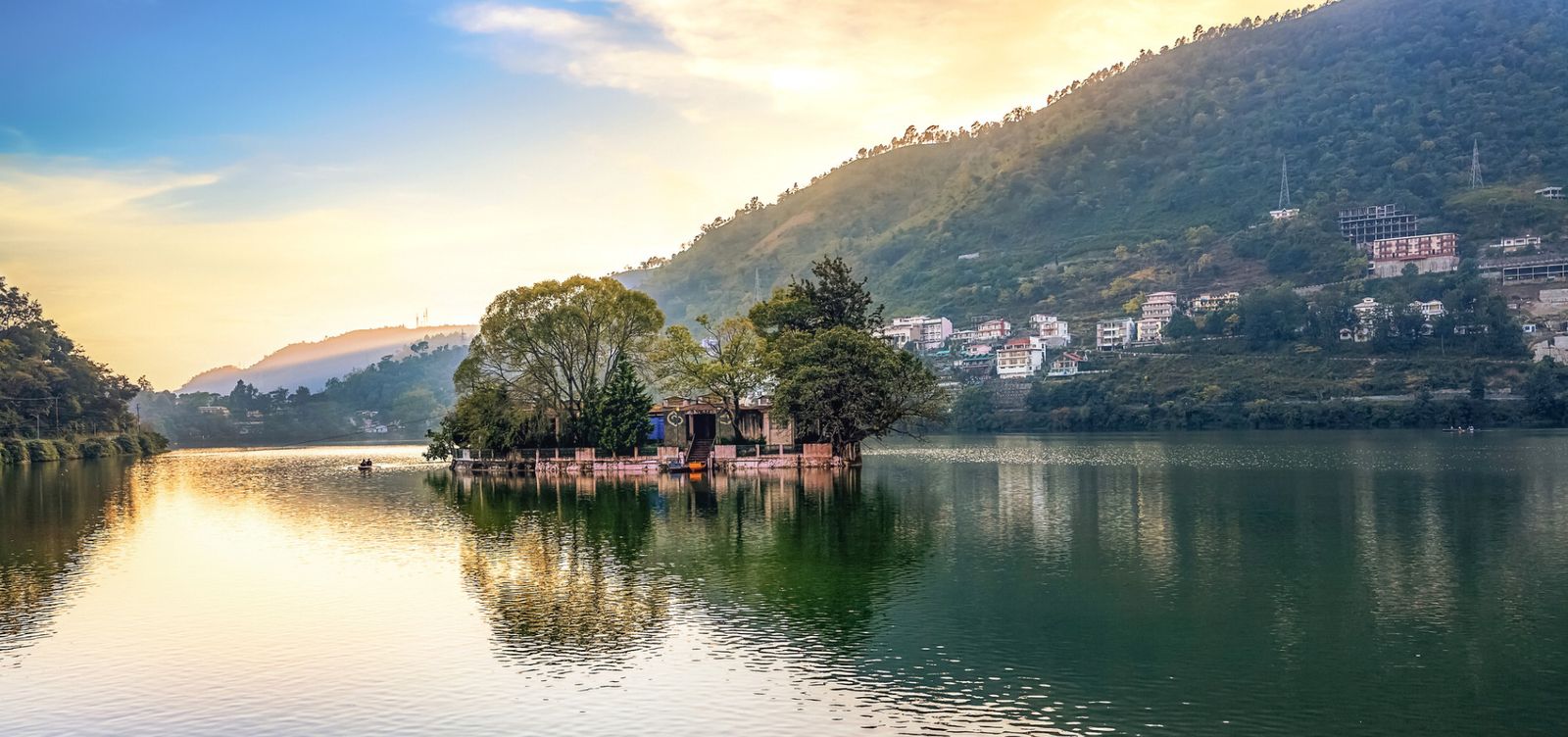
About twenty kilometers southeast of Nainital, a larger and considerably quieter lake spreads across a valley floor that most tourists drive straight past. Bhimtal Lake covers roughly 47 hectares — the biggest lake in the Kumaon region — yet it draws a fraction of the crowds that swarm its famous neighbor. This is precisely its appeal. The water sits at about 1,370 meters, cool enough to blunt a North Indian summer but low enough to remain accessible year-round. At its center, a small island holds an aquarium. An odd, slightly surreal detail that somehow suits the lake's personality perfectly.
Named after Bhima, the strongest of the five Pandava brothers from the Mahabharata, the lake carries old mythology without making a fuss about it. If you've grown weary of tourist-choked hill stations and want water that actually reflects the sky instead of a hundred paddle boats, Bhimtal is the antidote.
A Name Carved from Epic and Stone
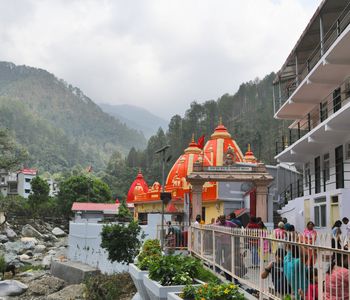
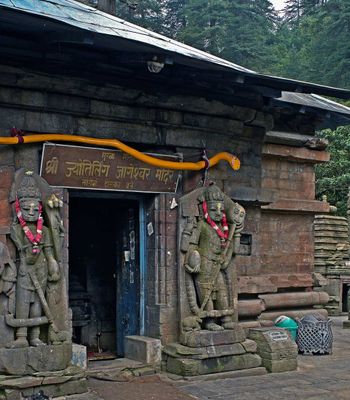
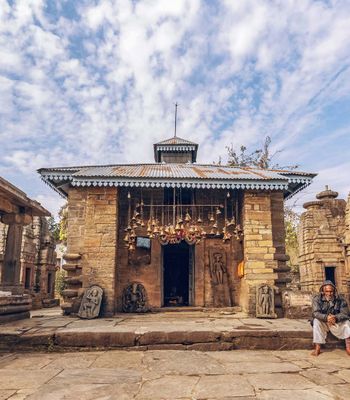
Local tradition holds that Bhima struck the earth here during the Pandavas' exile, and water rushed up to fill the wound. Whether you find that plausible is beside the point — what matters is that the story has shaped how people relate to this place for centuries. A Bhimeshwara Mahadeo Temple sits at the lake's dam, its age difficult to pin down precisely, but its Shiva lingam attracting steady devotion from locals who treat the site as sacred ground rather than a backdrop for selfies.
The dam itself was built during the British colonial period, replacing what was likely a more ancient bund. Walking across it gives you the lake's full panorama: terraced hillsides on the far shore, dense oak and pine forest climbing the ridgelines, and that peculiar little island anchored dead center like a period at the end of a long sentence.
The Island Nobody Expected
Bhimtal's strangest feature rises right from the lake's middle. A small island, accessible only by boat, houses a modest aquarium displaying freshwater and some exotic fish species in illuminated tanks. The building itself is unremarkable — concrete, functional, a little worn at the edges. But the act of floating across a Himalayan lake to visit an aquarium on an island has a logic all its own, the kind of thing that makes India endlessly surprising even when it's trying to be ordinary.
The boat ride takes roughly ten minutes each way. Rowing boats are the default option, and the silence they offer is worth choosing over the motorized alternative. You hear water against wood. The occasional kingfisher. Your own breathing. The aquarium won't rival anything you'd find in a coastal city, but it gives you a reason to linger on the island, sit on the steps, and look back at the shoreline from a vantage point most people never bother to reach.
What the Water Actually Feels Like
Bhimtal's water runs a deep green most of the year, shifting toward slate blue in winter when the surrounding foliage thins. It's not the turquoise of a tropical postcard — it's earthier, fed by natural springs and monsoon runoff carrying the minerals of the Kumaon hills. In early morning, mist clings to the surface like gauze. By midday, the wind picks up and small waves catch the light in brief, silver flashes.
A quiet fishing culture persists along the banks. You'll spot locals casting lines in the late afternoon, unhurried and largely indifferent to anyone watching. Carp and mahseer populate these waters, though catching them requires more patience than most travelers carry. Wild grass and the occasional willow crowd the periphery, and the smell after a rain shower — wet pine and damp earth — is the kind of scent that expensive candle companies try to bottle and never quite capture.
Beyond the Waterline
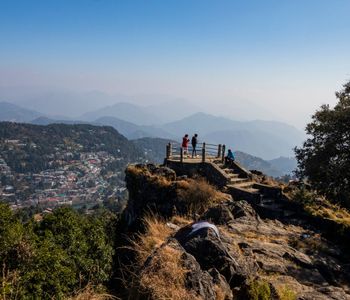
The land around Bhimtal rewards those who wander on foot. A trail from the lake leads uphill toward Hidimba Parvat, a modest peak named after another Mahabharata figure. The walk takes roughly forty minutes and delivers a commanding view over the entire lake basin. From up there, the water looks like a dark mirror pressed into green folds of land.
About three kilometers away, the smaller Naukuchiatal — the lake of nine corners — makes for a worthwhile side trip. It's deeper and more secluded than Bhimtal, though far less accessible. Back at the main lake, a handful of restaurants along the approach road serve simple Kumaoni dal and rice alongside the inevitable Maggi noodles. Don't expect culinary revelation, but the food is honest and hot, and at this altitude that's usually enough.
Getting There Without the Headache
The nearest major railhead is Kathgodam, about 30 kilometers south. Shared taxis and local buses make the climb from there in roughly an hour, depending on traffic and the driver's relationship with caution. If you're coming from Delhi, an overnight train to Kathgodam remains the most civilized option — you arrive at dawn, groggy but already in the hills.
From Nainital itself, the drive takes under an hour along a winding but well-maintained road. Auto rickshaws will negotiate the trip, though hiring a private taxi gives you the flexibility to stop at viewpoints along the way. The road passes through Bhowali, a small town worth slowing down for — its fruit market stacks wooden crates with apricots and plums from June through August, and the smell alone is worth a five-minute detour.
When to Show Up
The lake performs differently across seasons, and your timing shapes everything. March through June offers warm days and the clearest skies — ideal for boating and walking. The monsoon months of July and August turn the world intensely green but also muddy; the lake swells, trails get slippery, and some boat services pause. September through November delivers post-monsoon clarity, the air scrubbed clean, the surrounding hills glowing amber at dusk.
Winter brings its own reward. December and January temperatures hover around 5 to 10 degrees Celsius during the day, cold enough to keep casual visitors away. The lake turns reflective and still. Mornings are sharp. If solitude is what you're after, this is when you'll find it.
The Quiet That Stays With You
Bhimtal Lake doesn't compete for your attention. It doesn't need to. While Nainital wraps itself in colonial nostalgia and commercial energy, Bhimtal simply exists — a body of water in a valley, surrounded by hills that have been here far longer than any of us. The island at its center, the temple at its edge, the mist on its morning surface — these aren't attractions in the conventional sense. They're details that accumulate slowly, the way good travel memories always do. Come here not for spectacle, but for the rare pleasure of a place that hasn't learned to perform for its audience.