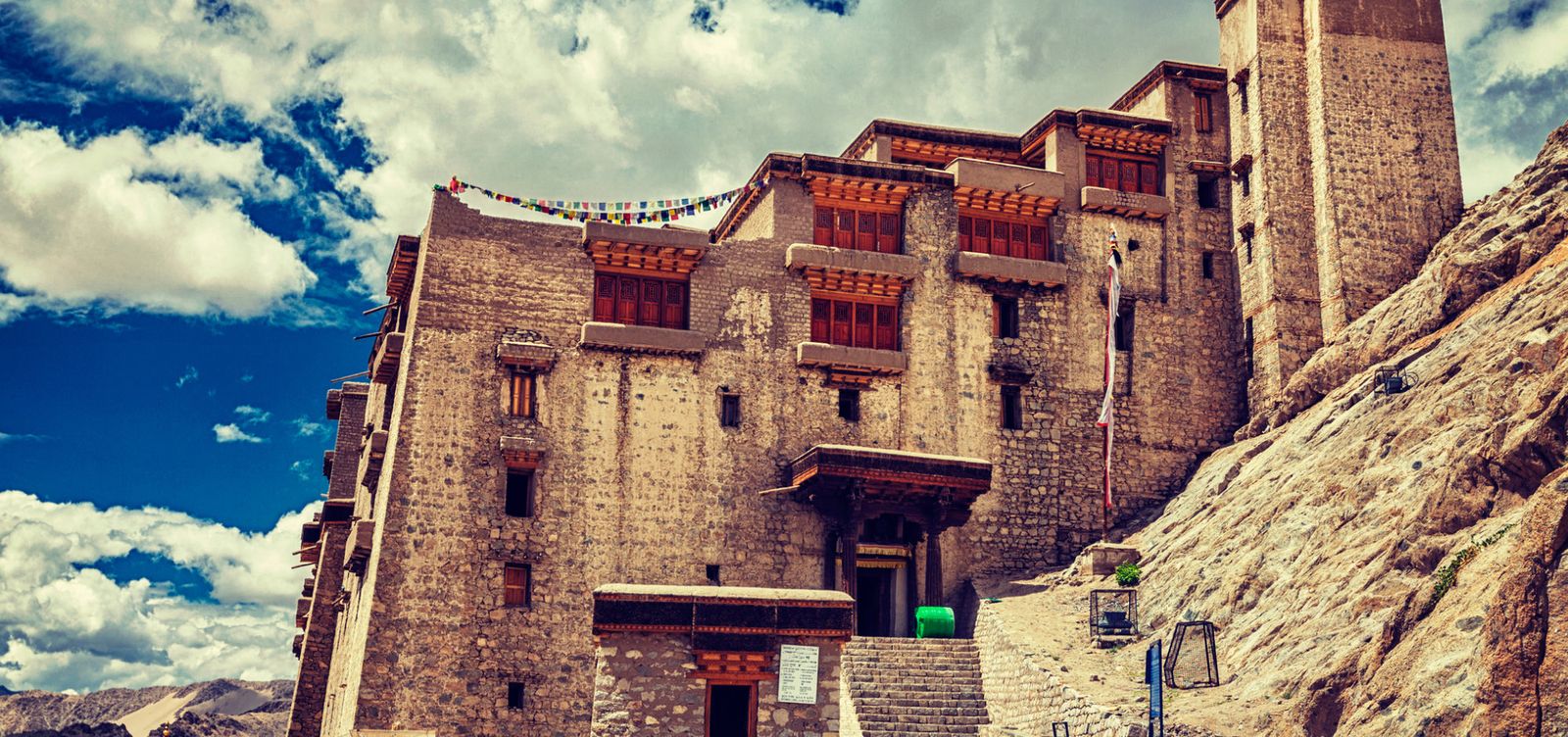
At 11,500 feet above sea level, Leh Palace doesn't greet you so much as it looms. Nine stories of mud brick and timber rise from a granite ridge overlooking the old town, and the first thing that strikes you isn't its grandeur — it's how exhausted it looks. The walls lean. The windows gape. Entire sections seem held together by little more than habit and high-altitude dryness. And yet, standing below it in the sharp Ladakhi sunlight, you understand immediately why the Namgyal dynasty chose this spot. The palace commands every sightline in the Leh valley. It was never meant to be beautiful. It was meant to be unavoidable.
King Sengge Namgyal raised this structure in the 17th century, several decades before its more famous architectural cousin — the Potala Palace in Lhasa — took shape. Some historians argue it served as direct inspiration for the Tibetan landmark. Whether or not that claim holds, the family resemblance is unmistakable: the same tiered profile, the same illusion of growing organically from the rock beneath it. The difference is that the Potala got restored and polished into a UNESCO monument. Leh Palace was simply left alone.
What the Walls Remember
The Namgyal dynasty ruled Ladakh for roughly five centuries, and this palace served as their seat until the mid-19th century, when Dogra forces from Jammu seized the region. The royal family relocated to Stok Palace across the Indus River. Their former home began its long, quiet decline — first repurposed as a garrison, then abandoned altogether.
Today, the Archaeological Survey of India oversees restoration efforts, though "restoration" might be generous. Progress is glacial. Scaffolding appears on one wall, vanishes, reappears on another. Rooms accessible five years ago are sometimes sealed off now; others open without explanation. The palace exists in permanent negotiation between decay and preservation, and that tension — honestly — is part of what makes it worth the climb.
Inside, the corridors are narrow and uneven. Ceilings drop without warning. You'll duck through doorways designed for a population shorter, on average, than today's visitors, and your eyes will take a moment to adjust to rooms where the only light enters through small, deep-set windows. On the upper floors, faded murals cling to crumbling plaster — Buddhist figures rendered in mineral pigments that have oxidized into muted reds and ochres over the centuries.
The View That Earns Its Keep
Most people climb to Leh Palace for the panorama, and on this front, the palace delivers without hesitation. From the rooftop, the entire valley unfolds — the green ribbon of irrigated fields tracing the Indus, the tawny expanse of the Zanskar Range shouldering up to the south, and the white dome of Shanti Stupa glowing on its hilltop across town. On clear mornings, the light is so precise you can count individual poplar trees in the villages below.
Here's what most guidebooks get wrong: the view from the palace is actually better than the view from Shanti Stupa, even though tourists overwhelmingly prioritize the stupa. The palace sits lower but closer to the old town, which means the human landscape — flat-roofed houses, mosque minarets, the labyrinth of alleys — fills your foreground with texture and life. At the stupa, you get distance. At the palace, you get intimacy.
Sunset draws the largest crowds, and deservedly so. The Zanskar Range turns from brown to copper to deep violet in about twenty minutes. Arrive an hour early if you want a quiet spot on the upper terrace. Bring a jacket — at this altitude, the temperature drops sharply the moment the sun dips behind the ridgeline.
Climbing to the Crown
Reaching the palace means a steep fifteen-minute walk from the old town's main bazaar. The path is paved in sections, loose gravel in others. At Leh's altitude, even fit travelers find themselves stopping to catch their breath, so don't be embarrassed when you do. The thin air turns a simple uphill walk into genuine cardiovascular work.
Acclimatization matters here more than most people expect. If you've just arrived in Leh, give yourself at least a full day before attempting the climb. Altitude sickness isn't a rumor — it's a medical reality that sends dozens of tourists to Leh's hospital every season. Drink water obsessively. Walk slowly. There's no prize for speed.
Entrance costs 100 rupees for domestic visitors, with a slightly higher fee for international tourists — verify the current rates at the ticket counter, as they shift periodically. Inside, a small museum maintained by the Central Institute of Buddhist Studies displays thangka paintings, ceremonial objects, and old photographs of the Namgyal family. The collection is modest but worth twenty minutes, particularly the black-and-white images showing the palace before its roof sections collapsed.
The Neighborhood Below
The old town directly beneath the palace is as compelling as the structure above it, though far fewer people bother to explore. A maze of traditional Ladakhi houses, many centuries old, lines the steep lanes leading to the palace entrance. Wooden balconies jut out over narrow paths. Prayer flags stretch between rooftops. The smell of juniper smoke drifts from doorways where families still burn it as morning incense.
At the base of the palace hill, the Jama Masjid — Leh's central mosque — anchors the old bazaar. The juxtaposition is deliberate and telling: Buddhist palace above, Muslim marketplace below, both coexisting in a town that has been a trading crossroads for a thousand years. Ladakh's identity lives in that layering. Leh Palace is its most visible expression.
When the Palace Reveals Itself
Summer, from June through September, is when Leh is accessible by road and when most travelers arrive. The palace opens daily from roughly 7 a.m. to 4 p.m., though hours can vary. Morning visits offer the softest light for photography and the thinnest crowds. By midday, tour groups from the bazaar hotels arrive in waves.
Winter visits are rarer but rewarding in a different register. Snow dusts the upper ramparts, and the palace looks almost ghostly against a grey sky. Flights to Leh operate year-round, weather permitting, so a February visit isn't impossible — just colder than you think. Temperatures drop well below minus ten degrees Celsius at night.
A Monument That Doesn't Perform
Leh Palace won't dazzle you the way a freshly restored monument does. There are no manicured gardens, no sound-and-light shows, no gift shops selling miniature replicas. What it offers instead is something harder to manufacture — the feeling of standing inside a structure that hasn't been tidied up for your benefit. The cracks are real. The silence on the upper floors is real. The wind pushing through empty window frames has been doing so for decades, and it will continue long after you descend back to the bazaar for tea. Some places earn your attention by being spectacular. Leh Palace earns it by being honest.