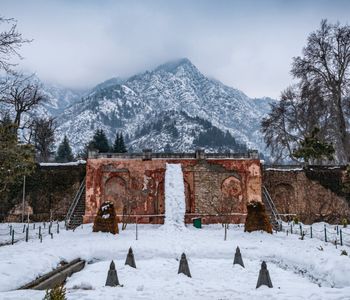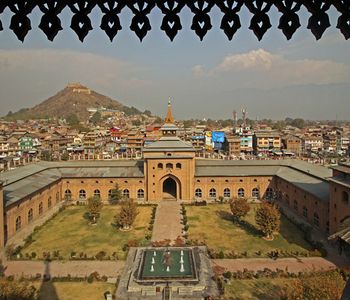
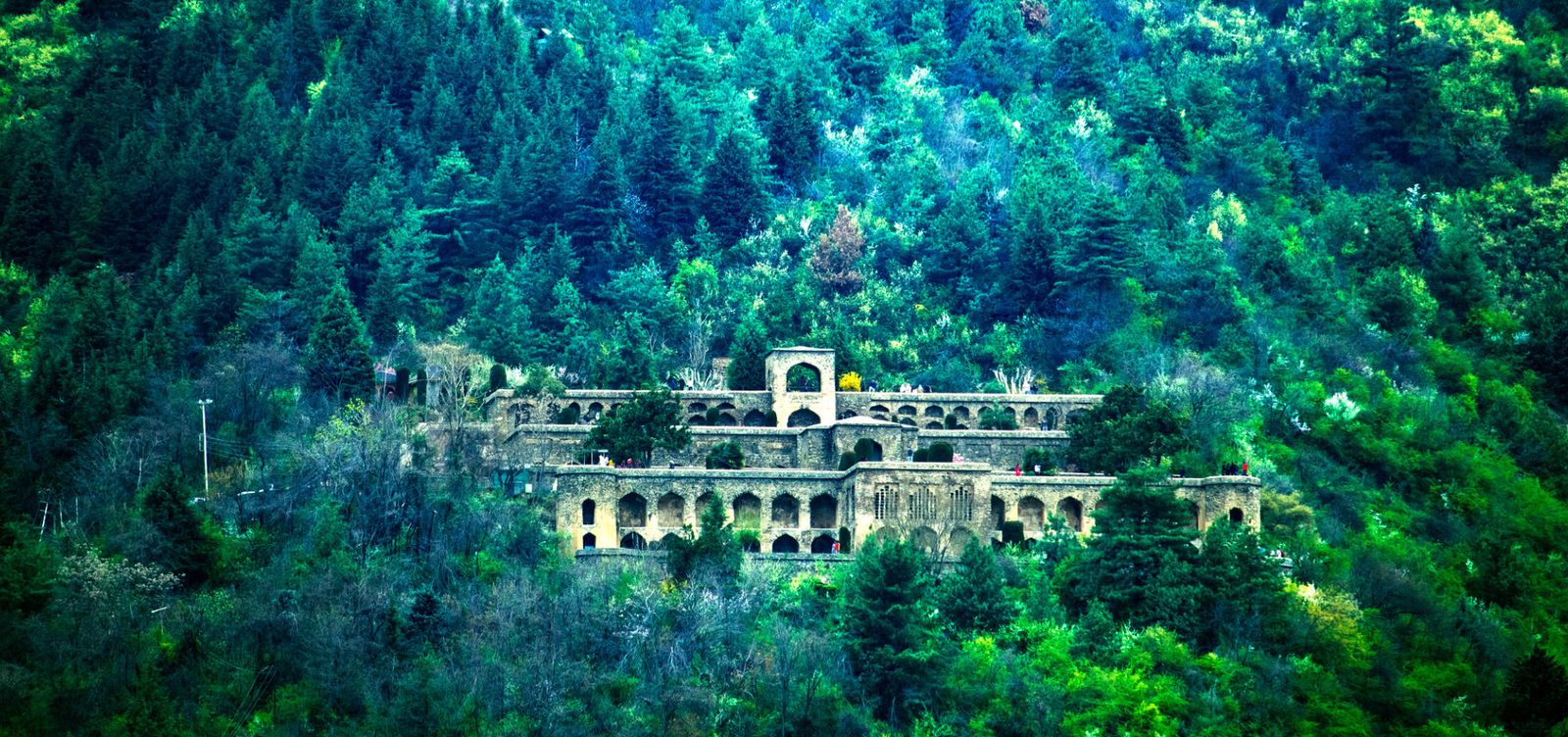
Seven terraces climb the Zabarwan Hills above Dal Lake, each one stepping closer to the sky that Dara Shikoh once studied from this very spot. Pari Mahal — the Palace of the Fairies — sounds like a name invented for postcards, but its origins are far more cerebral than romantic. This seventeenth-century monument served as a library and observatory for the Mughal prince who was more interested in astronomy and Sufi philosophy than in holding a throne. He lost his head for it, quite literally, when his brother Aurangzeb executed him in 1659. What remains on this hillside in Srinagar is a skeletal monument that feels less like a ruin and more like an open question — about power, about knowledge, about what endures when both are stripped away.
The Scholar Prince Who Lost Everything
Dara Shikoh was the eldest son of Shah Jahan, the emperor who built the Taj Mahal. Where his father channeled grief into white marble, Dara channeled curiosity into scholarship. He translated the Upanishads into Persian, corresponded with Sufi mystics, and pursued a synthesis between Hindu and Islamic thought that made him genuinely dangerous to the orthodox establishment.
Pari Mahal began its life as a Buddhist monastery long before the Mughals arrived. Dara Shikoh inherited the structure and converted it into a school of astrology and learning under the guidance of his tutor, Mullah Shah Badakhshi. The terraced gardens weren't decorative afterthoughts — they were designed as spaces for contemplation and astronomical observation. When Aurangzeb seized power, Dara's intellectual legacy was systematically erased across much of the empire. Pari Mahal survived largely because Kashmir was remote enough to escape the worst of that purge.
Stone Ribs Against the Sky
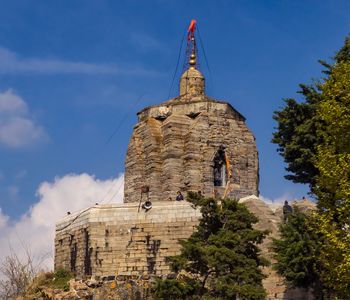
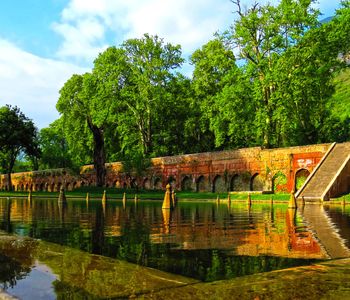
The first thing you notice is what isn't there. Roofs, ceilings, most of the interior walls — gone. What remains is the architectural skeleton: arched openings framing nothing but air and the valley beyond. The effect is unexpectedly beautiful. Sunlight passes through these arches the way it moves through a cathedral's clerestory, except here the ceiling is the Himalayan sky itself.
Six terraces descend from the uppermost level, connected by stone staircases worn smooth by centuries of feet. The construction mixes grey limestone with brick, and at certain hours the stone takes on a warm amber tone that photographs never quite capture. Baradari pavilions — open-sided structures with twelve doorways — punctuate the terraces, their arched niches still intact enough to suggest the refinement that once defined these rooms.
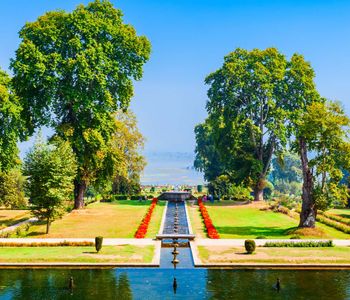
On the lower terraces, a system of water channels and fountains once fed the gardens through an ingenious spring-fed network. Most of these channels are dry now, though their carved stone beds remain visible, running in straight lines between planting beds. The Archaeological Survey of India maintains the gardens with seasonal flowers, but the real landscaping is geological — the Zabarwan range rising behind the monument like a dark wall of pine and exposed rock.
The View That Earns Its Reputation
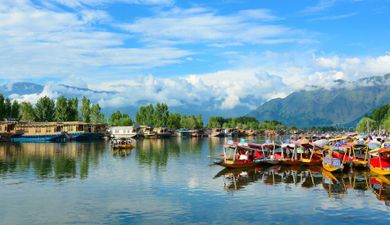
From the uppermost terrace, Dal Lake unfolds below in a way that explains why Dara Shikoh chose this particular hillside. The houseboats appear as small colored rectangles. The Mughal gardens of Nishat and Shalimar are visible along the far shore. On clear mornings, the Pir Panjal range holds snow well into May, and the reflection doubles the mountains in the lake's still surface.
Here's the counterintuitive thing about Pari Mahal: it's more powerful as a ruin than it ever could be restored. A complete building would compete with its setting. These open arches act as frames, directing your eye toward the valley, the water, the distant peaks. Dara Shikoh built an observatory, and four centuries later, the building still makes you look outward.
After Dark, a Different Monument Entirely
The Jammu and Kashmir government installed colored illumination across the terraces several years ago. At night, Pari Mahal glows green and gold against the dark hillside, visible from the Boulevard Road that runs along Dal Lake's western shore. Whether the lighting enhances or cheapens the mood depends on your tolerance for spectacle — it certainly transforms the monument into something closer to a stage set than a Mughal ruin. If you're staying on a houseboat, the illuminated silhouette is striking from the water. But the building deserves daylight. Artificial color flattens the textures that make the stonework worth studying up close.
Getting There Without the Headache
Pari Mahal sits roughly five kilometers southwest of Srinagar's city center, on the road that winds above the Cheshmashahi garden. Auto rickshaws and taxis make the climb without difficulty, though the final stretch is steep enough that drivers sometimes negotiate a surcharge. From the parking area, a short uphill walk on paved steps delivers you to the entrance gate.
The monument is open daily from around 9 a.m. to 7 p.m., and entry fees are modest — expect to pay about 50 rupees for Indian nationals and somewhat more for international visitors, though rates shift periodically. There's no ticket counter drama here; the crowds are thin compared to Srinagar's lakeside Mughal gardens. Most mornings, you'll share the terraces with a handful of local families and the occasional photography student hauling a tripod up the steps.
Combine your visit with Cheshmashahi, the smallest of Srinagar's three major Mughal gardens, which lies just downhill. The two sites share a water source — the same natural spring that once fed Pari Mahal's channels still runs through Cheshmashahi's grounds. Together, they ask no more than two or three hours of your day.
When the Season Matters
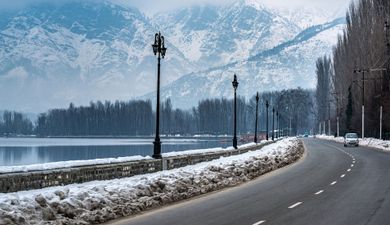
Srinagar's climate swings hard. Winter brings subfreezing temperatures and occasional snowfall that closes hillside roads entirely. Summer pushes past thirty degrees Celsius, and the gardens fill with domestic tourists escaping the plains heat. The ideal window falls in April and early May, when the almond and cherry trees across the Zabarwan foothills bloom and the air holds that particular crispness that makes distances feel compressed — the Pir Panjal seeming close enough to touch. September and October work nearly as well. The autumn light in Kashmir carries a golden weight that suits old stone.
Rain arrives unpredictably in spring. Carry a light layer, and wear shoes with grip. The stone staircases between terraces grow slick fast.
A Ruin Worth Your Silence
Pari Mahal doesn't overwhelm you with scale or dazzle you with ornamentation. It doesn't need to. This is a place where a prince who valued questions over conquests built a house for studying the sky, and where the sky eventually reclaimed the house. Stand on the top terrace in early morning, before anyone else arrives, and you'll understand why Dara Shikoh chose this hill. The silence is complete. The valley spreads below. The arches frame exactly what they were always meant to frame — everything beyond themselves.