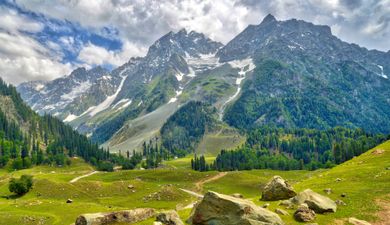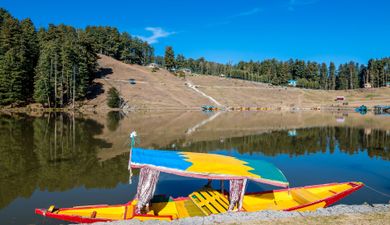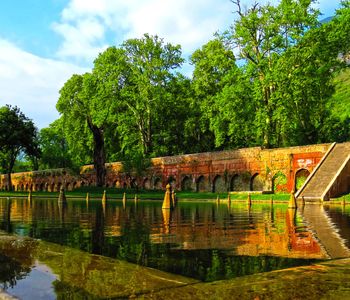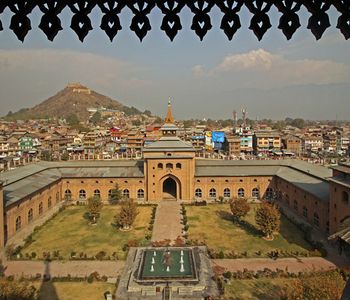
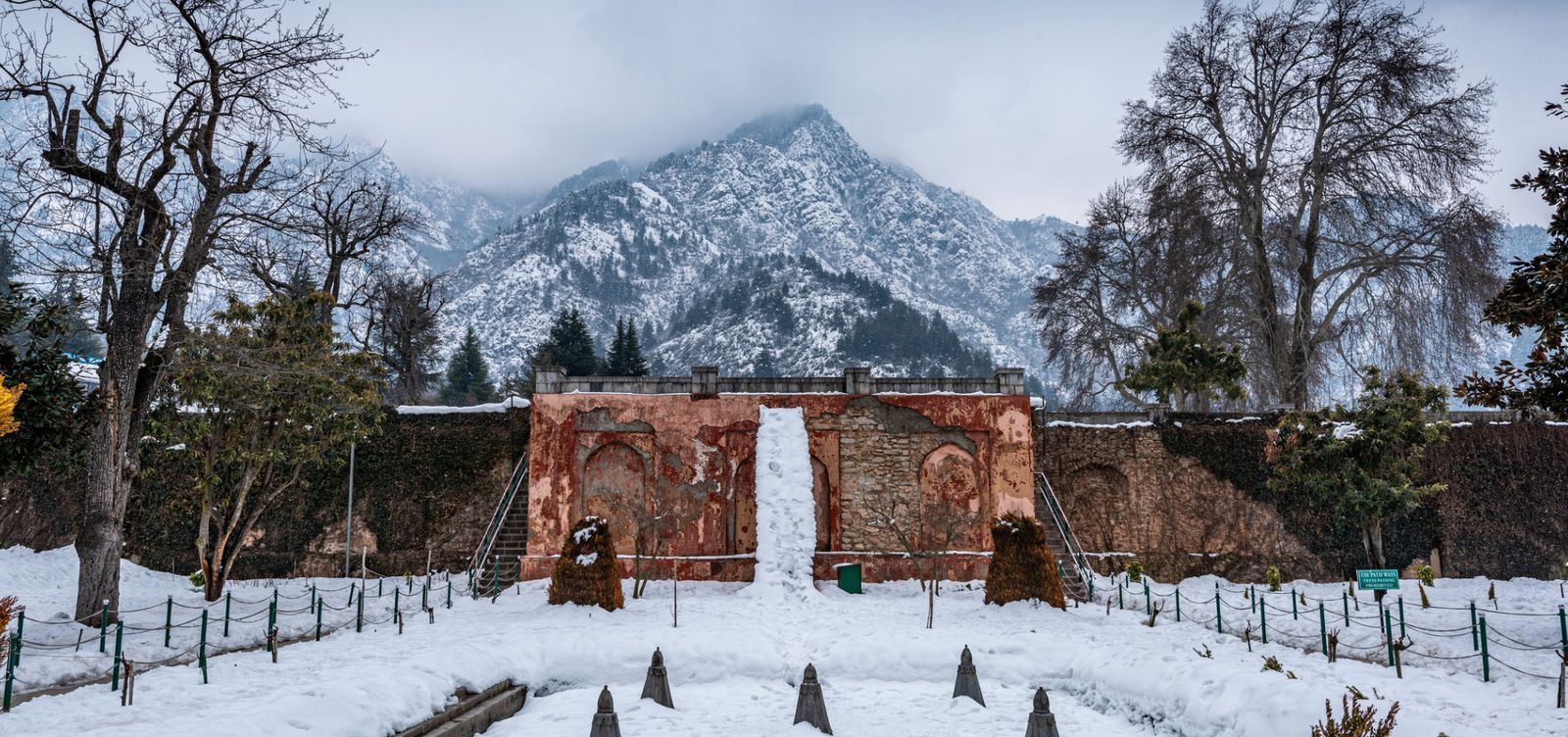
The water arrives before you notice anything else. Cold, startlingly clear, and fed by an underground spring that has never stopped flowing since long before the Mughals decided to build a garden around it, the water at Chashme Shahi defines everything about this place. It doesn't trickle. It announces itself — rushing through carved stone channels, pooling in terraced basins, and carrying with it the faint mineral taste of the Zabarwan Range above. While Srinagar's more famous gardens draw the tour buses and the selfie sticks, Chashme Shahi sits slightly apart, smaller and steeper, rewarding those who climb its three terraces with something the grander gardens can't offer: intimacy. Built in 1632 under the orders of Mughal Emperor Shah Jahan, this is the most compact of Srinagar's celebrated Mughal gardens, and arguably the most honest about what it is — a place designed around water, not flowers.
A Garden Built for One Spring
Shah Jahan's eldest son, Dara Shikoh, is credited with commissioning the garden, though the emperor's aesthetic fingerprints are unmistakable in the terraced layout. The entire design answers to a single natural spring, believed to carry medicinal properties. Locals have been drinking from it for centuries. Many still fill plastic bottles from a stone spout near the upper terrace, their faith in the water unshaken by time or modernity.
The name — Chashme Shahi — translates to "Royal Spring," and it's a rare case where a name tells the complete truth. Unlike Nishat Bagh or Shalimar Bagh, which sprawl across flat lakeside ground, Chashme Shahi climbs upward against the slope of the Zabarwan hills. Three terraces rise in quick succession, connected by a central channel that carries the spring's flow downward through the full length of the garden. The gradient is steep enough that you feel it in your calves.
At the highest point, the spring emerges from beneath stone. The water is genuinely cold, even in July, when Srinagar's afternoons push past thirty degrees. Taste it, and you'll understand why Mughal royalty bothered to terrace an entire hillside around a single source.
Compressed, Not Diminished
Chashme Shahi covers roughly 108 metres in length and about 38 metres in width — barely a fraction of Shalimar Bagh's footprint. Yet this compression works in its favor. You can walk the entire garden in twenty minutes, but you shouldn't. The stone channels deserve your attention: their edges carved with a precision that still holds water in smooth, unbroken sheets after nearly four centuries.
Chinar trees dominate the upper terraces, their broad leaves throwing heavy shade across the pathways. In autumn, those same leaves turn a copper-orange that no camera has ever faithfully captured. Flowerbeds along the lower terrace are maintained with seasonal plantings, though they're secondary to the structural bones of the garden: the stone, the water, the geometry.
Here's what most guides won't tell you. The garden's real architectural achievement isn't ornamental — it's hydraulic. The Mughals engineered the water channel's gradient so precisely that the spring's natural pressure carries water through the entire garden without any mechanical assistance. No pumps. No reservoirs. Gravity and geometry, collaborating without interruption since 1632.
The View That Earns the Climb
From the uppermost terrace, Dal Lake opens up below in a way the lakeside gardens simply can't match. You're elevated enough that the houseboats appear as small wooden dashes on the water's surface. The Pir Panjal range fills the western horizon. On a clear morning — and mornings are almost always clearer than afternoons here — the reflection of snow-capped peaks doubles the landscape into something almost implausible.
Turn around, and the Zabarwan hills press close, dense with pine and deodar. The contrast is immediate: manicured Mughal symmetry in front of you, untamed Himalayan forest at your back. Few spots in the Kashmir Valley compress that tension so tightly into a single vantage point.
What the Mughals Understood About Doing Nothing
The Mughals didn't build gardens for botany. They built them for the deliberate slowing of time. Chashme Shahi, with its modest scale, embodies this philosophy more clearly than its larger siblings. There are no vast lawns demanding a stroll, no sprawling pavilions hosting crowds. Instead, stone benches sit beside water channels, angled toward the view, sized for two or three people at most.
A small baradari occupies the middle terrace — a pavilion with arched openings on multiple sides, designed to catch cross-breezes moving between the lake below and the mountains above. Sit inside it during late afternoon, and you'll feel the temperature drop noticeably as air funnels through the arches. The Mughals understood ventilation the way modern architects understand air conditioning, except their solution has required no electricity for four hundred years. That fact alone should embarrass a few contemporary firms.
The Practical Details
Chashme Shahi sits about nine kilometres from Srinagar's city center, along the road that winds toward the Zabarwan foothills. Auto rickshaws and taxis cover it in roughly twenty-five minutes, depending on the traffic snarl near the Boulevard Road stretch along Dal Lake. If you're already at Nishat Bagh or the Botanical Garden, it's a short detour — perhaps three kilometres further up the same road.
Entry runs around 24 rupees for Indian citizens and about 50 rupees for international visitors, though prices can shift, so carry extra cash. The garden opens at 9 a.m. and closes by 7 p.m. during summer, with slightly shorter hours in winter. Arrive before 10 a.m. for the sharpest light and the fewest companions.
April through October is the ideal window. Spring brings the flowerbeds to life, summer delivers warmth without the punishing heat of the plains below, and autumn sets the chinars ablaze. Winter visits are possible but quieter — the spring still flows, though snow occasionally blankets the terraces, transforming the geometry into something softer and less defined.
A Garden That Knows Exactly What It Is
Chashme Shahi doesn't compete with Srinagar's larger gardens for spectacle. It doesn't try. What it offers instead is concentration — every element tightened, every line purposeful, every sound dominated by moving water. The spring at its heart has outlasted empires, earthquakes, and centuries of political upheaval. It will almost certainly outlast you. Drink from it, sit beside it, and let the smallest of Srinagar's Mughal gardens make its quiet, unanswerable case for why scale has never been the point.