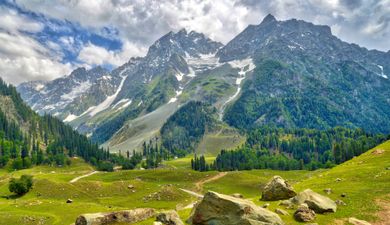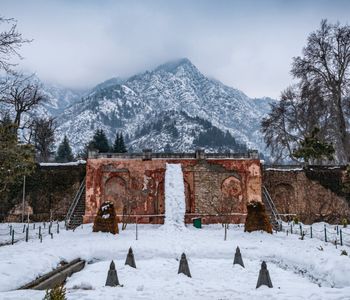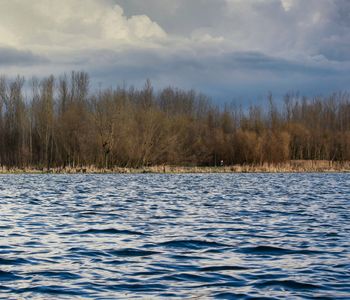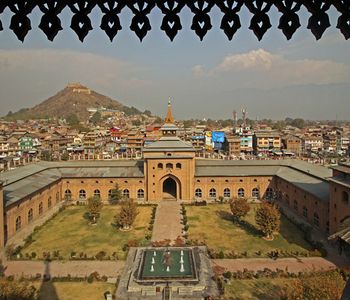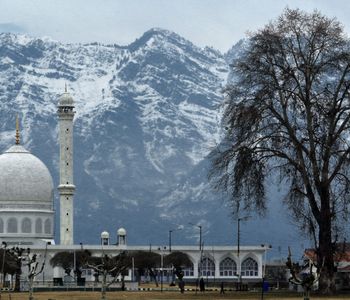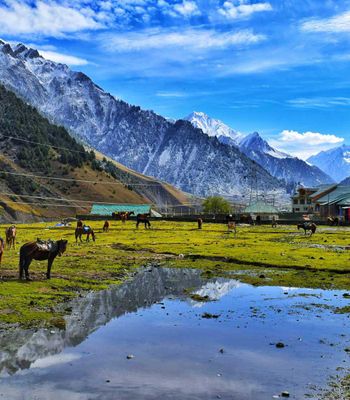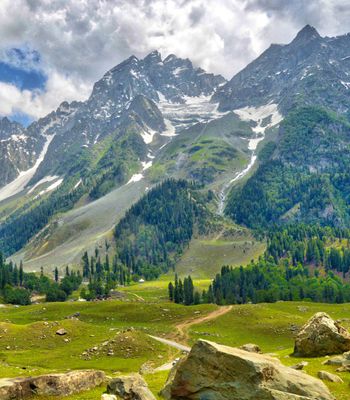
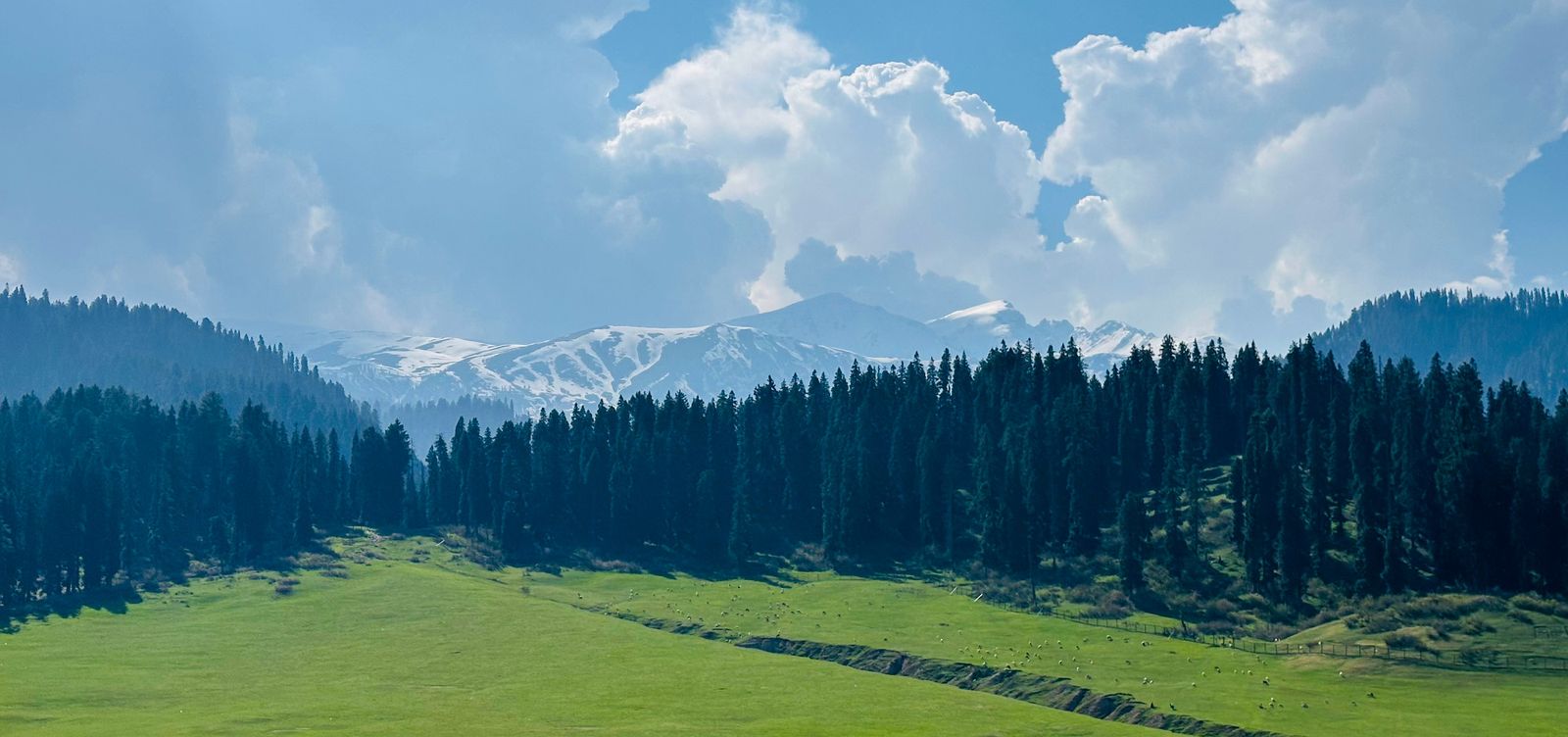
The name means "Valley of Milk," and the moment you see the Doodhpathri stream, the translation stops being metaphor. Snowmelt pours off the Pir Panjal range and churns across limestone beds until the water froths pale white — an impossible, luminous white that looks retouched against the grass. You blink. It stays. At roughly 8,957 feet above sea level and about 42 kilometers southwest of Budgam district in the broader Srinagar region, Doodhpathri occupies a bowl-shaped meadow that the vast majority of Kashmir's visitors never bother to find. No concrete hotels. No souvenir stalls. Just alpine pasture rolling outward in every direction, Gujjar shepherds drifting with their flocks, and a silence so complete it begins to register as its own kind of pressure against the eardrums.
A Legend Written in White Water
Kashmiris credit Doodhpathri's discovery to the Sufi saint Sheikh Noor-ud-Din Noorani, among the most venerated figures in Kashmiri Islam. The story goes that the saint struck his staff into the ground and milk sprang forth. The stream that emerged ran white — and it still does, though calcium-rich limestone under the riverbed provides a more earthbound explanation for the color.
But the geology matters less than the reverence. Locals move through Doodhpathri as though they owe the place something. You won't hear loudspeakers or see ticket booths. The Gujjar families who bring their horses and sheep here each summer hold to an unspoken compact: nothing taken, nothing left. That discipline, passed down without paperwork or enforcement, is why the valley still looks essentially the way it did a generation ago.
No Monument. No Railing. Just Ground.
Doodhpathri doesn't offer a single built attraction. The meadow is the whole argument. It unfolds in sections — Palmaidan being the easiest to reach, a wide plane of grass enclosed on three sides by dense pine and fir. In spring, wildflowers cover the ground in yellow and violet, and the air carries the sharp, resinous bite of deodar cedar.
Walk past the road and the terrain lifts gently toward Sach Pass. Grass gives way to rocky outcrops where marmots sprawl on flat, sun-warmed stones. The Doodhganga river — the same milky current that names the place — threads through the meadow in wide, lazy bends. In stretches, the water barely reaches your ankle. It stings with cold. Despite the white sheen on the surface, you can count every pebble on the bottom.
Here's the thing that's hard to explain until you've stood there: Doodhpathri is more compelling precisely because there is almost nothing constructed in it. No entry gates, no guided circuits, no designated photo platforms. You walk. That's all. And the absence of infrastructure does something strange — it forces you to actually see the landscape instead of performing your way through it.
Four Seasons, Four Different Valleys
Timing remakes Doodhpathri entirely. Between late March and June, snowmelt retreats and the meadows come alive in a green so saturated it looks oversaturated. This is the window most people aim for — temperatures between 10 and 20 degrees Celsius, and the sky holding that specific Kashmiri blue that painters have chased for centuries and never quite caught.
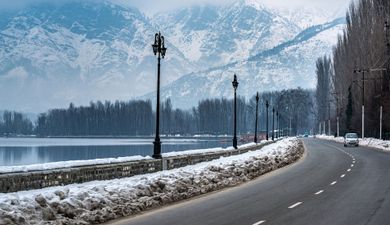
July and August bring monsoon rains. Unpaved roads dissolve into muddy trenches, and reaching the meadow becomes an ordeal. September and October offer a second opening: colder, sharper light, far fewer people. By November, snow closes the roads entirely, and the valley disappears into itself until spring returns.
If solitude matters to you, come on a weekday in early May. The grass is already thick. Wildflowers are just beginning their push. The Gujjar camps are being assembled — woodsmoke curling from temporary shelters, horses grazing without ropes, children watching you from a careful distance, half curious, half indifferent.
The Road In Demands Forgiveness
From Srinagar, the drive runs roughly two and a half hours via Budgam. The first stretch along the national highway is flat and forgettable. After the Budgam turnoff, the road narrows, corkscrews upward through pine forest, and begins to argue with your suspension. Don't expect proper tarmac for the final 15 kilometers — it's gravel and packed earth, particularly beyond Khansahib town.
Hiring a private car from Srinagar is the most sensible approach. Local drivers from Budgam know the road's temperament — which sections flood after rain, where the blind curves demand a horn blast to avoid oncoming trucks. Public transport exists, loosely, in the form of shared Sumo vehicles from Budgam town, but schedules are unreliable and the last leg usually requires a separate arrangement.
No fuel stations operate anywhere near Doodhpathri, so fill your tank before leaving Budgam. Carry cash. Card machines don't exist in the meadow, and mobile signals fade to nothing past Khansahib.
Pack Like Nobody's Selling Anything — Because They're Not
Doodhpathri has no restaurants, no permanent shops, and no accommodation in any conventional sense. During summer, a handful of seasonal tea stalls run by Gujjar families materialize along the meadow's edge — they serve nun chai, the salted pink tea of Kashmir, alongside freshly baked girda bread. That's the extent of it. If you want a real meal, you're bringing it yourself.
Layer up regardless of the month. At nearly 9,000 feet, temperatures plummet the instant the sun drops behind The Ridge. Sturdy walking shoes outperform trekking boots here — the ground is soft, grassy, forgiving — but the stream crossings are treacherous with slick rock. Pack a rain jacket even in dry season. Mountain weather in this range doesn't consult a forecast before turning on you.
There's no formal entry fee. The Jammu and Kashmir Tourism Department has floated development plans from time to time, but as of now, Doodhpathri remains largely unmanaged — a condition that serves as both its greatest risk and its defining grace.
Ponies, Chai, and the Value of Sitting Still
Gujjar families offer pony rides across the meadow — one of the only commercial transactions available here. Prices run between 500 and 1,000 rupees depending on distance and your willingness to negotiate. The ponies are small, thickset, and sure-footed on every trail. They know where they're going. Trust them.
But the real currency of Doodhpathri isn't a ride. It's time spent near the Gujjar shepherds, even if briefly. These semi-nomadic families follow the seasons uphill and down. Their presence here is temporary by definition. Sit long enough near a camp and someone will hand you chai. Take it. The conversation — halting, gesturing, conducted through fragments of shared language — tends to be richer than anything a plaque could tell you.
A Place Measured by What It Hasn't Lost
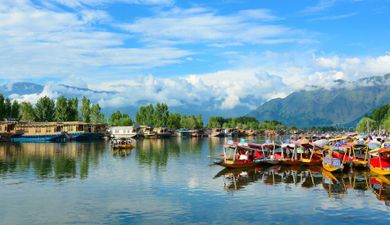
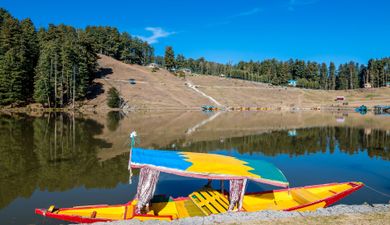
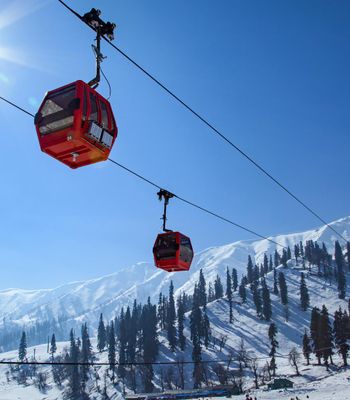
Doodhpathri doesn't compete with Gulmarg's gondola or Dal Lake's shikaras. It has no interest in competing. What it offers instead is something increasingly difficult to find anywhere in Kashmir — a landscape that hasn't been reformatted for consumption. The milky stream still cuts through meadows heavy with the smell of wet grass and woodsmoke. Horses graze without fences. The sky sits so low it feels like something you could lean against.
If you judge a place by what it hasn't surrendered rather than what it's constructed, Doodhpathri deserves an unhurried, full day. Bring lunch, leave Srinagar early, and let the valley dictate the tempo. It will be slower than you planned. That's the point.