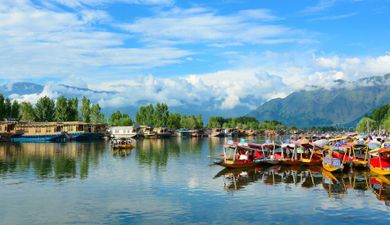
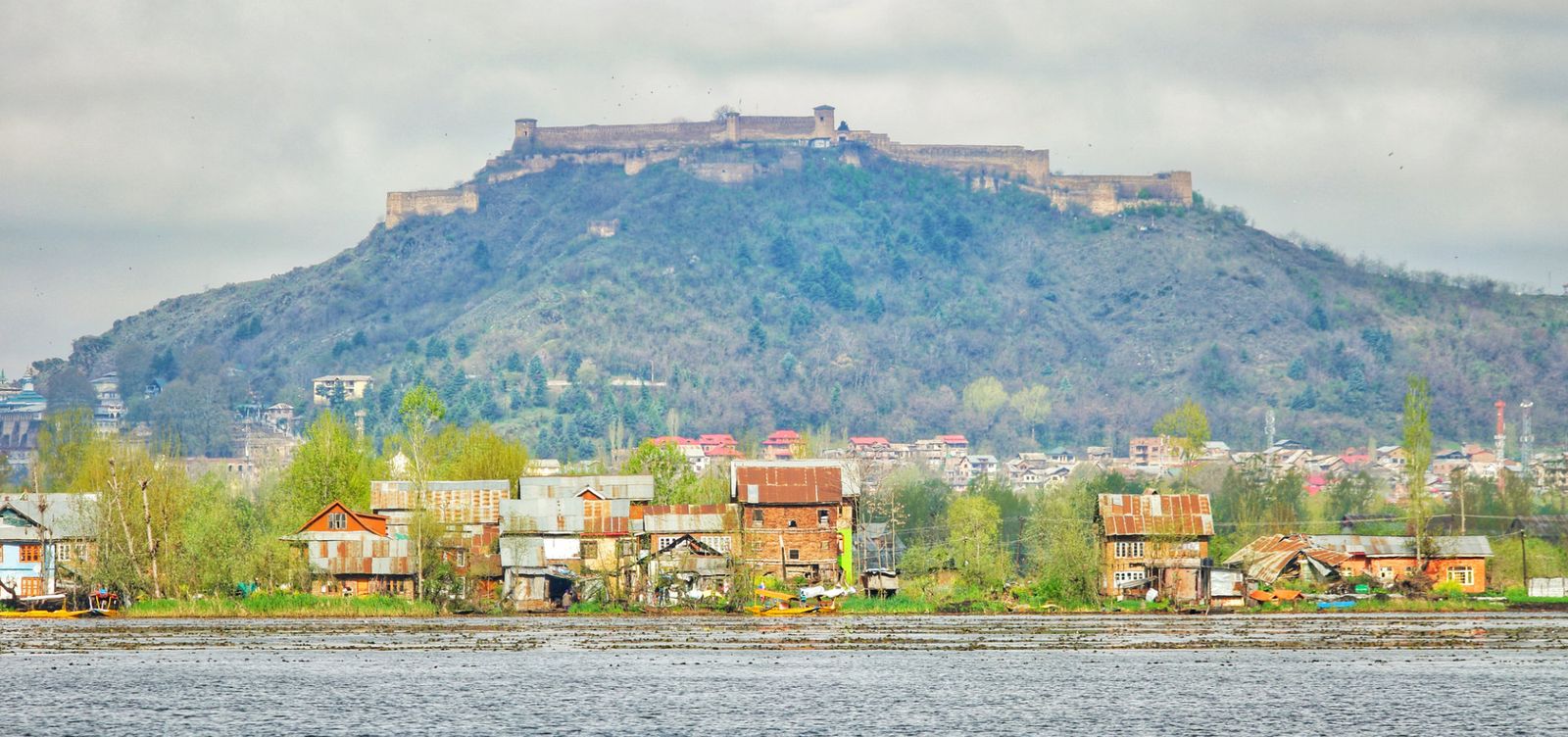
Above the Dal Lake houseboats, above the Mughal gardens, above the chinar-lined boulevards, a massive wall of grey stone wraps itself around Sharika Hill like an arm refusing to let go. Hari Parbat Fort doesn't announce itself with grandeur the way Rajasthan's fortresses do. It sits there — blunt, weathered, almost sulking — while the Kashmir Valley unfolds in every direction beneath it. Most travelers to Srinagar never climb this hill. They stay on the water, mesmerized by shikaras and floating markets, and they miss what might be the most revealing vantage point in the entire valley. From Hari Parbat's ramparts, Srinagar reveals its true shape: not a postcard, but a living city pressed between lake and mountain, ancient and fraying at the edges.
Three Empires, One Hill
The fortifications you see today are Afghan in origin, built during the late 18th century under the governorship of Atta Mohammad Khan. But the hill's defensive story reaches back much further. The Mughal Emperor Akbar commissioned the outer wall — a sprawling perimeter fortification that took decades to complete and still encircles much of the hill. Walk along sections of it, and you'll notice the stonework changing character, rougher in places where later rulers patched what time had broken.
The Durrani Afghans added the main fort at the summit, a compact and utilitarian garrison built less for beauty than for control. When the Sikhs took Kashmir under Maharaja Ranjit Singh's empire, they modified the interiors and layered in their own strategic additions. Each regime left its fingerprints in the masonry. You read Hari Parbat's walls the way you'd read geological strata — century by century, one power yielding to the next.
Sacred Ground Long Before the First Stone Was Laid
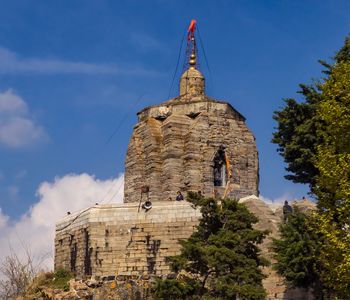
Sharika Hill was holy centuries before anyone thought to fortify it. Hindus revere it as the abode of Goddess Sharika, a manifestation of Durga. The Sharika Devi Temple sits on the western slope, and during the annual Navreh festival — Kashmiri Pandit New Year — devotees still make the climb to offer prayers. The temple itself is modest, a low stone structure that doesn't compete with the fort above it. Yet for Kashmiri Pandits, this hillside carries a spiritual gravity that no military architecture can match.
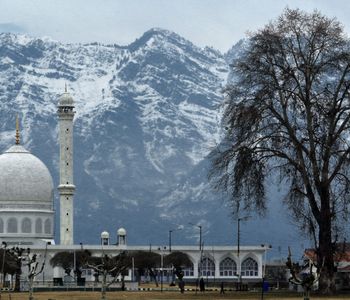
On the southern slope stands the shrine of Makhdoom Sahib, one of Kashmir's most venerated Sufi saints. This Muslim shrine draws its own steady current of visitors, particularly during Urs celebrations. A Hindu temple and a Sufi shrine sharing the same hill — it tells you something essential about Kashmir's layered identity, something the valley's more recent history has tried, and failed, to simplify.
What the Walls Actually Look Like Up Close
Don't expect polished restoration. Hari Parbat Fort remains under the control of Indian defense authorities, and access has historically been restricted. Permits have become easier to obtain in recent years, but the fort still carries a semi-abandoned quality. Grass pushes through the courtyard stones. Sections of the rampart walls stand exposed, rubble cores visible where facing stones have fallen away.
This rawness is precisely what makes the place worth reaching. Without the sanitizing hand of a heritage board, you encounter the fort as it actually is — a military structure that served its purpose and was left to weather. The Afghan-era bastions are squat and functional, with narrow loopholes designed for musket fire rather than ornament. Inside, a few arched chambers remain intact, their ceilings blackened by what might be centuries of cooking fires or simply the slow chemistry of damp stone and time.
Here's the thing about Hari Parbat that catches you off guard: its state of gentle neglect makes it more honest than most restored forts in India. Nobody has rebuilt it to look like a movie set. What you touch is what was actually built.
The View That Redraws Your Map
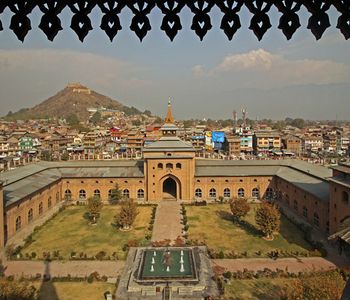
Climb to the highest accessible point, and Srinagar reorganizes itself below you. Dal Lake stretches northeast, its surface broken by floating gardens and the geometric lines of houseboats moored in clusters. The old city's dense neighborhoods press against the lake's western shore — a tangle of wooden houses and tin roofs that looks nothing like the tourist brochures. To the south, the Jhelum River threads through the city in slow, deliberate curves.
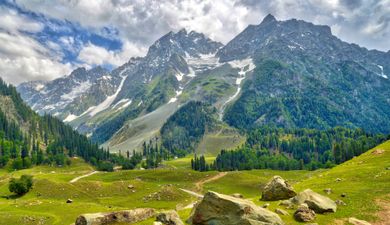
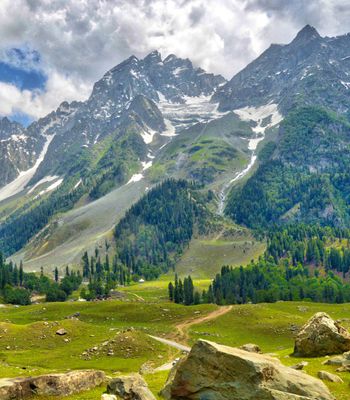
On clear mornings — and they're more common than you'd expect outside monsoon season — the Pir Panjal range fills the western horizon with snow. The Zabarwan hills rise to the east. Standing on Hari Parbat's walls, you occupy the center of this natural amphitheater, and for a few minutes the honking auto rickshaws and the political tensions and the military checkpoints all fall away. The valley reasserts its geography over its politics. That shift in perspective alone justifies the climb.
Getting There and Getting In
Hari Parbat sits in the Nageen area of Srinagar, roughly two kilometers from Dal Gate. Auto rickshaws and taxis from the city center reach the base of the hill in about fifteen minutes, depending on traffic. A paved road winds partway up from there, but the final approach requires walking along a stone pathway that steepens near the top. Wear shoes with decent grip — the stones turn slick after rain.
Because the fort falls under defense jurisdiction, you may need a permit from the local tourism office or the Archaeological Survey of India's Srinagar circle. The permit process has varied over the years, so confirm current requirements before you go. When access is granted, the fort is typically open during daylight hours. There's no entry fee for the fort itself, though the shrines on the hill operate independently.
Give yourself at least two hours for the full experience — the hill, the fort, and both religious sites. Bring water; there are no vendors on the upper slopes. Early morning delivers the best light for photography and the fewest other visitors, which in Hari Parbat's case often means none at all.
When to Make the Climb
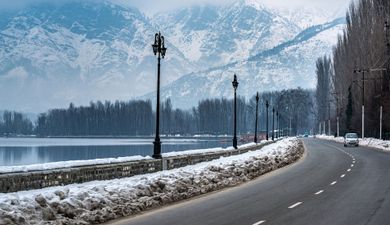
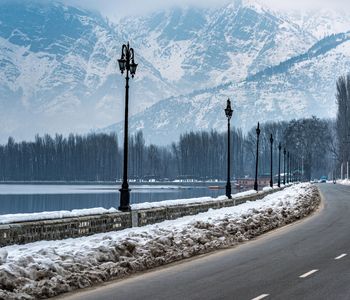
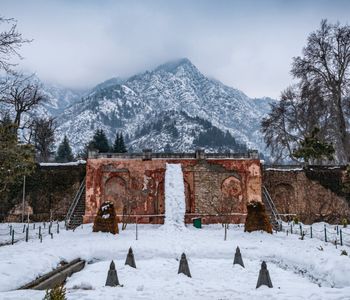
Spring — late March through May — covers the hillside in wildflowers and brings comfortable temperatures in the low twenties Celsius. Autumn, from September to November, sharpens the air and sets the famous chinar trees turning copper and gold across the valley below. Summer works fine but can feel warm on the exposed slopes. Winter transforms the fort into something stark and cinematic, though icy paths demand real caution.
Avoid Friday afternoons if you want to visit the Makhdoom Sahib shrine at a quieter moment; it draws large congregations for weekly prayers.
A Fort That Earns Its Silence
Hari Parbat won't dazzle you with ornate jali screens or manicured Mughal gardens. It won't offer you an audio guide or a gift shop. What it gives instead is rarer: an unmediated encounter with a place where empires, faiths, and centuries have simply accumulated, one on top of the other, without anyone tidying the layers. Stand on its walls at dawn, watch the mist lift off Dal Lake, and you'll understand Srinagar in a way the shikara rides never quite reveal. Some places need to be seen from above before they make sense at ground level. This is one of them.