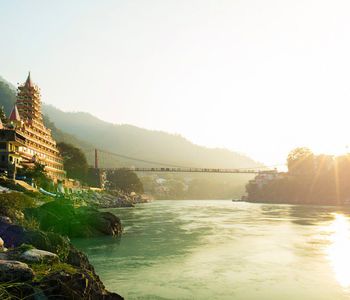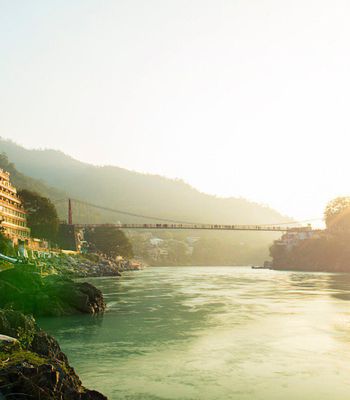
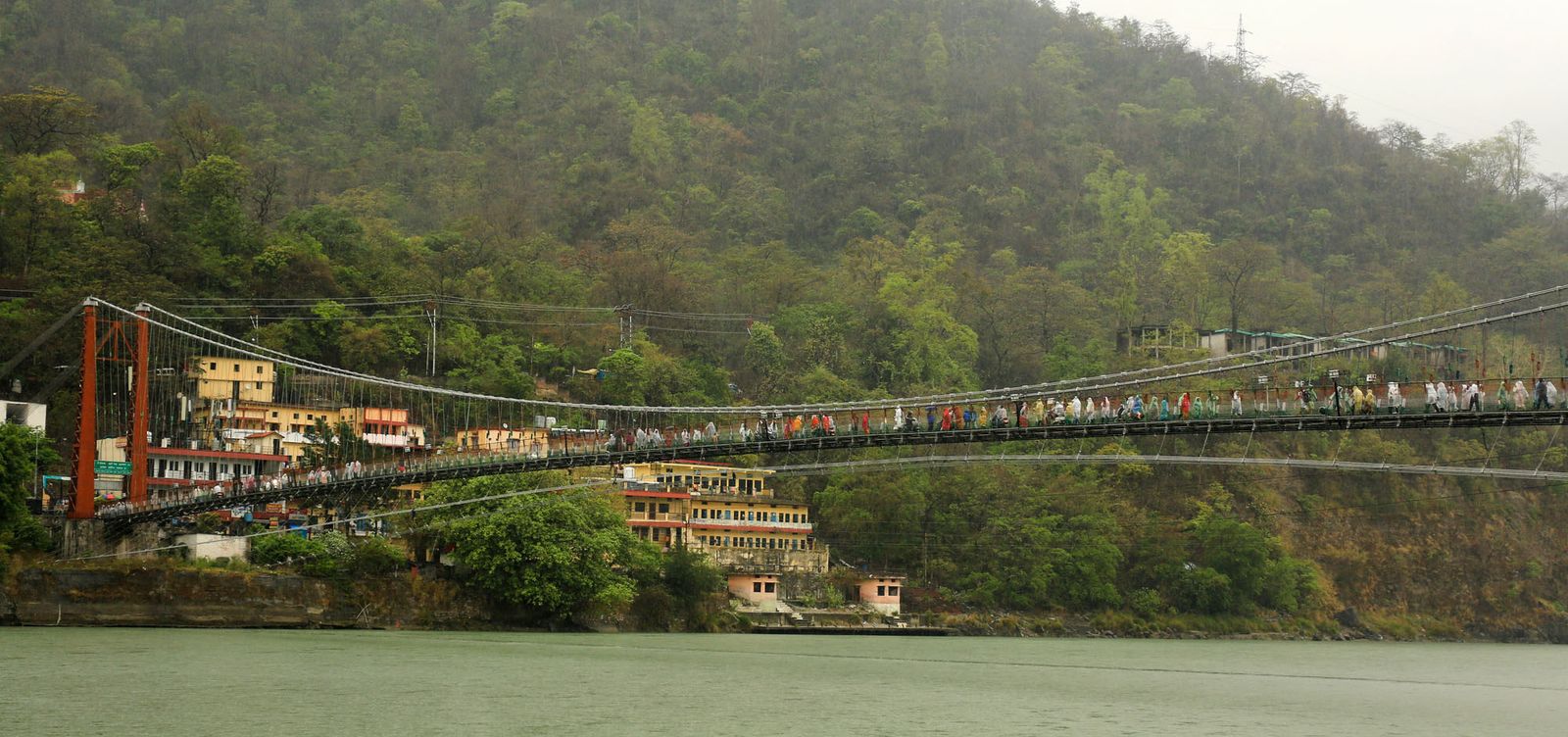
The iron cables hum faintly beneath your feet, the bridge swaying just enough to remind you there's nothing between you and the turquoise rush of the Ganges but steel grating and faith. This is Ram Jhula — Rishikesh's most iconic suspension bridge, a 750-foot walkway strung high above the holiest river in Hinduism. Built in 1986, it links two vibrant spiritual neighborhoods: Sivananda Nagar on the east bank and Swargashram on the west. Pilgrims clutching marigold garlands share the path with backpackers, cyclists, and the occasional fearless motorcyclist. Temple bells echo from both shores. The Himalayan foothills rise soft and blue in the distance. Whether you've come to Rishikesh for yoga, for the rapids, or for something you can't quite name yet, crossing Ram Jhula is the moment the city's spiritual pulse becomes unmistakably real.
Where Rama Crossed: The Legend Behind the Bridge
Hindu legend holds that Lord Rama himself crossed the Ganges at this very spot — not on iron cables, but on a simple jute rope bridge. For centuries, that story transformed this stretch of river into a divine threshold, a place where the act of crossing water carried the weight of something sacred.
The modern suspension bridge replaced those ancient rope crossings in 1986, giving pilgrims and travelers a sturdier path between the ashrams and temples that cluster on either bank. Its sister bridge, Lakshman Jhula — completed in 1929 and long beloved by visitors — was permanently closed in 2022 due to structural concerns. Ram Jhula now carries that legacy forward, welcoming thousands of people daily.
More than a river crossing, the bridge functions as a spiritual corridor. Because the Ganges is revered as a living goddess in Hinduism, anything built above her waters absorbs that reverence. Every footstep across Ram Jhula becomes, in its own quiet way, part of an unbroken pilgrimage tradition stretching back generations.
750 Feet Above the Ganges: What the Bridge Reveals
From a distance, Ram Jhula looks like straightforward engineering — steel cables, iron anchors, a narrow pedestrian walkway. Step onto it, though, and the bridge tells a different story.
That first gentle sway catches everyone off guard. The walkway rocks subtly with each cluster of crossing pilgrims, a rhythmic reminder that you're suspended high above a powerful river. Peer down through the metal grating and the Ganges rushes beneath you in ribbons of jade and white foam, moving with a force that feels almost personal.
Lift your gaze and the scene expands dramatically. Multi-story temples rise from the western bank like pastel-colored cliffs. On clear mornings, the foothills of the Himalayas stack themselves along the horizon in soft layers of green and grey. The contrast is striking — raw industrial steel framing one of the most spiritually charged landscapes in India. It's also why photographers line the bridge at dawn, chasing that moment when golden light spills across the water and sets the temple towers glowing.
Sivananda Nagar and Swargashram: Two Worlds, One Bridge
Sivananda Nagar: Where Silence Is the Curriculum
Step off the bridge onto the eastern bank and the energy shifts immediately. Sivananda Nagar takes its name from Swami Sivananda, one of India's most influential spiritual teachers, and the neighborhood reflects his legacy of quiet discipline. The Sivananda Ashram, founded in 1936, anchors the area — a serious center for yoga practice, Vedantic philosophy, and meditation that draws students from every corner of the globe.
Smaller ashrams and modest guesthouses line the roads branching away from the bridge, many offering affordable rooms just a short walk from the river. The pace here is slower, more contemplative. You'll hear birdsong and Sanskrit chanting before you hear traffic.
Swargashram: Temples, Chai, and Sensory Overload
Cross to the western bank and brace yourself — Swargashram hits you with everything at once. The scent of sandalwood incense mingles with frying batter from street-side stalls. Temple bells clang. Vendors call out from narrow lanes crammed with handmade jewelry, Ayurvedic oils, rudraksha beads, and embroidered shawls.
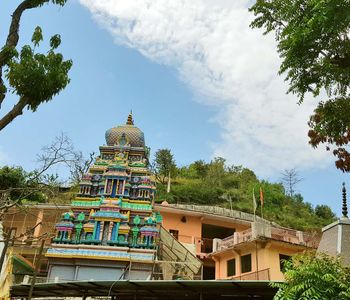
Dominating the skyline is the Swarg Niwas Temple, a towering 13-story structure visible from the bridge itself, its pastel façade housing shrines to multiple Hindu deities across floor after floor. Right beside it stands the equally imposing Kailash Niketan Temple. Climbing through their levels — each dedicated to Lord Shiva, Lord Vishnu, or other gods — feels like ascending through a vertical map of Hindu cosmology.
Between these landmarks, grab a plate of crispy aloo tikki from a roadside stall, or wrap your hands around a clay cup of milky, cardamom-spiked chai. Sticky-sweet jalebi, still dripping from the fryer, makes the perfect walking snack. And when the crowds feel like too much, slip down to the riverside ghats below the bridge — stone steps descending to the water's edge where the noise fades and the river reasserts its calm.
Flames on the Ganges: The Nightly Aarti Below Ram Jhula
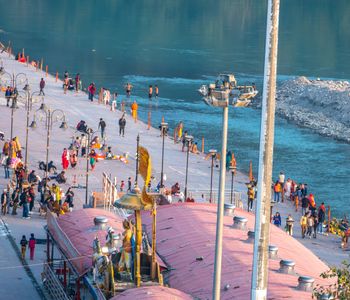
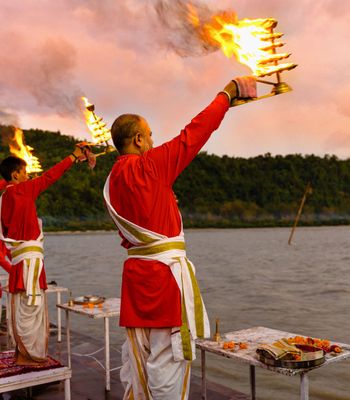
Dusk settles over the ghats, and something extraordinary begins. Priests in saffron robes take their positions along the stone steps below Ram Jhula, lifting heavy brass lamps trailing curtains of flame. This is the Ganga Aarti — a nightly devotional ceremony that transforms the riverbank into something between a prayer and a performance.
Hundreds of people press together on the steps as Sanskrit chanting rises and falls in hypnotic waves. Brass bells ring out in sharp, rhythmic bursts. The priests swing their fire lamps in synchronized arcs, and the flames reflect off the dark water in trembling orange lines. Small leaf boats carrying single candles are set adrift on the current, each one a whispered wish floating downstream.
The air smells of camphor and river water and marigolds. Even if you arrive as a casual observer, something about the collective devotion — the sound, the heat of the flames, the sheer beauty of fire meeting water at twilight — gets under your skin. Time your visit to catch this ceremony. You won't regret it.
When to Go and How to Get There
Ram Jhula is open to pedestrians all day, every day, and crossing is completely free. For the most peaceful experience, arrive early — before 8 a.m., foot traffic is light, the air is cool, and the morning light on the Ganges is impossibly beautiful.
The sweet spot for weather falls between October and March, when daytime temperatures range from a comfortable 50 to 75°F and the skies stay clear. Monsoon season (July through September) brings dramatic downpours and swollen river levels. The bridge stays open, but humidity and reduced visibility can dampen the experience — though the emerald-green Ganges in full monsoon fury has its own wild beauty.
Making Your Way to the Bridge
From Delhi, Rishikesh is roughly a six-hour drive via National Highway 334 — buses and private cars make the journey daily. The nearest train station, Rishikesh Railway Station, sits about five miles from Ram Jhula; auto rickshaws and shared taxis shuttle passengers between the two for a modest fare.
Flying in? Jolly Grant Airport in Dehradun is approximately 20 miles away, with domestic connections from Delhi, Mumbai, and Bangalore. A taxi from the airport to Rishikesh takes about 45 minutes.
Once you're in town, your feet are your best transportation. The bridge and its surrounding temples, ghats, and lanes are all walkable. Shared autos also loop between the main market areas and Ram Jhula for just a few rupees.
What the Guidebooks Don't Always Mention
Wear shoes with good grip. The bridge's metal grating collects morning dew and can turn slick — sandals are a recipe for a graceless stumble.
Watch for the monkeys. Langurs and macaques patrol both ends of the bridge like furry toll collectors, and they are bold. Tuck away sunglasses, dangling jewelry, and especially food. A macaque stealing your banana is funny exactly once — and only when it happens to someone else.
Dress modestly and keep your voice low. Many of the people around you are pilgrims deep in prayer or meditation, not tourists. A little reverence goes a long way here.
Bring a refillable water bottle. The midday sun, combined with all that temple-hopping and ghat-climbing, will leave you parched faster than you expect.
High above the Ganges, with temple spires piercing the sky on both sides and the Himalayas watching from the distance, Ram Jhula distills everything Rishikesh is into a single, unforgettable walk. It's a river crossing, a spiritual passage, and a front-row seat to one of India's most sacred cities — all in 750 feet of swaying iron and steel.