The first thing that hits you isn't the sight of the Ganges — it's the sound. A low, resonant hum of chanting voices rolls across the water, mingling with the sharp clang of temple bells and the distant wail of a conch shell. Then comes the incense — sandalwood and camphor curling through the humid air — and suddenly, you're standing at Har Ki Pauri, one of the holiest ghats in all of India, and every sense you have is wide awake.
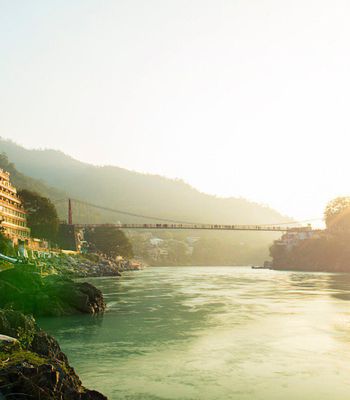
Perched on the banks of the Ganges in Haridwar, Uttarakhand, this ancient ghat marks the sacred threshold where the river spills from the Himalayan foothills onto the northern plains. For millions of Hindus, these waters carry the power to dissolve lifetimes of sin — a single immersion is believed to set the soul on a path toward liberation. But you don't need to arrive as a devotee to feel something shift inside you here.
At dusk, thousands of tiny oil lamps drift downstream on leaf boats, their flames trembling against the dark current like fallen stars. The air thickens with marigold petals and prayer. Whether faith brought you here or sheer curiosity, Har Ki Pauri doesn't ask — it simply pulls you in.
Where a God Once Stood
"Footsteps of God" — that's what Har Ki Pauri means, and the name isn't metaphorical. Hindu mythology holds that Lord Vishnu himself visited this very spot, pressing his divine footprint into the stone. Devotees say that impression still exists, preserved within the upper wall of the ghat, drawing pilgrims who press their palms against the ancient surface as though touching something beyond time.
The ghat's physical origins trace back to King Vikramaditya, who built it to honor his brother Bhartrihari. Historians place his reign around the first century BCE, which means these steps have witnessed over two thousand years of whispered prayers and river baptisms. Successive rulers and spiritual leaders expanded the complex over the centuries, and the most notable modern renovations took shape during British colonial rule in the early twentieth century.
What stands today is a palimpsest of eras — ancient stone layered with medieval repairs layered with colonial-era engineering — all united by a single, unbroken purpose: to bring human beings to the river's edge.
A Sprawling Labyrinth of Stone and Spirit
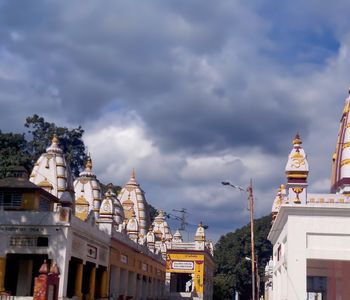
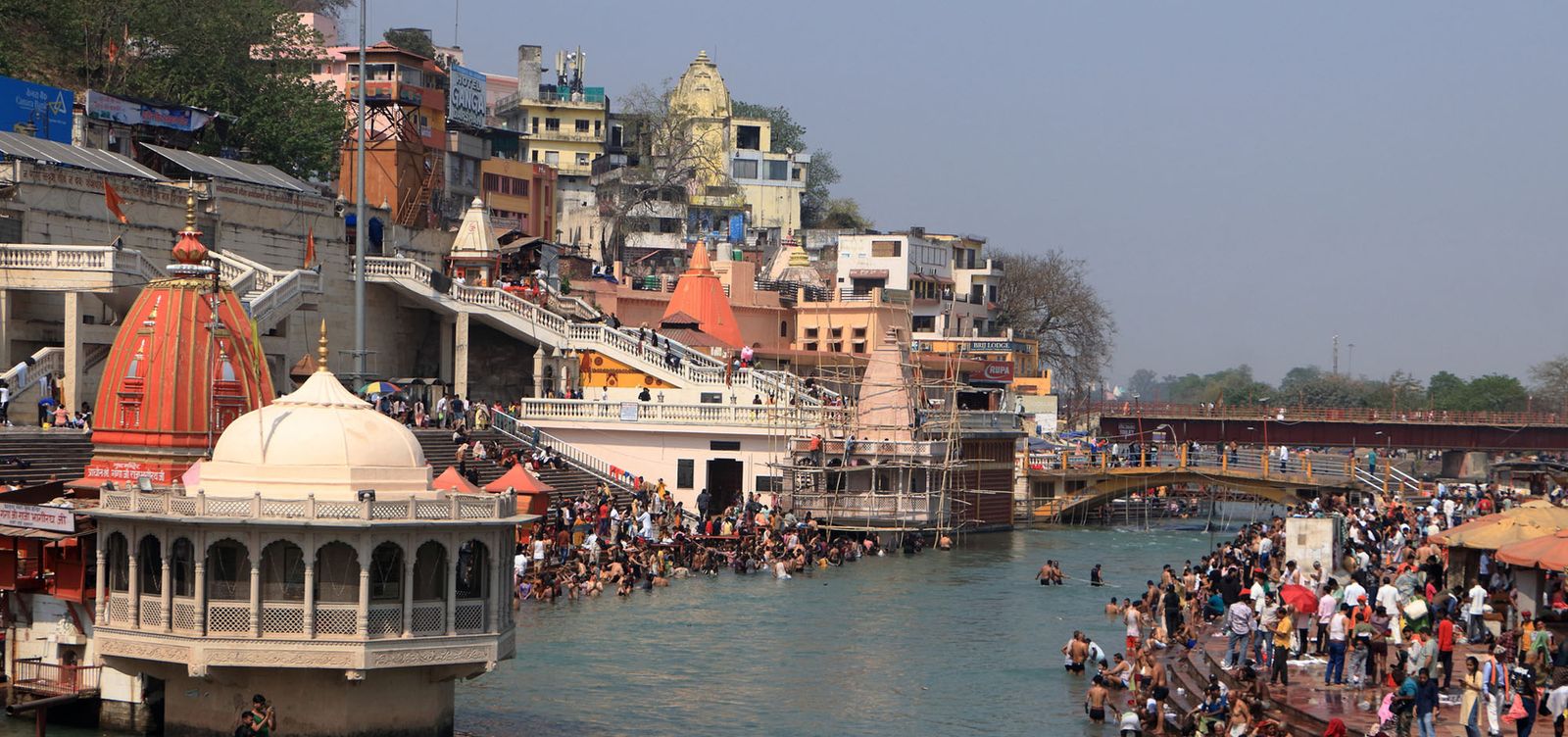
Don't expect a tidy set of stairs leading to the water. Har Ki Pauri unfolds as a vast, interconnected maze of ghats, platforms, temples, and pavilions stretching along the riverfront. A clock tower rises from the center of the complex, its silhouette visible from nearly every angle — your constant landmark in the crowd.
Broad stone steps descend to the Ganges at multiple points, each section wide enough for hundreds of bathers to stand shoulder to shoulder. Closer to the waterline, sturdy metal chains and railings catch your hand — a necessary lifeline against the river's surprisingly muscular current.
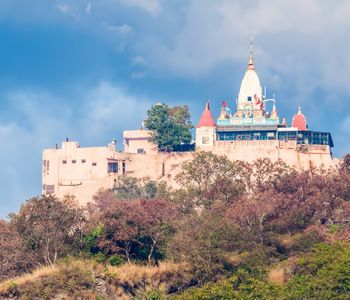
Climb to the upper levels and you'll find temples and shrines dedicated to various Hindu deities tucked between walkways and shaded pavilions. The Ganga Temple sits nearby, a quiet refuge for worship before or after a ritual bath. And if you know where to look, you'll find Lord Vishnu's legendary footprint embedded in the upper wall — the spiritual heart of the entire complex, and the reason many pilgrims traveled hundreds of miles to stand exactly where you're standing.
When the River Catches Fire
Nothing — truly nothing — prepares you for the evening Ganga Aarti.
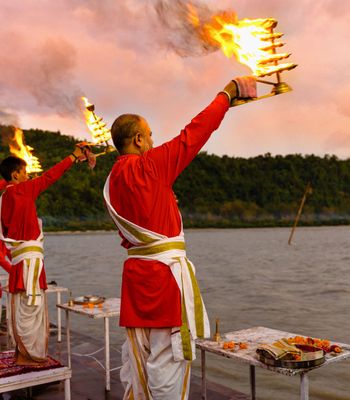
As the sun drops behind the hills, priests line the ghat's edge holding enormous brass lamps, each one blazing with open flame. A conch shell cracks the silence. Then the hymns begin — deep, rhythmic, rising from the throats of thousands — and the priests swing those flaming lamps in wide, synchronized arcs, painting circles of fire against the twilight sky.
Below, devotees bend to release leaf boats onto the water's surface. Each one carries a clutch of bright marigolds and a tiny oil lamp. Within minutes, the Ganges becomes a river of trembling light — hundreds, then thousands of flames drifting downstream in a slow, shimmering procession. The reflection doubles them, so it looks as though the fire is burning beneath the water too.
Photographers will lose their minds here — the golden light, the smoke, the faces lit by flame. But arrive at least an hour before sunset. Every step, balcony, and rooftop fills fast, especially during peak pilgrimage seasons. The morning aarti at dawn draws far smaller crowds and carries a quieter, more contemplative energy — worth setting your alarm for if you prefer stillness over spectacle.
The Epicenter of the World's Largest Gathering
Every twelve years, something almost incomprehensible happens at Har Ki Pauri. Tens of millions of pilgrims — yes, millions — converge on this single ghat for the Kumbh Mela, one of the largest religious gatherings the planet has ever seen. They come for a sacred dip believed to grant moksha, liberation from the endless wheel of death and rebirth. The Ardh Kumbh Mela, held every six years, centers its rituals here as well.
Even outside these colossal festivals, the ghat pulses with devotion year-round. During Makar Sankranti in January, pilgrims believe that bathing here during the planetary transition carries extraordinary spiritual merit. Through the monsoon months of Shravan (July–August), a steady stream of Kanwariyas — saffron-clad devotees carrying Ganges water home to their temples — file along the steps in an unbroken orange ribbon.
Remarkably, hundreds of pilgrims visit on perfectly ordinary days too, arriving for daily prayers and ritual bathing as naturally as you might stop for morning coffee. The spiritual energy here never powers down — it simply breathes.
When to Go and How to Get There
Timing Your Trip Right
Haridwar's summers are punishing — temperatures soar past 100°F between May and June, and the heat radiates off the stone steps like an open oven. For the most comfortable experience, visit between October and March, when mild, pleasant weather makes wandering the ghats a genuine pleasure.
That said, the monsoon season from July to September has a wild, dramatic beauty all its own. The Ganges swells and surges, the surrounding hills erupt in electric green, and rain hammers the river's surface into a million tiny explosions. Just know that water levels rise significantly — some lower sections of the ghat may be partially submerged, and you'll want to exercise extra caution near the steps.
Open All Hours, Free for All
Har Ki Pauri welcomes visitors around the clock, and there's no entry fee — ever. The evening Ganga Aarti typically begins between 6 and 7 p.m., shifting with the sunset. Morning aarti takes place at dawn. Because this is a living place of worship, dress modestly and slip off your shoes before stepping onto the lower platforms near the water.
Finding Your Way
Haridwar connects easily by rail, road, and air. Jolly Grant Airport in Dehradun sits roughly 35 kilometers away, with taxis and shared cabs waiting outside arrivals. Haridwar Railway Station is barely a kilometer from the ghat — a pleasant walk through bustling streets or a two-minute auto rickshaw ride.
Traveling from Delhi? Frequent trains and buses cover the approximately 200-kilometer journey in four to five hours. Once you're in Haridwar, the city itself funnels you toward the river — just follow the crowds, the temple bells, and the unmistakable scent of incense drifting downhill.
Savvy Tips from the Steps
Those stone steps get treacherously slick, especially in the cool, dewy early morning hours. Wear sturdy footwear until you reach the water's edge, then go barefoot. The Ganges current here is stronger than it looks — always grip the metal chains while bathing, and don't venture into deeper sections no matter how confident a swimmer you are.
Leave your valuables at your hotel. The crowds during peak hours are dense and jostling, and pickpockets know that distracted pilgrims make easy targets. Street vendors flanking the ghat sell marigold garlands, coconuts, and puja items for offerings — bargaining isn't just acceptable, it's expected, so don't pay the first price you hear.
When hunger strikes, follow the locals to the small eateries and sweet shops lining the lanes that lead to the ghat. Crispy, golden aloo puri served on steel plates and syrup-soaked jalebi still warm from the fryer — these are Haridwar's signature flavors, and they cost almost nothing.
Har Ki Pauri isn't a monument you visit and photograph and check off a list. It's a place where the sacred and the everyday have been tangled together for two millennia — where a grandmother's morning prayer and a backpacker's wide-eyed wonder occupy the same ancient step. Sit down. Watch the river pass. Let the chanting wash over you. Whatever you came looking for, the Ganges has a way of answering in its own time.