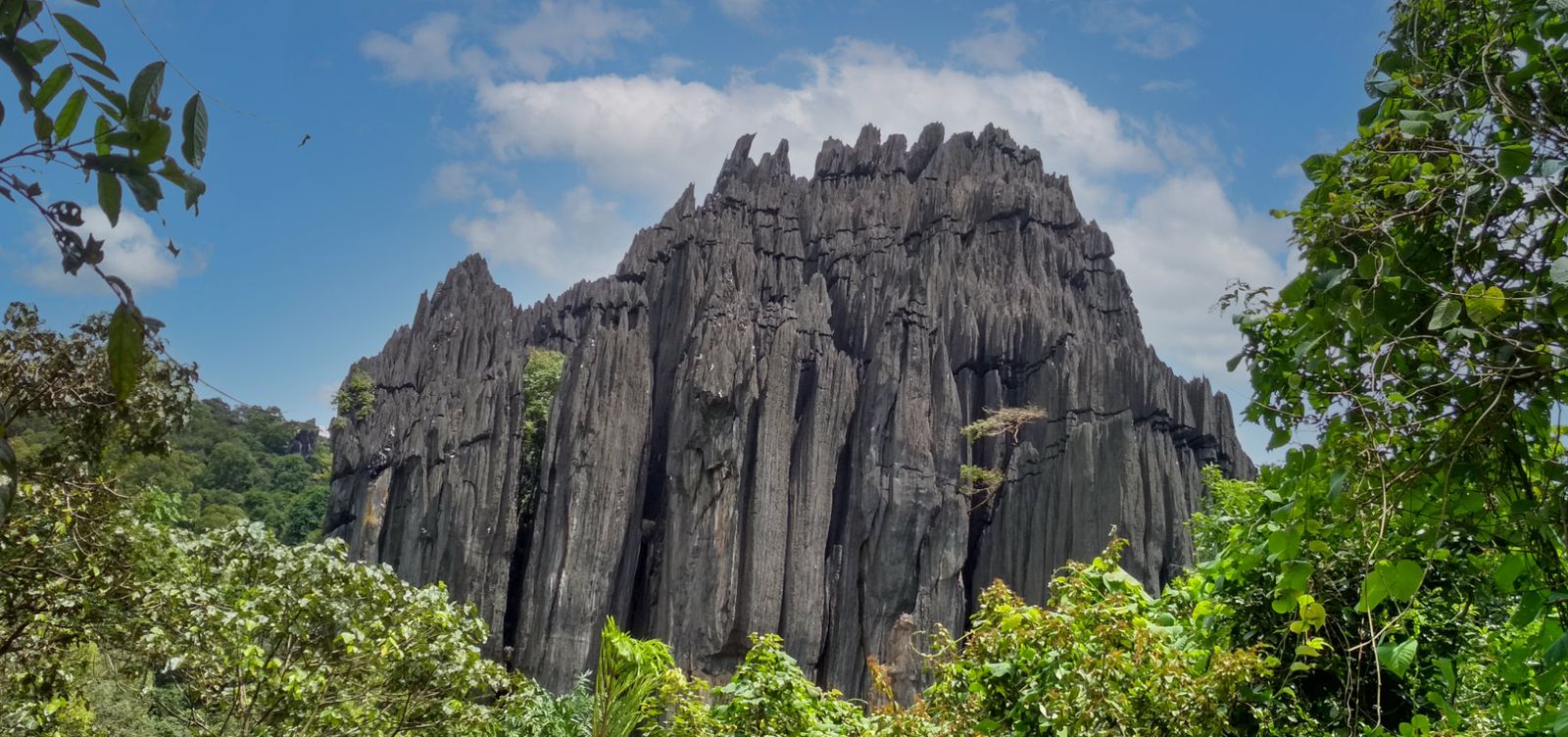
Two rock formations punch upward from the forest floor like jagged black teeth, and the first time you see them through the canopy of the Western Ghats, you'll question whether geology alone could produce something this theatrical. The Yana Caves aren't caves at all, not really. They're a pair of massive limestone and karst outcrops — Bhairaveshwara Shikhara and Mohini Shikhara — rising 120 feet and 90 feet respectively from dense tropical forest about 60 kilometers from Gokarna. One is dark, craggy, almost menacing. The other is smoother, lighter in tone. Locals will tell you they represent Shiva and Parvati, and once you've stood between them, you'll understand why. The scale makes the spiritual interpretation feel less like mythology and more like common sense.
The Trail That Earns the View
Getting to Yana requires a trek of roughly three kilometers through semi-evergreen forest, and this walk is half the reason to come. The trail begins near the village of Yana itself, a small settlement in the Uttara Kannada district of Karnataka. From the trailhead, the path descends gently through areca nut plantations before thickening into proper forest — teak, jackfruit trees, and creepers that hang low enough to brush your shoulders.
Birdsong dominates. The Malabar whistling thrush is a frequent companion, its call slicing through the humidity like a question with no answer. During and just after the monsoon months, from June through September, the trail turns slippery and surrounding streams swell into small waterfalls. The forest canopy blocks most direct sunlight even at midday, keeping the air thick and cool in a way that feels ten degrees removed from the coast.
Don't rush this stretch. The Yana formations are spectacular, yes, but the approach earns them. By the time the first black pinnacle appears above the treeline, you've been primed by an hour of green silence. That contrast — jungle calm to geological violence — is what makes the arrival land the way it does.
Two Towers, Two Temperaments
Bhairaveshwara Shikhara, the taller formation, is the one that stops people mid-step. Its surface is crumbling, crystalline black limestone riddled with small caves and overhangs at its base. Water seeps through the karst rock, creating natural Shiva lingams inside the caves below — smooth, wet formations that have become active sites of worship. A small temple occupies the base, and on most days you'll find a priest performing rituals, the sound of chanting competing with dripping water.
Mohini Shikhara stands nearby, shorter and composed of lighter-colored rock that almost glows white against the surrounding greenery. The textural difference is striking. Where Bhairaveshwara looks ancient and weathered to the point of aggression, Mohini appears composed. Serene, even. Geologists attribute the color variation to differing mineral compositions within the same karst system, but the visual effect is undeniably dramatic.
Here's what surprised me most: despite the area's religious significance, the atmosphere at the base of the formations isn't solemn. Families picnic on the rocks. Children chase langur monkeys through the undergrowth. The sacred and the ordinary coexist without friction, which says something about how this place functions in the lives of people who live nearby — not as a monument, but as a backyard.
Sculpted by Rain, Not by Hands
The formations at Yana are composed of crystalline limestone, a relatively rare geological feature in peninsular India. Over millions of years, rainwater — slightly acidic from dissolved carbon dioxide — has eaten into the rock, hollowing cavities and sharpening ridges into the dramatic spires visible today. This process, karstification, is the same force that produces sinkholes and underground river systems elsewhere in the world, but here it has worked upward rather than downward, leaving behind towers instead of tunnels.
What makes Yana unusual even within karst geology is the isolation of the formations. There's no surrounding limestone plateau or cave system extending for miles. The two shikhars stand alone in the forest, geological orphans with no obvious siblings. Scientists have debated the exact conditions that produced this isolated pair, and no single explanation has gained universal acceptance. The mystery, frankly, adds to the appeal.
Timing, Gear, and the Leech Question
The post-monsoon window from October through January is ideal. The forest is still lush from months of rain, streams are active, and the humidity has dropped just enough to make the trek pleasant rather than punishing. Temperatures hover between 20 and 28 degrees Celsius during these months. February through May brings drier conditions and better trail footing, but the forest loses some of its intensity, and the small waterfalls along the route may have dried up entirely.
Monsoon visits between June and September are for the committed. The trail gets genuinely muddy, leeches emerge in numbers, and the rock surfaces near the formations become dangerously slick. That said, the forest during peak monsoon is astonishingly alive — ferns unfurl overnight, mushrooms colonize every fallen log, and mist wraps the shikhars in a way that no photograph has ever adequately captured.
Wear proper trekking shoes regardless of season. Carry at least a liter of water per person, and pack a light rain jacket even in the dry months — the canopy traps moisture, and brief showers arrive without warning. There are no food stalls along the trail itself, so bring snacks if you plan to linger at the base of the formations.
Getting There Without the Headache
From Gokarna, Yana sits roughly 50 kilometers inland. The most practical route runs by road through Kumta, a small town on National Highway 66. From Kumta, a state road winds east through increasingly rural terrain for about 30 kilometers to Yana village. Private taxis from Gokarna charge between 1,500 and 2,500 rupees for a round trip, depending on your negotiation skills and the driver's mood.
Public buses run infrequently from Kumta to Yana, and their schedules are unreliable enough that banking on one for a return trip requires either deep optimism or a backup plan. If you're on a motorcycle or driving yourself, the road is paved but narrow, with hairpin turns that demand your full attention. Parking is available near the trailhead, and a small entry fee of around 10 to 20 rupees per person applies.
Gokarna itself connects to Goa and Mangalore by rail and road, making it a reasonable base for a day trip. Alternatively, the town of Sirsi, about 40 kilometers east, offers closer accommodation and serves as a hub for exploring the broader Uttara Kannada forest region.
What Stays With You
Yana doesn't compete with India's grand monuments or famous pilgrimage sites, and it doesn't try to. Its power is quieter, stranger, more personal than that. Two rock towers in a forest, shaped by nothing but rain and time, managing to feel both sacred and playful at once. You walk in through trees, you walk out through trees, and what happens in between stays with you longer than places that tried much harder to impress.
If you're already in the Gokarna area and you skip Yana, you've missed the most interesting thing within an hour's drive.