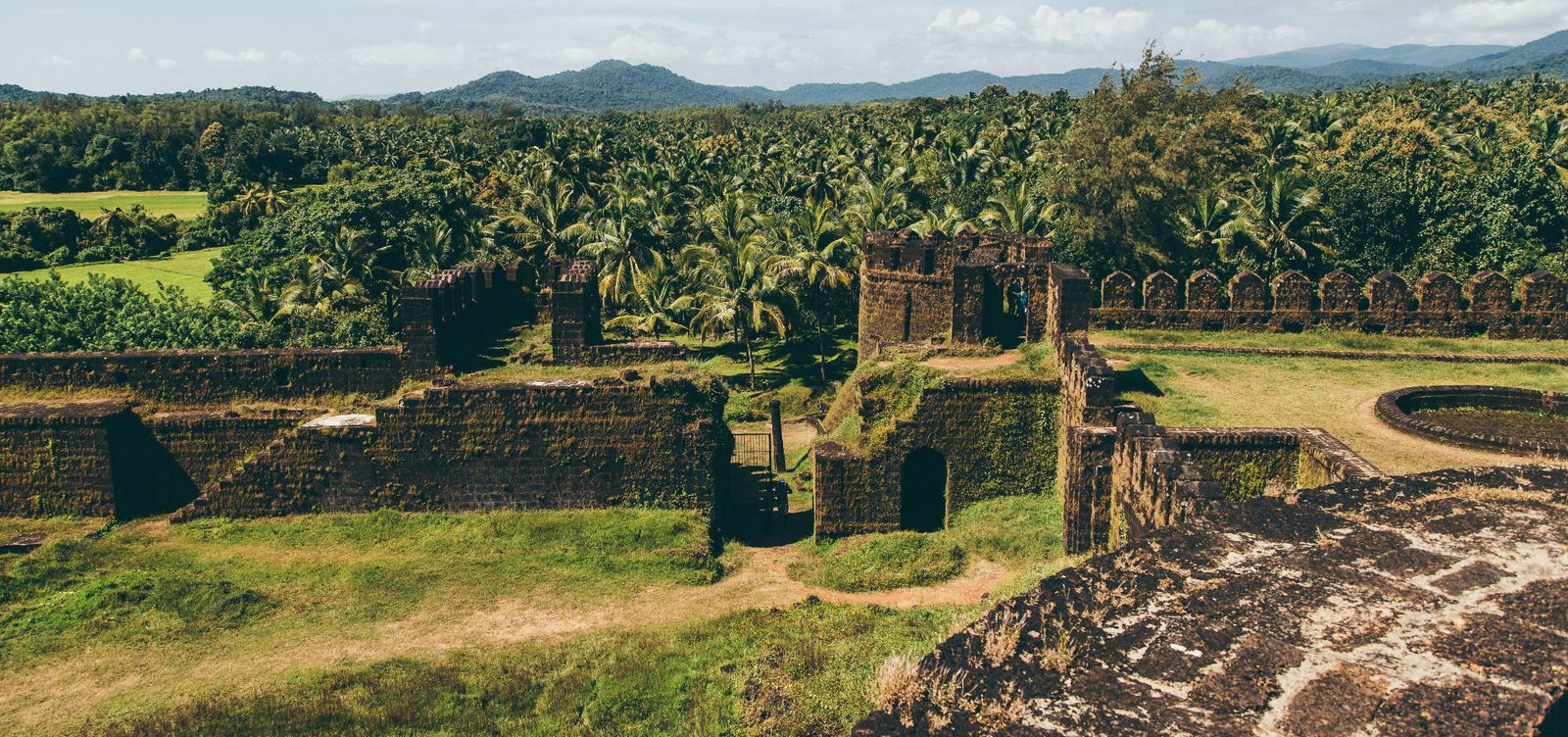
About fourteen kilometers south of Gokarna, along a road that cuts through cashew plantations and laterite dust, Mirjan Fort rises from the earth like something the surrounding forest almost managed to swallow whole. Banyan roots grip the ramparts. Moss carpets the bastions in green velvet during the monsoon. Wild pepper vines thread through what were once ammunition stores. This is a fort that hasn't been polished for visitors — no sound-and-light shows, no gift shops, no roped-off corridors. You walk in through a gate that's been open to the elements for centuries, and whatever you find inside, you find on your own terms. That rawness is precisely what makes Mirjan worth the detour from Gokarna's beaches. The fort doesn't perform its history. It simply wears it.
Pepper, Power, and Portuguese Rivals
Mirjan Fort's story begins and ends with pepper. In the sixteenth century, this stretch of Karnataka coastline was one of the most bitterly contested spice corridors in the Indian Ocean trade. The Nawayath sultans of the region, particularly Queen Chennabhairadevi of the Gersoppa dynasty, controlled the pepper moving through nearby ports, and Mirjan served as a fortified node in that commercial network.
The Portuguese wanted the pepper badly. Chennabhairadevi — whom they called the "Pepper Queen" — used Mirjan as part of her defense against their encroachment. The fort changed hands more than once over the following decades, passing through the Bijapur Sultanate and eventually Hyder Ali's forces in the eighteenth century. Each ruler left an architectural thumbprint, but none bothered to erase what came before. The result is a layered structure that reads like a geological cross-section of Deccan Coast politics.
Laterite and Light
Unlike the granite and sandstone forts that dominate much of India, Mirjan is built almost entirely from laterite — that iron-rich, rust-colored stone soft enough to cut when freshly quarried but which hardens stubbornly with exposure to air. When wet, the walls darken to deep burnt sienna. In dry season, they fade to warm ochre that catches coastal light with an almost amber glow.
The fort covers a substantial footprint, enclosed by double walls and punctuated by circular bastions at the corners. You enter through the main eastern gate, which retains its arched stonework and the grooves where a heavy wooden door once swung. Inside, the layout reveals itself slowly — an inner citadel, a series of what appear to have been storage chambers, a well that still holds water, and several open courtyards where tall grass now grows waist-high between the paving stones.
Here's what caught me off guard: the acoustics. Stand inside one of the vaulted chambers near the western wall and speak at a normal volume, and your voice carries with an eerie clarity, bouncing off those curved laterite surfaces. It's an accidental effect of the architecture, but it tells you something about how commands — or warnings — might have traveled through these rooms when the fort was operational. A building remembers its purpose even when no one's listening.
What the Ramparts Reveal
Climb the steps to the top of the bastions, and the surrounding landscape unfolds in every direction. To the west, the Aganashini River winds through tidal flats toward the Arabian Sea, coconut palms crowding the riverbanks. In the opposite direction, dense tropical scrub presses right against the fort walls, and you can hear birds — koels, mostly — calling from the canopy.
The rampart walk isn't maintained with handrails or safety measures. Loose stones require attention. Roots have cracked through the parapet in places. But the elevation gives you the fort's full geometry, and its defensive logic clicks into focus — the bastions positioned to cover blind spots, the double-wall design creating a kill zone for any attacker who breached the outer perimeter. Military architecture reveals its intelligence best from above.
Most people spend thirty to forty-five minutes here. That's a mistake. Give it ninety. The inner chambers reward patience, especially rooms along the northern wall where carved niches in the laterite suggest storage for documents or valuables. A quick circuit misses all of this.
When the Monsoon Takes Over
Between June and September, Mirjan Fort becomes a different place entirely — closer to a Romantic-era ruin painting than a heritage site. Every surface grows a fine moss. Puddles fill the courtyards. The laterite, saturated with rain, turns so dark it looks almost purple under overcast skies.
This is also when the fort is least crowded, though you'll want waterproof shoes and a willingness to get thoroughly damp. The surrounding landscape hits its peak color — electric greens, swollen rivers, low clouds dragging across the treetops. If you're already in Gokarna for the quieter beach season, Mirjan in monsoon is the better half of that day trip.
Getting There Without the Hassle
From Gokarna town, Mirjan Fort sits about a twenty-minute drive north along NH 66. Auto rickshaws make the run regularly, and you can negotiate a round trip with waiting time for a reasonable fare — expect somewhere around 400 to 600 rupees depending on your bargaining stamina. Buses running between Gokarna and Kumta also pass through Mirjan village, where a short walk brings you to the fort entrance.
The entry fee is nominal — around 25 rupees for Indian nationals and 300 rupees for foreign visitors, though it's worth confirming current rates before you go. There are no food stalls or water vendors inside the fort grounds, so carry what you need. A small tea shop operates near the parking area, but its hours are unreliable at best.
The fort opens at sunrise and closes at sunset. Morning visits, particularly before 9 a.m., give you the softest light and often the entire place to yourself. By late morning on weekends, college groups and day-trippers from Goa begin to arrive, and the quiet dissolves fast.
A Ruin That Doesn't Apologize
Mirjan Fort won't hand you its story on a placard. There's minimal signage, no audio guide, and the single information board near the entrance offers a paragraph that barely scratches the surface. Bring what you know, or bring curiosity — either works.
What the fort gives you in return is something increasingly rare among Indian heritage sites: the feeling of genuine discovery. You trace your fingers along the laterite walls, peer into dark chambers, watch a monitor lizard disappear into a crack in the bastion, and for a moment the distance between you and the sixteenth century feels remarkably thin. That's worth fourteen kilometers of cashew-lined road.